BAD DECISION BY NORTHEASTERN UNIVERSITY POLICE


new NU logo

^ Northeastern University’s new logo ?

—- —- —- —-

Northeastern University administrators recently announced that its police would add rifles to their arsenal of arms used in policing the campus. We deplore this decision and ask that it be rescinded.

The last thing that private security cadres should be doing is upping their arms race. All police forces need to de-escalate, not ramp up. In that regard, read the following story by Kevin Cullen in today’s Boston Globe : http://www.bostonglobe.com/news/nation/2015/12/12/cullen/Fq3paOXrSqrYa1HD0k4VgK/story.html

We read there the Boston Police Department practicing its restraint philosophy. “Don’t take it up a notch,” says Commissioner Bill Evans. “If you need to retreat, do it… you don’t have to shoot even when you have the right to shoot.”

Such words ! “retreat.” “don’t have to shoot.” “don’t take it up a notch.” We have not heard the like from armed authority in — how long has it been ? Yet these were once the legal rule, before the days of “stand your ground,” before the militarization of police, before the NRA was taken over by gun manufacturers and their open-carry addicts. Instead, today the first move is to reach for the most powerful guns available

As City Councillor Matt O’Malley tweeted, upon reading Northeastern’s police move, ‘absurdity.”

Why should university campus police be armed at all ? No vote of the public constitutes them as a law-keeping authority, much less an authority armed with weapons of life or death. How can students go about the mission of learning, of study, of quiet and thought, if their campus is a kettle of armed gunmen ? It’s bad enough that the city’s police carry weapons of death, much less private security cohorts. (not all city police have done so. London’s “Bobbies” mostly do not go armed with anything but a nightstick.)

The decision to go to rifles arises, of course, from the occurrence recently of mass shootings on campuses. I find the move as unconvincing as disastrous. Will Northeaster station a rifleman in every classroom ? every study hall ? every laboratory cubicle ? every cafeteria ? Will it place riflemen at every campus entrance ? Of course not.

The university says that rifles will only be deployed during times of high threat and will be placed in campus police vehicles. Of course the term of art is “times of high threat.” Who is to make THAT decision ? To whom is that decider answerable ?

It’s also an assumption, and a bad one, that mass shooters will be deterred, or stopped, by the presence of 100 rifles in police cars. If a shooter can’t get past 100 SUV riflemen, he or she can always drop a backpack filled with nail bombs. That is what the Tsarnaev Brothers did. Or the terrorist can park a truck bomb at campus entrance, or enter wearing a suicide vest.

Far better for Northeastern, if it really does care about student safety, to create paths of retreat, and to drill students on how and where to find and  use them. Evans is right : “retreat if you can.”

Retreat was always the common law rule, even for persons assaulted in their home. The basis for the rule was common sense : he who retreats saves life without aggravating the breach of peace. As we have seen, not all home “invaders” have evil in mind. Some come looking or help. Retreat prevents the accidental shootings that occur more often than a wise policy allows. “Stand your ground,” too, leads too often to the use of excessive force — another rule of the old common law that made sense : keep the peace to the full extent feasible.

Northeastern students do have a security issue, but it takes place well outside the campus, on the street toward Ruggles MBTA stop. One recalls the horrific killing of a Northeastern student several decades ago, accosted by two muggers in precisely that zone. There, however, campus police have no jurisdiction. The Boston Police Department (BPD) controls; and today, the BPD headquarters building sits right there, almost astride the Ruggles T stop.

For all of the above reasons, Northeastern’s decision to equip campus police cruisers with rifles should be taken back.

—- Mike Freedberg / Here and Sphere

OF RUNAWAY TRAINS AND DOMESTIC VIOLENCE CONFERENCES

ghost

^ the now legendary Red Line, a driverless service haunted by a real-life ghost

—- —- —-

Yesterday Bostonians were treated to the fact of a driverless Red Line train rumbling through four stations before having its power snuffed — and the emergency presser Governor Baker called to explain what seems to have caused it. The day before, many Bostonians took part in a conference, hosted by Lieutenant Governor Polito, on sexual assault and domestic violence crime.

Two days before that, Governor Baker led a large rally of municipal officials in support of his landmark bill to reform city and town administration. At the same time, Baker had to decide whether to terminate, or merely admonish, the DCF social worker who failed to follow procedure when overseeing the mother of Baby Bella. Meanwhile, Polito spoke to hundreds attending Massachusetts Conference for, Women.

Sometimes, administering state government looks a lot like CEO-ing a huge conglomerate of very dissimilar parts cobbled together. It’s dizzying for us, the public, to keep up with the various segments — the DCF, the RFMV, the T, DOR, Energy, Conservation, Public Safety, Economic Development, etc. — yet somehow we expect Governor Baker to command the hubbub — no sweat, baby ! After all, he campaigned as the expert manager, Mr. Fix It, who had fixed big knots and could whiz through a whole kettle of state government wigglies.

To do this — to fix all  of what needs fixing — Baker has to rely on the state’s 85,000 employees (including the Red Line conductor whose “multiple errors” seem to have enabled the ghost train); and to oversee then, he has to hope that the 2,000 or so higher-ups who he has appointed share his diligence, caution, and foresight. None is perfect at this, not Baker even; and we see just what even a slight crease in the wave gives rise to.

Meanwhile, the Baker team moves forward on matters not yet reduced to practice, policies still in the conversation stage. Baker and Polito have no peer at initiating ideas from conversation; I’ll discuss their latest after I tell of the runaway Red train.

If what we read is correct, the Red Line conductor who tied off the train’s accelerator control and failed to set the safety brake did not have evil in mind. He had readied the train to begin its trip, only to find that the signal system at Braintree terminal wasn’t working. This required him to request by-pass. T conductors request by-pass all the time; if they had no such option, trains would wait forever, stuck by signals on the fritz — an every hour occurrence somewhere in the T. Unfortunately, in order to enable by-pass the driver had to get out of his cab and flip a toggle attached to the outside of his car. So he did it, kind of in a hurry probably, forgetting to set the brake. Just an error,  can happen to anyone.

Haste does in fact make waste.

What is the T’s manager to do about this mistake ? is there ANY good response ? Secretary of Transportation Stephanie Pollack says that henceforth a driver will not be allowed to use by-pass except in the presence of a senior T official. That would be  a huge mistake. Without driver by-pass discretion,  trains will sit forever at broken signals, and as I said above, these happen all the time. Does the T then fire the forgetful driver ? That seems a hard penalty to assess. After all, everyone forgets at some time or other.

My own feeling is that the ghost train has aroused so much attention that no one will ever forget it, least of all T conductors. The solution thus has already occurred.

And now to Lieutenant Governor Polito and the matter of Sexual Assault and Domestic Violence, addressed by Chapter 260 of the acts  of 2014. A link to chapter 260 provides the full language of the law : https://malegislature.gov/Laws/SessionLaws/Acts/2014/Chapter260

The law calls itself an “emergency act,” and its language suggests the emergency is to get court and law enforcement personnel up to speed on how to recognize domestic and sexual assault; how to best respond to it; and, notably, to recognize that much of such violence is visited upon gay, lesbian, and transgender people.

I find it significant, considering that, in the minds of those who oppose the transgender public accommodatio0ns bill currently before the House, transgender people do not exist, to read the first paragraph of Polito’s press release : “Polito presented a report from the Governor’s Council to Address Sexual Assault and Domestic Violence on the implementation status of Chapter 260.  In April, the council was re-launched and elevated to the Governor’s Office to improve the administration’s ability to address the important issues involving domestic violence and sexual assault.  Per Executive Order 563, the council was first tasked with the assessment and implementation of Chapter 260.”

Only the Governor can issue an Executive Order. Baker thus agreed that the emergency nature written into chapter 260 is indeed such; that said emergency includes violence against gay, lesbian, and transgender people; and that court and law enforcement personnel need, in the process of learning, to comprehend all three communities.

Polito’s press release continues : “…The report includes status updates on numerous provisions related to newly implemented trainings and reporting requirements for members of law enforcement and district attorneys.  The Trial Court will also provide biannual domestic violence training to trial court personnel and enforce a series of stricter laws for offenders, such as tougher penalties for domestic assault and limited visitations for a parent convicted of rape.  Additional support services for survivors have been enacted through the Attorney General’s Office to establish employment leave for domestic violence victims.  

“…At their first meeting in June, the Governor’s Council reviewed each provision of the legislation and created work groups whose charge included an analysis of the provisions of Chapter 260 implementation across the Commonwealth and provide recommendations.  Today …the Council reported on the substantial accomplishments by agencies in the areas of training, guidance to law enforcement and courts, and development of materials and resources for victims and perpetrators.  It also notes areas for improvement and contains recommendations.  The section summaries were developed with assistance from Jane Doe Inc. and the Attorney General’s Office, and the section statuses and recommendations were developed by the Governor’s Council to Address Sexual Assault and Domestic Violence.”

Much, if not most, domestic violence and sexual assault occurs in private places, or in social gathering spots — the most difficult loci to monitor without overreaching by police persons. Almost all violence against transgender people occurs in such locations. The energy being devoted to this urgency by Polito, by Attorney General Healey and by the entire legislature — chapter 260 was enacted unanimously — makes it all the more inexplicable that the legislature has not yet seen fit to enact transgender public accommodations protection for fear of a small number of persons who deny that transgender is even a thing.

—- Mike Freedberg / Here and Sphere

REMAKING THE MASSSACHUSETTS GOP : OBSTACLES

FullSizeRender

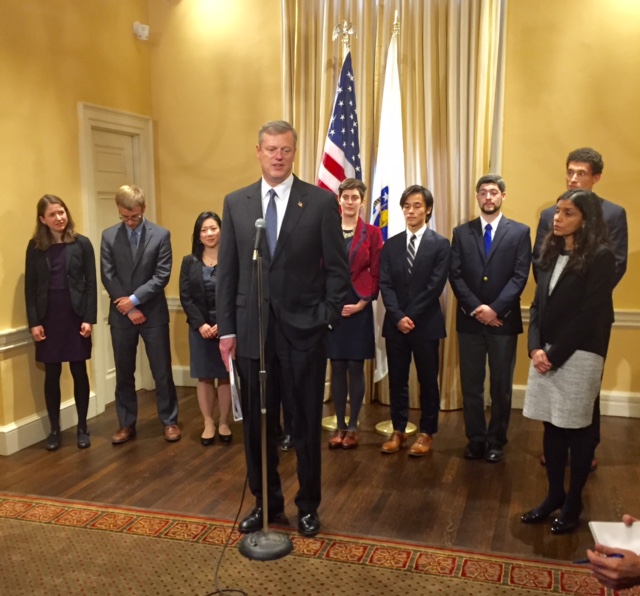
^ Governor baker with medical students committing to study addiction medicine. Now if he could only get them (and 200 like them) to run for office as Baker Republicans…

—- —- —-

Notice to readers : this article is Part 3 in a series that I have been posting for the past two weeks or so. To have my entire overview, you should to visit http://www.hereandsphere.com and read the prior two postings.

Because Governor baker has moved to take full control of the Massachusetts Republican state committee, it is appropriate to consider a long term campaign to remake the entire Massachusetts GOP, top to bottom, purpose and personnel. Whether Baker has such an ambitious climb in mind, I do not know. Yet Baker is not one for half measures. Once he decides that an institution of governance needs reform, he pursues reform from roof to basement and every flo0r in between; and because the Massachusetts GOP is small — only 11 percent of voters –those who might avoid a Baker reform don’t have many nooks in which to hide.

One might think that the local GOP’s smallness would offer Baker a clear field. Many party positions haven’t been filled in decades. Local GOP clubs long ago surrendered their charters. Party organization in general matters far less than it did 50 years ago — a majority of Massachusetts voters belongs to no party. Yet smallness has its difficulties too. A recent flap involving a former, briefly Polito operative who signed onto the Donald Trump campaign, thereby entangling Baker and his Lieutenant Governor in the Trump mess, exemplifies the challenge of smallness. It’s almost impossible for Baker or Lieutenant Governor Polito to have not encountered many operatives whose political bent, we now find out, is for the untouchable. After all, during the years 2007 to 2013, when the local GOP faced near extinction, activists and potential candidates reached out to whoever was there, just to survive. The politics of it was left for later.

That GOP politics was toxic already, was shown to all voters when at the beginning of 2014 the party’s state committee, whose members had been elected in 2012 at the nadir of the recent lean years, adopted a platf0rm rejecting marriage equality, spurning women’s reproductive rights, and asserting many economic positions anathema to a solid majority of Massachusetts voters.

Thus the decision by Baker to elect a much more representative state committee at next March’s primary.

“Much more representative means “elected by many more voters,” and at the level of a state committee election, the increase is achievable. Less so at the next level : actual candidacies for publicly elected office.

Everywhere I go, in eastern and central Massachusetts, the folks who turn out for events given by legislative candidates make clear just how far back our state’s GOP sits. Those who attend GOP candidates’ events are much older than those I see at Democratic candidates’ times, and almost exclusively 1960-ish white-bread, the squarest of the square, some of them touting fringe causes (fringe even in this year of GOP fringe fever).

From what I see, the typical GOP campaigner is at least 60 years old; whereas Democratic activists — multiple times more numerous — tend to be young, even very young. Many successful Democratic legislative campaigns are peopled by activists still in college, even in high school. And what a difference culturally ! At Democratic candidates’ headquarters you see lots of folks of all colors, hairstyles, genders — everything from dreadlocks and hardhats to suits and grunge. Meanwhile, at most GOP candidates’ headquarters — when there even IS a GOP candidate — I see clean-Gene, crew cut guys who look almost military; a handful of earnest girls; some very well-heeled, clubby women; and a ton of older — much older — true believers working their 20th losing campaign in a state of mind you’d expect of a 20th losing effort.

That’s what I see because that’s all there is. In Massachusetts, almost every young person who wants to get into politics signs onto a Democratic campaign, because they want to win — quite naturally. (Not always : the Susannah Whipps Lee campaign, in the 2nd Franklin State Representative District, was almost all young people. Good reason why she defeated her incumbent opponent by ten points. More about Whipps Lee later)

The few young people our state GOP does get come top it by way of the national GOP and its “conservative” ideology. They’re ill prepared for the realities of Massachusetts elections and oftener kill a campaign than help it. Baker, for all his power as a charismatic Governor, can do little, by himself, to change the population of new GOP voters. The national GOP overwhelms local messages, even a Governor’s. There is, however, one way that Baker can direct the composition of Massachusetts GOP voters : he can encourage young people to run for office and to do so as Baker Republicans.

He is popular enough to do that. If the young people he encourages do likewise, and recruit their friends, and friends of friends, as well as their district’s baker activists, they can, if there’s enough of them — 100 to 200 at least — assemble maybe 20,000 activists statewide (100 to 200 per campaign) : a number more than sufficient to create an entirely new, Baker GOP far outnumbering the present party and aged to outlast it.

20,000 is all that it takes. That’s about the same number as Elizabeth warren energized in her 2012 Senate campaign. It’s doable, by the nation’s most popular Governor, if he chooses to work it.

The Susannah Whipps Lee campaign I mentioned above is an example. Her cadre of “interns for Whipps Lee” was very young and — probably for that reason — waged a campaign effective energy par with the strongest Democratic platoons. Add Whipps Lee’s mainstream message 9at times even progressive), and the result was victory.

Jaclyn Corriveau, of Peabody’s 12th Essex District special election, appears to have a following similarly young and mainstream, supporting her because they like her, not t.o prove some ideological point.

Other than finding 100 to 200 campaigns like these, I do not see how the Massachusetts GOP can prolong its long streak of Governor wins or sustain its current legislative numbers, small as they are. 2016 is going to be a terribly difficult year for the 37 GOP legislators and 6 state GOP Senators having to win re-election in  the teeth of Hillary Clinton winning Massachusetts by 23 to 30 points. Given the outrageous venom of the national GOP: campaign so far, how many Massachusetts voters are going to “split tickets” to re-elect their local GOP legislator ? In the six to ten districts I see as vulnerable, maybe one third will have to do so. That’s hard to do even in polite election years.

If that sort of setback does cut the number of Massachusetts GOP legislators, how would Baker, even if he goes all in on the project, recruit win-oriented, ambitious young candidates who aren’t idelo0gically unelectable ? I do not know. Meanwhile, several associations of activist oriented to the national GOP’s toxic issue positions are gathering their own, in PACs and think tanks, to render undoable any such Baker mission as I have predicated. Meanwhile, the Democratic party is loaded with terrific down-ticket office holders looking to “move up” and excellently positioned to do so.

The Massachusetts GOP can probably continue to elect Governors, because the structure of o0ur state government, and the composition of its legislature, makes it far wiser to have a Governor who is not a Democrat. But other than Governor, the obstacles to creating a viable, populous, culturally representative GOP seem almost insurmountable. Baker has his hands full just shaping a GOP that can improve his own re-election rather than hinder it.

No Democratic candidate for high office wastes any effort on state committee elections. He or she doesn’t have to. Baker has to. That in itself should tell you just how daunting are the party-politics difficuolt8es that even he faces.

—- Mike Freedberg / Here and Sphere
FIRST SUFFOLK AND MIDDLESEX : OUTCOME MAY SURPRISE

Jet_over_Neptune_Road,_East_Boston,

^ Politically, the two most important facts about the First Middlesex and Suffolk senate seat : East Boston and the Airport

—- —- —-

What if NONE of the obvious candidates decides to run for the First Suffolk and Middlesex State Senate seat ? It could happen. Then what ?

Nobody will tell me who is, or is not, going to seek the State senate seat being vacated by Anthony Petrucelli. I suppose that’s how it should be. I’m not certain that anybody even knows what he or she will do. Consider the many obstacles resulting from Petrucelli resigning at the most inopportune of times :

(1) there’ll be a special election, probably in April, folllowed almost immedately by a primary in September. Whoever seeks the seat has to raise enough money, and volunteers, to run not one but TWO campaigns. Basically, whoever wins will be campiagning all the way through to mid-September, hardly having time to actually represent the District.

(2) none of the five State Representatives in the District has an easy path to the election, or else is in no position to run it :

* Speaker Robert DeLeo, who represents Winthrop and beachside Revere, is obvioiusly not running.
* Representative Roselee Vincent represents the rest of Revere plus precincts in two other communities that lie outside the District. She backed the loser in revere’s recent mayor contest, hardly a path to winning the senate nomination.
* Adrian Madaro, who representseadt boston, the community for which this Senate seat was designed, is still finishing up his own first term won in a special election. (Disclosure : if Madaro runs, I am all in supportiung him.)
* Aaron Michlewitz, who represents the North End, Chinatown, and some of the South End, has a constituency not known for great percentage turnout in local elections (except for the four North End ones). Almost certainly he’d be an underdog to a serious East Boston – Winthrop candidate. (and there is one. More later.)
* Jay Livingstone, who represents  Beacon Hill, Bay Village, and some of Cambridge, has an even less likely constituency as ar as voter turn out.

It may thus be that none of the five representative runs, at least not in the spoecial election.

If that happens, the District’s new State senator may be only temporary, if one of the five Representatives decides to pass on the “special” to run in September. Or the new senator may survive that test. Who might be in the running for such a scenario ? there are several.

* Revere City Councillor Jessica Giannino is being touted by some supporters of the city’s new mayor, Brian Arrigo. Giannino topped the ticket in the recent election. She is chariamatic and has an Italian last name, as do at least 30 percent of the District’s voters (probably 50 pecenht of those who will actually vote).
* North End restauranteur Philip Frattaroli, who ran for Boston City Council in 2013, has the same ethnic attribiute and can raise the big bucks. He also now has an East Boston restaurant and probably has the most District-wide reach of any likely candidate not currently holding office.
* no one is mentioning Winthrop school committeeman Tino Capobianco, who would probably back Adrian Madaro if he runs. but if Madaro does not, why not Capobianco ? He has the youth, the respect, the Italian last name, and the following.
* a new name entirely. And there are some. What of Francisco Urena, Hispanic in a District increasingly so, an East Boston resident, recently Governor Baker’s Veterans affairs Secretary, and before that, City of Boston veterans affairs commissioner ?

UPDATE 12/11/15 at 10 AM : Capobianco informs me that is not running. However, the East Boston Times reports two additional names : Winthrop Housing Authority’s Joe Boncore, and East Boston activist Ernest DeAraujo.

Of all the likely candidates, it’s interesting to note that none, not even Urena, is especially allied to Boston Mayor Walsh. (Joe Ruggiero, Walsh’s candidate in the recent State Representative special election, is evidently not running for this seat.) Petrucelli was a Walsh supporter in the crucial 2013 race. His leaving office is not at all good news for a Mayor who has struggled to solidify a constituency in a senate District most of whose Boston precincts he lost badly.

Meanwhile, almost all the likely candidates have strong ties to Governor Baker. That should hardly be a surprise given that Baker won more than half the District’s Boston precincts and was beaten badly in none. Petrucelli, on the other hand, was on the other side of the Governor battle. His leaving office is a big plus for the Governor’s political strength in Boston’s most tradition-bound Senate district. It’s also a huge plus for Carlo Basile, East Boston’s former representative, who has outlasted all rivals, now directs Baker’s appointments office, and of all East Bostonians, enjoys unrivaled influence in the halls of state decsion making.

Next : what role, if any, will Speaker DeLeo play in this selection ?

—- Mike Freedberg / Here and Sphere

THE MOST SERIOUS MUNCIPAL LAW REFORM IN DECADES


FullSizeRender

^ Governor baker leading rally in support of his municipal finance and administration reform. Lt Governor Polito on left, Secretary of Administration and Finance Kristen Lepore on the right.

—- —- —-

Yesterday about 150 prominent municipal leaders from across Massachusetts gathered on the State House’s Grand Staircase to rally for a reform of municipal finance and administration proposed by Governor Baker. If I read its provisions correctly — follow this link to the Governor’s press release :  http://www.mass.gov/governor/press-office/press-releases/fy2016/administration-introduces-municipal-modernization-bill.html — it’s the most comprehensive reform of our state’s town and city governance in decades, since the creation n of the Lottery “cherry sheet” at least and maybe since the creation of municipal zoning law in 1956.

Geoff Beckwith, Executive Director of the Massachusetts Municipal Association, says “The Act to Modernize Municipal Fimnance and Government is history-making in itys deo0th and breadth.” He should know, having once been a State Representative himself. Baker’s proposed bill scraps outdated laws, smooths state oversight, allows cities and towns greater leeway in procurement, taxation, and debt restrictions, and steps back from the micro-management of municipal finance that has frustrated city and town executives for so long.

Baker’s bill bears his signature attention to detail. Among its provisions : (a) updating boat evaluations to allow more accurate boat excise taxes (b) permits towns and cities top enforce removal of “double (telephone) poles” (c) gives cities and towns right of first refusal when a property owned by a charity is to be sold or developed for a non-exempt purpose.

In addition, the bill enacts more sweeping reforms : (a) electronic advertising of required notices and Civil Motor vehicle infarctions (b) creates a statutory formula for evaluating State-owned land and (c) allows cities and towns to borrow funds for up to ten years from the present five.

Beyond its specifics, Baker’s municipal reform bill broadcasts his policy of empowering our state’s most local governments, supporting their discretion to make decisions, and signaling them to work efficiently above all.

Credit Lieutenant Governor, Karyn Polito, for the grunt work that enabled this bill. All year long she has traveled all across Massachusetts to sign “best practices community compacts’ with towns and cities. To date, about 68 of our 351 municipalities have signed onto. Now comes Baker’s bill incorporating much of what Polito has worked out with local governments. It was appropriate for baker to allow Polito the spotlight at yesterday’s rally.

Two days ago I saw a comment on a facebook page top the effect that Governor Baker appoints panels, smiles a lot, then does nothing. Really — has this person been travelling in Mongolia all year long ? Baker has accomplished more in his first eleven months than our last Governor got done in his full eight years — and, so far, without a flaw. And if many of Baker’s initiatives remain stuck in legislative disputes, that is hardly his fault, except to the extent that reform of any vested interest is difficult and contentious.

Keep the reforms coming, Governor !

—- Mike Freedberg / Here and Sphere


SCRAMBLE IN THE FIRST SUFFOLK

Boston Area

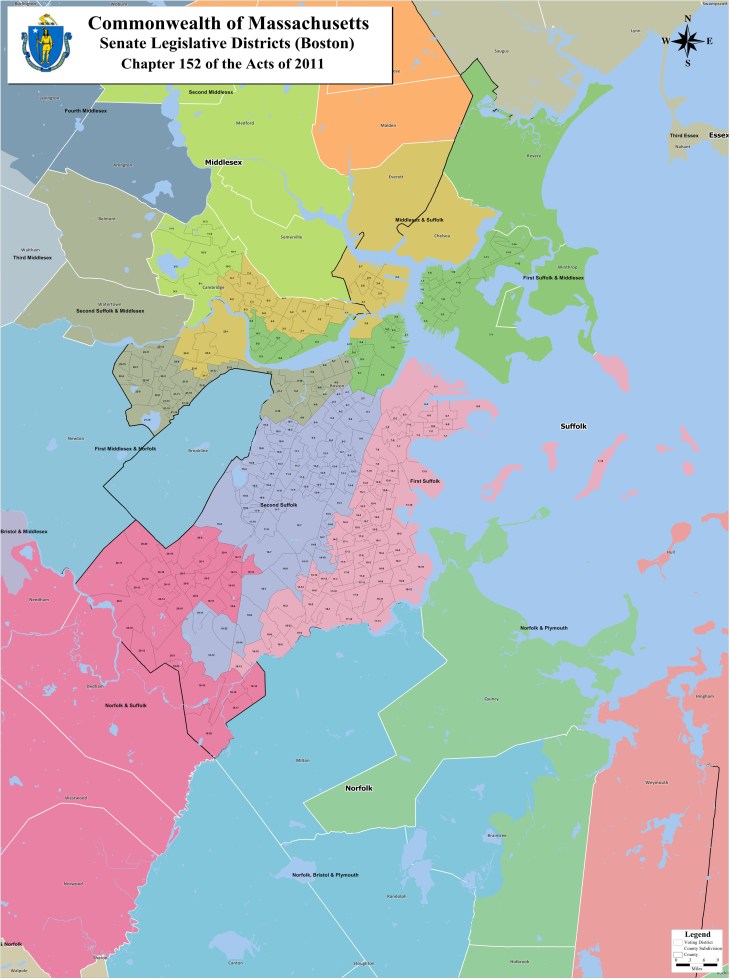
^ in apple green : First Suffolk/Muddkesex Senate District, covering  very different communities & neighborhoods, but centered on East Boston & Winthrop

—- —- —- —-

The resignation of Anthony Petrucelli, the First Suffolk/Middlesex’s State Senator, comes at an inopportune moment for potential successors. The District’s shape has a lot to do with why. Centered on East Boston, it includes all of Winthrop and Revere, the North End, Beacon Hill, parts of the South End,and a slice of Cambridge along the Charles River from Western Avenue east to Kendall Square. There’s not much to connect these disparate neighborhoods, several of which appear to be tacked onto an East Boston – North End – Winthrop core.

Thirty years ago, the previous alignment of this District included only East Boston, the North End, and Winthrop. It wasn’t difficult to see it as the state’s premier Italian-American Senate seat, and in the hands of Bob Travaglini, it was exactly that. “Trav” eventually became Senate President and remains a local hero to long-time voters in the present First Suffolk.

Prior to “Trav,” the First Suffolk/Muddkesex was fought over, back and forth, between Mario Umana and Michael LoPresti, whose son represented the seat after Umana’s last term and before “Trav.”

Much of that history no longer applies. Italian-Americans dominate only in Revere. Winthrop is less than 50 percent Italian name, East Boston maybe only 30 percent. The North End has long since become an upscale, young professionals’ neighborhood. Italian name people own tons of North End boutiques and restaurants, and the street action does a good job of pretending to be Bologna or Naples;  but their proprietors mostly live elsewhere. maybe 15 percent of North End voters have an Italian last name. As for Beacon Hill, the South End, and Cambridge. Italian was never part of their heritage and isn’t today. My guess is that voters with an Italian last name barely amount to 30 percent of this year’s First Suffolk/Middlesex.

Which makes it difficult, this time, for an East Boston candidate of Italian heritage to assume victory in what promises to be a multi-candidate primary. Nor does the obvious East Boston choice, Adrian Madaro, clear the field : barely nine months ago he was elected State Representative in a special election occasioned by Carlo Basile’s joining the Charlie Baker administration as Appointments Secretary. Given the condition of today’s First Suffolk/Middlesex, Madaro would be in a much stronger position to “clear the field” if he had won a November re-election; that won’t happen until 2016. (Disclosure : Madaro would be my choice, and I have committed to him if he runs. It’s also my neighborhood, my Mother’s family having come to “Eastie” in the late 19th Century.)

Three candidates so far seem to have decided to run : Revere City Councillor Jessica Giannino, who easily won the most votes in that city’s municipal election last month; defeated Revere Mayor Dan Rizzo; and State Representative Aaron Michlewitz, who has represented the District’s North End and South End precincts for two full terms. And what of East Boston, the presumptive core community ? So far, no obvious candidate.

UPDATE : Philip Frattaroli, of the North End, who ran very credibly for Boston City Council in 2013, has let me know that the race interests him. Frattaroli comes from a prominent North End restaurant family (Filippo’s), owns one himself (Ducali), and has recently opened an East Boston eatery, Cunard. Frattaroli’s entry would almost certainly end any chance that Aaron Michlewitz might have.

If no East Boston candidate of note runs, it will signal the end of this neighborhood’s dominance of a Senate District that, in one form or another, has provided Boston-area voters of Italian heritage a powerful voice. Granted that ethnic politics are fading away, to be replaced by ideological alignments — hardly an unmixed blessing. How likely is this outcome ? We’ll soon find out. Myself, I cannot imagine, yet, that East Boston and Winthrop do not still form the First Suffolk/Middlesex’s power center.  Many East Boston voters actually live in Winthrop; many Winthrop voters once lived in East Boston. The two might as well be one; and — do not forget — Winthrop’s State Representative is Speaker Robert DeLeo, the state’s most powerful elected official. DeLeo may well avoid involvement in this scramble; but if he chooses to, he can — so I see it — dictate the winner.

Even if he does not involve, there are plenty of Winthrop leaders for a quality East Boston candidate to link up with. I have one such leader in mind.

In a special election, the very populous Beacon Hill, South End, and Cambridge precincts aren’t very likely to turn out as intensely as the District’s core community. There’s still lots of life in East Boston’s dominance of the First Suffolk/Middlesex.

—- Mike Freedberg / Here and Sphere

MASSACHUSETTS : REMAKING THE STATE’S REPUBLICAN PARTY (PART 2)

FullSizeRender(3)

^ State Representative Sheila Harrington : her decision to support of H 1577 is likely a positive effect of the Baker campaign to take control of the GOP State Committee

—- —- —- —-

Yesterday I wrote about Governor Baker’s campaign to take full control of the State Committee, the 80-person body charged, by law, with directing a political party in Massachusetts. I stated that Baker’s move is limited to the state GOP only; that the national GOP is an entirely separate matter related but tangentially to the GOP of Massachusetts and what is happening to it — subject to one big “if”  which I will discuss below.

Baker’s state committee campaign has been undeer way for some time. Much money is being deployed to fight it and win. Baker is publicly endorsing a list of state committee member candidates and opposing others.

I mentioned in yesterday’s story that Baker seeks control of a body that is his power platform in dealings with the Speaker of the House and Senate President, whose absolute control of their legislative bodies Baker hopes to match. Full state committee control assures him maximum power to command a legislative agenda of his own. Governors haven’t often commanded that power. Consequently the legislative leaders bulldoze everything.

Because the Massachusetts GOP is so small, control of the state committee matters, as the Democratic state committee, overseeing a party three times as sprawling, does not.

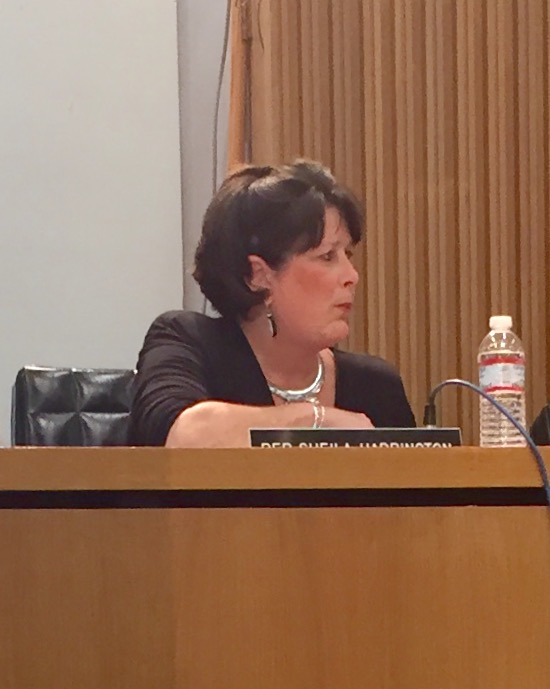
Baker’s move already is having an effect. State Representative Sheila Harrington (of Groton), who in 2012 voted against that session’s transgender rights bill, now reportedly supports adding public accommodations protection to it. (the House Bill is H 1577.) Harrington’s support is significant for a bill that Baker has avoided positioning upon so as not to give his state committee opposition a hot button issue to rally behind. My sense is that Harrington’s support for H 1577 portends (1) that many of the 36 other GOP members of the House will join her (2) that she expects Baker will lead the fight for its enactment once he takes the state committee and (3) Harrington, who ran for GOP National Committeewoman in 2012 and lost narrowly, will seek that office again, with Baker’s blessing.

Even if my read of Harrington’s support for H 1577 goes too far, Baker’s state committee surge suggests he will be able to support a fiscal year 2017 State Budget more advanced, by way of revenue, than the “no new taxes” budget enacted in fiscal year 2016. This, he will have to do, as (1) the MBTA and Commuter rail will require substantial additional funds for working down a $ 7.6 billion infrastructure and equipment backlog and (2) expansion of early education cannot be further delayed. Baker also owns a full queue of forward legislation — criminal justice reforms, charter school cap lifts, a clean energy proposal more progressive than the House version, and what he calls “the second part” of an initiative to assist low-wage workers, the first part of which was EITC expansion.

Might Baker even support the $15/hour minimum wage now being passionately advocated by the SEIU and others ? It is not impossible.

Doubtless he could secure most of these, as House Speaker DeLeo backs them; but Baker would like these enactments to include provisions of his choosing rather than a DeLeo alternative. Being able to command the votes of, say, 30 out of 37 House GOP members would help Baker’s negotiations enormously.

Will it be that simple ? Baker surely wins control of the GOP state committee, but he has absolutely no sway with the national GOP , which holds positions, on just about every issue, hugely at odds with Baker’s. So far, the national GOP has let Massachusetts alone, because it knows it cannot win any elections here. Its donors know that as well.

At the level of individual voters, a significant number newly registered for this year’s dramatic, angry Presidential campaign weighs upon the rolls of Massachusetts Republicans’ mere 11 percent. These new voters, and those who have enrolled during the last seven years of angry national political strife, cannot be ignored forever. To the extent that they know anything about the Baker agenda, they oppose it. Money PACs minded like theirs are also popping up. The field does not belong entirely to Baker and his party soldiers.

The oppositionist habits of the newly enrolling, nationally oriented Republican voters would also, if these voters knew about it, extend to the tactics of GOP Governor campaigns. Since 1970 at least, the election of GOP Governors in Massachusetts has depended upon Boston-area Democratic activists. We have elected GOP Governors for most of these 45 years because Democratic activists prefer the political independence of a GOP Governor to the factional weakness of a Democrat. Further, large numbers of Boston activists can back Baker because his agenda has the support of an overwhelming majority of city voters. That would not be the case were Baker a national Republican taking positions anathema to almost every activist in sight.

Will the Republican electorate of eight to twelve years from now be as sophisticated ? As willing as Massachusetts GOP voters are now to back a Governor candidate who supports political Massachusetts majority sentiment, utterly at odds with the national GOP ? Knowing that given their small number, and politically isolated, they cannot win any statewide election ever ? Or will we, like so many other states, become a society of “red” versus “blue” ? Because these voters — “red” versus “blue” to the core — will populate the future Massachusetts GOP, the current Massachusetts GOP rank ad file being well over age 60 on average.

Upon a positive answer to that question rests the entire success or complete failure of the Baker Republican iitiative.

—- Mike Freedberg / Here and Sphere

MASSACHUSETTS : THE REPUBLICAN CONONDRUM

IMG_1593

^ running for an “open” State Representative seat in the new, baker-revised Massachusetts GOP : the 7th Middlesex District’s John Fetherston

—- —- —- —-

Here in Massachusetts, where the national GOP has no chance, an entirely local, state-based GOP is in the process of forming. Governor Baker, his popularity among our voters unmatched, is using t.hat popularity to assert complete control of the GOP state committee. The campaign he and his team have assembled is also generating candidacies for the legislature. Let’s take a look at what is happening and try to assess its prospects :

1.Baker is endorsing candidates for the 80-memener GOP state committee4, the executive body that, by law, directs the Massachusetts GOP. It’s rare to see a GOP governor spend political capital to elect members of a body that, by itself, has almost no power; but there are two strong reasons why baker has undertaken the effort : ( a ) in 2014 the state committee endorsed an anti-gay rights, pro-life platform that seriously impeded Baker’s campaign; and ( b ) just as the Speaker of the House controls his membership utterly and thus dominates Beacon Hill legislation, so Baker seeks a similar level of dominance of his power platform so that he can deal with the Speaker from a position of strength.

Baker isn’t mistaken. He has been unable to take any kind of stand at all on the transgender rights bill now pending because passionate opponents of it control the state committee — and use it to put pressure on the GOP’s 37 House members and six State Senators. I don’t doubt for a second that baker wants this bill to pass, so that an issue that shouldn’t be an issue at all gets off his plate; nor does he want to find himself thus cornered as he faces, in the upcoming year, legislation far more contentious than the no-brainer enactments of this year’s session. For example : new revenue for the MBTA; a potential $ 15/hour minimum wage bill; charter cap lift legislation; and a constitutional issue vote on the upcoming “millionaire tax” ballot initiative.

Baker wants a state committee less ideological and more practical, a body oriented to realistic reform and to candidacies that seek to win elections, not to use them to proselytize an agenda that most Massachusetts voters reject. Given Baker’s popularity, doggedness, and all-out commitment to his state committee slate, all of which his opponents in the party cannot match at all, I think he will win this fight.

2.The fight wonk, what will Baker do ? What can he do ? The next step is to sponsor or support candidates for the legislature. Yet this step is much more problematic. Challenging sitting legislators hardly moves them to endorse a legislative agenda that would be controversial in any case. Many legislators are reluctant to support charter cap lift legislation that teachers unions and their allies passionately oppose. The Governor’s energy legislation proposes clean energy advances well beyond what the House currently accepts. as for new revenue for the MBTA, why should a legislator voter for it only to face a GOP opponent who will use it against her ?

Fact is, that the legislators most vulnerable to a GOP opponent will likely vote for baker’s legislation anyway, while those legislators most likely to oppose it represent districts with few or no Republicans. For example : Baker can certainly count on Boston Mayor Walsh to assist him on legislation the two men support; but Walsh will necessarily be less likely to support a Baker effort if the Boston delegation faces GOP opponents.

What’s left are legislative seats left open because the incumbent isn’t running again. Those are fair game; but how many open seats will there be, and how many of them are districts in which a Republican has a fair chance of winning ? A handful at most.

3. At the same time, the Baker GOP will have its work cut out trying to hols the 37 House seats and 6 Senate seats that it now has. Hillary Clinton will alskmo9t certainly win Massachusetts’s Presidential vote by 23 to 26 points. A GOP legislative candidate, in all but the most Republican districts, might have to win the votes of 15 to 25 percent of Clinton voters if she hopes to be re-elected. In the open seats, the prospects will be even harder.

So the questions confront :

1.  Can a local, state-specific Republican party be built in a nationally. Democratic state like ours ? A party visibly unlike the national Republican party, opposed to it on so many major issues, and vastly different in t9one and mission ?

2. What would such a party’s purpose be ?

3. How would it relate to the state’s Democrats ? Right now, a GOP Governor’s campaign is run, in Boston and environs, almost entirely by Democrats, because that’s all there is and because city Democrats are accustomed to having GOP Governors and even prefer it. Would Boston-area Democrats so readily ally with Baker’s revised, state-specific GOP ? Many might indeed welcome his reform-minded, socially progressive local GOP. But would that GOP remain content, as today’s Massachusetts GOP is, to have the city portions its major  campaigns be run by Democrats ?

Right now the success of a GOP Governor rests politically on a very delicate equilibrium. Repositioning the components thereof risks losing the entire game. On the other hand, a successful revision could occasion a reform party strong enough to generate lasting political power. Let’s see where this goes.

—- Mike Freedberg / Here and Sphere


AN AMBITIOUS NECESSITY

FullSizeRender

^ Boston’s Building Trades mayor welcomes Hillary Clinton to a rally of unionists at Faneuil Hall (photo by P J McCann)

—- —- —- —-

We usually don’t write about the Presidential campaign going on in America right now. There’s more than enough policy to talk about right here in Massachusetts. Besides, the national campaign’s demagogic bullying is better ignored than fed into. Today, however, we make an exception for the $ 275 billion infrastructure proposal advocated by Democratic candidate Hillary Clinton at a rally on Sunday at Faneuil Hall.

There, endorsed by Mayor Marty Walsh, speaking to a crowd of about 500 Building Trades and laborers unionists, Clinton proposed the $ v275 billion plan along with other, private infrastructure allocations adding up to $ 550 billion in all.

As the AP reported : “Clinton’s campaign said she would allocate $250 billion to direct investment by the federal government in crumbling roads, bridges, public transit and airports. An additional $25 billion would fund a national infrastructure bank, an idea unveiled by President Barack Obama in his first term that has been blocked repeatedly by congressional Republicans. The bank would support $225 billion in loans intended to spur private investment in struggling projects, adding a total of $500 billion in new infrastructure funds into the economy, her campaign estimates.”

The politics of her proposal — rallying building trades unions to her side — matter less to me than the feasibility of her initiative. That our nation needs massive infrastructure spending, no serious activist can doubt. Roads, bridges, rail lines and signals, commuter rail and urban transit all suffer from decades of deferrals. The economic consequences stagger us. If people and goods cannot get to where they are directed, efficiently and on time, the economic loss, to the nation and to individual people and families, defies measurement. Our economy is transactional; and transactions involve delivery of the thing (or individuals) transacted from seller to buyer. Transportation is the deliverer. If the delivery is hampered, or impeded, or sometimes stopped altogether by transportation boggles and breakdowns, the economy boggles and breaks down as well. If union workers are available to make our transportation systems go smoothly, let’s get them working; let’s be glad that they’re there.

Nor is there any reasonable doubt that Clinton’s $ 550 billion total proposal will by itself enormously spur the economy. Building trades workers earn fat paychecks, and the ones I know spend most of that right back into the economy. After all, they work hard, often outdoors in bad weather, for long hours, sometimes at night. Are they then not entitled to spend their earnings on good time stuff ? Their spending enables all kinds of businesses : boat builders, marina operators, vacation hotels, swimming pool installers, builders of home additions, truck dealers, clothes retailers, and tool kit sellers, just to name the most obvious. As those businesses — and others — see demand boom, they then hire employees to handle it. This is how an economy grows.

Some argue that Clinton’s massive spending plan will hurt the economy by increasing Federal deficit spending. I find this argument without merit. Deficit spending, with interest rates barely above zero, is what you want to take advantage of. It is said that the trillions of investor-owned dollars now parked in money market accounts aren’t being invested into the economy because of Federal budget imbalance., I find that assertion  misdirected. Investor money remains uninvested, I think, because investors cannot find an investment that offers a reasonable chance of a substantial return. Oil prices are falling, probably for a long time, maybe forever. There’s no big blockbuster drug on offer. Nor is there a significant new technology platform to attract investor billions. Investors are worried about actual deflation, as prices fall (except in some housi9ng markets); in a deflation economy, parked money wins.

Now back to the Clinton proposal and the big question : is it feasible ? That depends on two factors : (1) over what period of time will the $ 550 billion be allocated ? and (2) will the allocations go to the most needed projects or the most politically potent ones ?

The second question raises the issue of waste. Spending hawks love to talk about Federal budget waste. It exists, and that is why we have a General Accounting Office and an inspector General : to monito9r allocations and procurement. Even then, waste exists. Here, the late Ted Kennedy’s axiom applies : “the perfect is the enemy of the good.” Clinton’s plan should not be sidelined because it is likely to occasion some spending waste.

I expect that much of Clinton’s infrastructure allocations will be awarded politically. That’s not necessarily a misapplication. Her support is strongest in the cities, where infrastructure needs loom biggest and injure our economy the most. This is especially true today, as cities become once again the beehives of innovation and its makers that they were 120 years ago during the Industrial Age’s heyday.

Now to the first and more problematic warning : over what period of time will Clinton’s plan be spread ?

If the $ 550 billion is budgeted over a ten year period, it probably will be overtaken by infrastructure disrepair and obsolescence. A decade is a lifetime in today’s fast-moving economy. If our infrastructure cannot be rescued more quickly, alternative transportation platforms, many of them deriving from Uber, Lyft, Bridj and the like, will render most public transportation nugatory. Yet if the Clinton allocation is telescoped to, say, five years, one asks if it c an be done : assessing the needs, soliciting contractor bids, vetting the bids, and beginning the immensely complex process of environmental and traffic review, not to mention zoning, eminent domain, and road or transit closures while work is going on, all suggest that five years won’t get the repairs even one quarter done. Nor is anything this complex done well in a hurry.

Here in Massachusetts, it has taken more than five years to get Green Line expansion in process and looks like it will require another two to three years to complete. The $ 7.6 billion of MBTA and Commuter rail upgrade backlog will take at least as long to complete. Imagine, then, how many years will it take to do Massachusetts’s likely share of the Clinton allocation. Two decades would be my guess; yet as I said above, even one decade might well render her plan moot. As for two decades : by 2035, public transit as we know it will either long since have rendered private transportation innovation price-negative, or it will go the way of the horse and buggy.

Roads and bridges, however, will remain. Maybe that’s where most of the Clinton billions should go, leaving public transit to small increments easily built quickly. I look forward to seeing how — and if — Clinton details her proposal.

—- Mike Freedberg / Here and Sphere


THE POWER OF PARADOX : ISIS HAS UNITED THE WORLD

isis

instruments of their own destruction : ISIS and the paradox of civilization

—- —- —- —-

In seeking to divide the world between people who like life and those who like death, the death cult known as ISIS has united the world, not divided it.

This is paradox — a nerve of life we cannot do without. The co-existence of good and evil, injustice and justice, is what generates commitment to do right. Augustine was perhaps the first Western Civilization thinker to see the point; he made it his theme and the structure of his prose, and if you want to understand how paradox drives life, you should turn to his Confessions and read it, as vivid as a drama, in full cry.

Paradox creates civilization as we know it. Those who seek an outcome often bring about an opposite result, one that almost everybody wants but which, without the acts of those who opposed it forcing the matter, probably would not have happened at all. Vested interests prevent transformative outcomes. Those who seek to change the situations over which vested interests exercise dominance, and who use persuasion to do so, most often taste defeat. then comes an unreasonable, or even violent event or series of events, and vested interests are swept away.

Thus ISIS has united nations once enemies — Russia and France, America and Iran, Turkey and Great Britain — in struggle to defeat it. By unify I do not men alliance; the many nations and people now working to end ISIS have their own outcomes in mind and mostly are going about the mission on their own dime. Still, the opposition to ISIS encircles. Coming at ISIS from many directions may even be more lethal to it than a alliance.

Within the Muslim communities, also, whereof ISIS has arisen by revelation, an enormous confrontation is swelling : the overwhelming majority are telling the radicals, “not in my name.” How could it not be thus ? It is one thing to be ready to die, another to die in the act of killing people.  Few of us go that route; such revelations do not come to us, fortunately, and if they do, they usually come as happened to Saul of Tarsus : a revelation to cease persecution and travel the road of good news.

The road of good news is almost part of our genes; how could it not be ? Whatever life may be, the breath of it strikes almost all of us as good, as a miracle, as a treasure to protect and enhance; and when Rabbi Hillel famously told the Torah student that “whatever is hurtful to you, do not do to your fellow man, the rest is commentary,” his saying struck consciences with truth sufficient to keep his words alive and quoted even 2000 plus years later. Often it strikes some that the road of good news is a deception, that those who profess it mean good only to their own nation or community; and because life is almost always tough even for those who believe in it — Thoreau had it right when he said that “most people live lives of quiet desperation” — for those who despair of life, the route of death seems tasty. At least in death there is a decision. The desperate are often advised to wait, wait, wait; until it becomes a mockery. In death there’s no more mocking. Yet most people prefer to wait, if need be, and to seek a better day in which their olives can be glorified; maybe even happy.

In the meantime, during the years of waiting and struggle people fall out and divide against each other; this we know from reading history and from observing our own day. Easily enough we dislike those we differ from, even to “unfriended” them on facebook or block them on twitter. These blockages cut deep (don’t I know it !). Then along come the  killers of ISIS, and suddenly all that had divided us from each other no longer matters.

For bringing us together; for making us whole again; for reminding us how sacred to us is the life we have been accorded by grace, we thank the killers of ISIS. Pursuing death, they ennoble life. The empire of paradox reigns still, powerful to rescue and revive our civilization.

The more heinous the evil, the more restorative the good that arises in opposition to it.

And this shall always be our destiny as a civilization.

—- Mike Freedberg / Here and Sphere