OUR FIRST ANNUAL “CITIZENSHIP” AWARDS


karyn

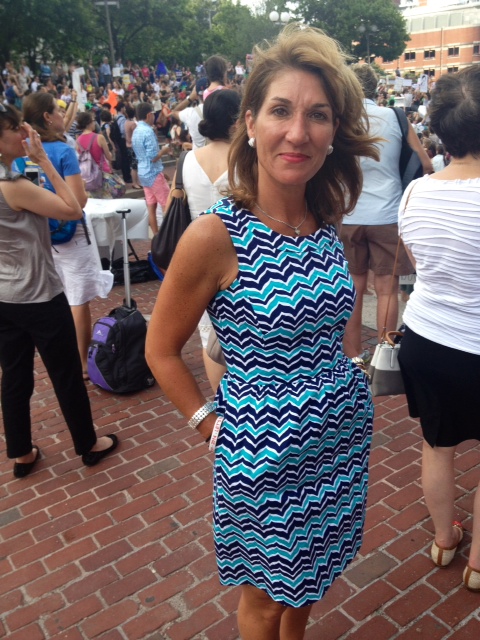
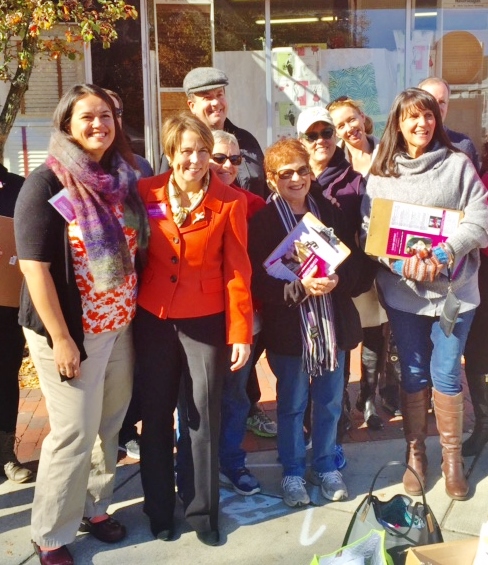
^ our Citizen of the Year : Lieutenant Governor Karyn Polito, who epitomizes “for all of us.”

—- —- —-

Being, as we are, a journal that doggedly reports the good, the bad, and the ugly of State and city affairs, it’s fitting that Here and Sphere award those who have lived up to the calling of citizenship as we see it.

We will do this every year, starting with today. Next year we will even invite you, our readers, to nominate people for this award. What, then, do we award ?

First, that a public figure recognize that citizenship is about all of us. The self-absorbed do not get there. Second, that said official, elected or appointed, take the time to explain to the community at large what he or she is doing, and why. Third, that our prospective citizen be an innovator, bold for reform. Fourth that he or she  inspire others to do likewise. We will also award several “activists of the year.”

Our “citizens” may be legislators, City Councillors, the Governor, Attorney General, appointed officials, Mayor, and of course citizen activists.

Citizenship being about all of us : Lieutenant Governor Karyn Polito. (Disclosure : we are friends.) No public figure has blossomed more unexpectedly and thoroughly than Polito, who has embraced every sort of person in Massachusetts with a loving gusto uniquely hers. Honorable mention : AFL-CIO Leader Steve Tolman, who has committed as totally to Governor Baker’s opioid addiction working group as to the union members who follow him.

Citizenship taking the time to explain to the community at large : Governor Charlie Baker for his conversations to all and sundry on the need and methods for solving the opioid addiction crisis.

Citizenship as bold for reform : Suffolk Sheriff Steve Tompkins, for transforming his normally out-of-view office to an out front platform for addressing all kinds of reforms crucial to those who he calls “the most compromised in our society.” Honorable mention : Attorney General Maura Healey, who has kept her promise to be “the people’s lawyer” on all fronts.

Citizenship as inspiring others to do likewise : East Boston’s Paul Rogers. Where would East Boston be today were it not for his readiness to cover every corner of the community, publicize every story no matter how tiny, and engage every resident of the City’s most diverse neighborhood both in person and via social media, where his presence dominates ? Honorable mention : Savin Hill’s Paul Nutting, Jr.

Citizen activists of the year — all of them number one’s :  Joel Wool, tireless advocate for clean energy initiatives, always ready to reach out to those he can persuade — and usually does. Kasey Suffredini, without whose optimism and eloquence transgender people’s civil rights would probably be set aside. John Connolly, who, having lost a Mayor’s race, went on to found the state’s most significant education reform initiative, 1647fam.com, dedicated to organizing home visits by teachers — the one move most sure to close the achievement gap. Jack Kelly, the state’s most dedicated and convincing advocate for the huge addiction recovery community. Honorable mentions : Isaura Mendes, tireless advocate for gang peace in a community where peace often goes missing, and Bing Broderick, whose presence and persistence has turned Haley House Bakery and Cafe into Roxbury’s must-do meeting place..

Special award to Legislator of the Year : Boston is lucky to have two dozen legislators most of whom rank very, very high on anybody’s list. The rest of the state I know less well, but there’s many stand-outs there too.

It’s almost unfair to pick, but one Boston legislator does stand out for incredible diligence and remarkable mastery of the state budget : Dan Cullinane, who represents the 12th Suffolk. Honorable mentions : Paul Tucker of Salem, Sheila Harrington of Groton, Suzannah Whipps Lee of Athol, Hannah Elizabeth Kane of Shrewsbury, Daniel Ryan of Charlestown, State Senator  Will Brownsberger of Belmont, Michael Day of Stoneham, Adrian Madaro of East Boston, Randy Hunt of Sandwich, Evandro Carvalho of Dorchester,

Campaign of the year : the first annual ElKey awards sort of stole my thunder on this, but let me follow their lead, if I may ? Award here goes City Councillor elect Andrea Campbell, who did everything a candidate is supposed to do, and continued to do it during a very intense, often nasty final month, defeating her incumbent opponent — no slouch himself — by 30 points. Honorable mention : City Councillor-elect Annissa Essaibi George, who mastered the art of appealing convincingly to constituencies often opposed on most matters.

There are so many other people who could have taken home any of these citizenship awards. I can think of many more than I have space to list, but let’s at least give a shout to these : Linda Dorcena Forry, Mike Rush, Steve Grossman; Francisco Urena of East Boston and Tom Lyons of South Boston, Congressman Joe Kennedy, Gigi Gill of Salem, Rachel Poliner of West Roxbury; Tim McCarthy and Michael Flaherty, Matt O’Malley and Michelle Wu, Rose Arruda; Mike Dukakis and Bill Weld; Dianne Wilkerson and Malia Lazu, Maria Sanchez, Crystal Kornegay and Mark Culliton; Mayor Dan Rivera of Lawrence; Mike Swells and Audtin Diogo; Gabriel Gomez; Brian Lang and Yvonne Turner, Robert Reynolds and Paul Grogan, Steve Pagliuca and Glynn Lloyd, Rahn Dorsey and Erin Santhouse, Jake Hasson and Maureen Dahill, Ann Coppinger Carbone, Elizabeth Mahoney, and Ed Lyons; Paul Treseler and Justice Ralph Gants, Mel King, Jessica Giannino and Speaker Robert DeLeo, Carla Gomes and Philip Frattaroli, Tom Brady and David Ortiz, Frank DePasquale and Fred Taylor, Carli Carioli and Shirley Leung, Bill Evans and William Gross, Will Dickerson and Christine Poff, Jacques Dady Jean; Samuel Gebru and Magdalena Ayed, Phil Carver, the staff at St George’s Antiochian Orthodox Church in West Roxbury, Cardinal Sean O’Malley; Harvey Silverglate and Jennifer Levi; Mary Pierce and Denella Clark; Keith McDermott; Tina Dtanton and Ted Dooley; Constance Waverly; Rady Mom and Nam Pham; Ed Coppinger, Jay Kaufman of Lexington; Sue O’Connell, Juliette Kayyem, and above all, Boston Mayor Marty Walsh, who could easily fit into any of the four citizenship categories and whose dedication and boldness we should all celebrate in summing up this first Annual Citizenship Awards.

—- Mike Freedberg / Here and Sphere


MAURA HEALEY’S EXCELLENT YEAR

FullSizeRender(4)

^ campaigning with her people : Maura Healey (in orange jacket) with Boston City Councillor-elect Annissa Essaibi George (on left)

—- —- —-

In last year’s state election, we supported Maura Healey for Attorney General. She won her election, and since taking office in January has amassed exactly the sort of activist record we hoped for. She views the office of Attorney General as being “the people’s lawyer,” and sees herself as a vanguard or us. Given the 62 percent of the vote that chose her, clearly Massachusetts agrees.

Occasionally we have disagreed with some of Healey’s activism — did she really need to put her two cents into the Tom Brady “deflategate” situation ? — but for the most part she has moved against targets that well deserve her push back.

She has defended Planned Parenthood, sued wage thieving employers, and convened community conversations about all kinds of topics important to “the people’s Lawyer,” the opioid addiction epidemic especially. Recently she took on two targets that surely merit a spanking : debt collectors and gun dealers.

Two days ago she announced sueing one of the state’s biggest debt collector law firms, Lustig & Glaser (disclosiure : this firm has sued me seeking to collect on two old debts, one that i ackowledge), charging tem with what is all too common among debt collection irms : suing on debts that aren’t proved, or have expired, or for which the firm has no documentation. I do not know if this is the case with Lustig & Glaser, but it has been scandalously so for others, many of which firms use scare tactics — such as purporting to hold an arrest warrant, or claiming they will garnish your bank accounts — to frighten people into paying up. Other firms violate Federal law by calling you at work, or repeatedly, and being nasty on the phone till you wnat to cry. These practices have to stop.

Fact : the “arrest warrant” such firms may hold, called a “capias,’ is a civil arrest only. The sherif or other court officer holding the actual “capias” paper — if he doesn’t have it, he can’t act against you — brings you into court. No more. Also fact : no debt collector can garnish your bank account, or anything you have, until it has a judgment against you AND also a second judgment, from a follow up case called “Supplementary Process,” the gist of which is determining your ability to pay. Do not be fooled or harrassed into agreeing with any caller who claims otherwise. (NOTE : some of your assets are exempt from attachment. Look at M.G.L. c. 235 for a list of exemptions, which include your automobile up to a value of about 10,000.)

The recent recession forced many millions of people into economic distress that left them unable to pay even legitimate debts. Healey’s office is holding seminars to inform people about how to file a bankruptcy case, and why; she explains to attendees  the exemption of almost all student debt from bankruptcy provisions — an exemption which she decries. We agree, and we applaud her for her stance.

Meanwhile, the suit against Lustig & Glaser goes forward.

Healey also recently notified the state’s licensed gun dealers that she will closely monitor their gun sales. She suspects that many have surreptitiously transacted guns of types that Massachusetts law does not permit private persons to own, and that dealers may have sold weapons without performing our state’s required background checks. There isn’t mch that even the Attorney General can do about weapons dealing, given the absolutist frenzy now going on in favor of univeral ownership of whatever weapons you choose; but Massachusetts has very strict wepons ownership controls, they are not going away soon, and Healey has put dealers on notice that her office will enforce state gun laws to the fullest.

Again we applaud her diligence. In some states more people die by guns than by vehicle; whatever we can do to cut back gun ownership by irresponsible people, we should do. I would like to see Healey, as the state’s chief law enforcement officer, file legislation to require — at the very least — that gun owners obtain liability insurance, just as our state requires of vehicle owners. And why not legislation to reuire that a written record be kept of every weapons sale in the state, naming the seller and buyer, as we do of every real estate transcation ?

Don’t bet against Healey doing just this. She has had a formidable year, and everything I know about her gives me confidence she will do just as well in her next three years in office.

—- Mike Freedberg / Here and Sphere

OVERTIME AT THE MBTA

Red Line

^ overtime pay abuses do not help the MBTA to win public confidence

—- —- —-

Yesterday’s pay and fare hike report by the MBTA’s Fiscal Control Board (FCB)  has already generated passionate argument and much outrage. Some of that outrage is well founded. That a maintenance worker was allowed to work 2,660 overtime hours during this year and take home pay of $ 315,000 surprised the FCB, so its members said. It certainly shocks me.

There’s much more in the FCB’s appraisal of T expenditures, but first let’s focus on overtime. In no way should the T allow employees to chalk up unlimited overtime, which calls for pay at “time and a half .” The maintenance worker I spoke of worked more hours than two normal full time employees. Why wasn’t that second employee hired instead, to be paid at the normal rate, saving maybe $ 42,000 ? Nor is this employee the only one. A large percentage of T employees earned more than $ 100,000 this year — a higher proportion than in any other State agency.  By limiting allowable overtime, the T will save money usefully.

Unlimited overtime may be written into the Carmen’s Union contract. I hope not. Or perhaps the FCB does have the power to limit overtime. If so, it must do so. If not, the policy must be changed when the next contract is negotiated. Limiting overtime will also require new hires — always a good thing — and limit the impact of exhaustion on overtimers. How can an employee work 92 hours a week, every week, and not overtax his or her physics ?

Other matters in the FCB report don’t shock me. You can read the Boston Globe’s narrative of them at this link : http://www.bostonglobe.com/metro/2015/12/21/policy-allows-percent-fare-hikes-every-years/wJou9HfEIoT07GELNXf3DP/story.html

First, the hourly pay for bus drivers and train operators : we learn that the averaged wage is $ 35/hour and that that’s 50 percent higher than the national average for public transit drivers. This sounds bad: but Boston is a much more expensive city to live in or near than most American metropolitan regions. Rents here run double to quadruple the rate in most other cities.

In discussion, I learned that drivers at private bus company Peter Pan earn $ 17/hour. Yes : but Peter Pan is based in Springfield, were the cost of living isn’t half of what it is in Boston (rents are about 25 percent as high), and how do you compare a private bus company to a transit system that serves whoever gets aboard a bus or train, often unruly or drunk or even abusive ? Nor does a private bus company travel routes unprofitable, as a public transit service must.

Conclusion : the basic wage for MBTA drivers and train operators isn’t the problem. Overtime abuse is the problem.

Second : proposed fare hikes : the FCB says it may ask for increases of ten percent every two years. I’m inclined to oppose that. Right now an MBTA round trip costs $ 4.20 (half that if you are a “senior”), which is less than  the cost of bridge and tunnel tolls. Today the difference doesn’t matter to most, but if the round trip fare becomes $ 4.62, it might. Multiply the extra $ 1.12 by 25 work days, and you’re talking $ 28 a month, $ 336 a year.

The only cost that might continue to hold people back from choosing to drive into Boston instead of taking the T is parking. Many lots charge $ 20 a day. That’s a significant deterrent, but one that fare increases lessen.

We are trying, as a society, to encourage people not to bring cars into Boston. So far, the tactic is working. The T risks reversing that trend if it seeks fare hikes that people can feel. Better, if fare hikes must be ordered, to keep them small and rare.

The entire question of fare prices should wait until we know the outcome of two initiatives : ( 1 ) an FY 2017 State Budget that may well include increased funding for the T and ( 2 ) a ballot question which, if passed by the voters, will create a new income tax surcharge designated for transportation (and education) costs. It is premature to raise fares if the T will receive needed revenue from these upcoming sources instead.

Nor would fare increases amount to anything like enough money to complete the current $ 7.6 billion backlog of equipment., signal, and track upgrades, a sum that will surely grow every month until and unless we get serious about doing the work. This is no time to grind the huge mountain of T deferrals exceeding small.

Smallness has already reared its head at the T by way of proposed cutbacks to service. The FCB proposes to abandon late night rides, pull back tghe Green Line extension to West Medford, and to limit “the Ride,” which severs the elderly and the disabled. This cannot stand. We should be expanding T service, not retreating from it. Sooner or later, the Governor’s transit policy makers are going to grasp that their mission is to bring T service to all, not withhold it when the revenue doesn’t balance. The T is not a business — but the business economy depends on it.

Basic fact.

—- Mike Freedberg / Here and Sphere


CAN WESTERN MASSACHUSETTS THRIVE AT ALL ?


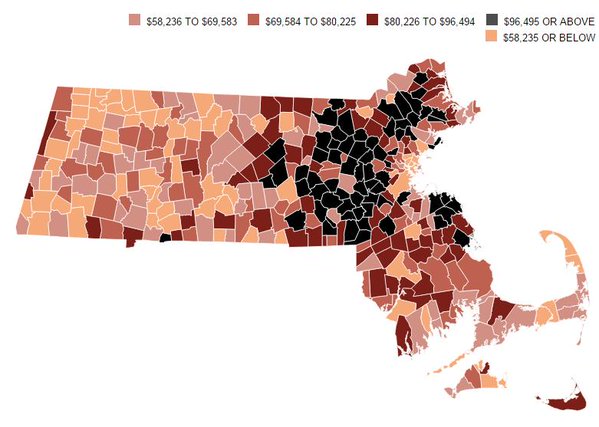
towns by income

^ Massachusetts towns by income : we are two states, not one.

—- —- —- —-

An article in today’s Boston Globe includes a map that we all should memorize. I’ve posted it above. What it shows isn’t pretty. If you live west of what we used to call “the accent line,” you likely earn barely half — or less — of what people earn in most municipalities to its East.

Many factors have brought our state to this point.

Historically, the Connecticut valley was settled not from the East but from the South, and it has, ever since, always belonged economically to the Hartford to New Haven region. (That it was peopled from the South, not from Boston, is also why its speech does not have the Boston accent, which ends in the towns just west of Worcester.)

Then, in the 1930s, Quabbin Reservoir was created by razing and flooding four towns whose boundaries begin in the North of our state and end almost at its South, thereby cutting off much of the West from through traffic. The Massachusetts Turnpike skirts the southern end of Quabbin only a few miles above the Connecticut border. If you live in Pelham, or Hadley, or in Goshen or Plainfield, you have to drive quite a bit out of your way to catch a major East-West route. In the 1930s, that didn’t matter much; almost the entire region was rural and local. Today it matters a lot, and to the towns just east of Quabbin as well (for example : Rutland, Barre, Ware, Hubbardston).

Diversion of the “Mass Pike” so far to the South also impacted the towns on Massachusetts’s northern border. Athol, Orange, Gardner, Fitchburg, Winchendon, Shelburne, and North Adams may connect well to Albany, NY, but they’re a long way off the Mass Pike route, and their own throughway, Route 2, does not compare.

Towns along the Connecticut River — Holyoke, Chicopee, Springfield, Greenfield, Northampton — do enjoy a major route, Interstate 91, but that’s not much help: because Hartford, New Britain, Meriden, Bridgeport, and New Haven in Connecticut —  which still anchor our Connecticut valley cities — have experienced at least as serious economic fall back as our cities north of them. 125 years ago this corridor was one of America’s busiest industrial strips, but that era is long gone. Today brick factory complexes either sit empty and crumbling or have become condominiums, museums, and artists’ lofts.

Boston prospers because it’s a center for all four horsemen of the new economy : finance, higher education, research and technology, and hospitals. The Connecticut valley cities, in both our state and Connecticut itself, lack the first three, in large part because New York City, to which they are hugely subject, isn’t a technology center at all.

Every one of the Connecticut Valley cities is at best a one-trick pony. Forf example : New Haven has Yale University and some smaller colleges but no industry and very little finance. Bridgeport has its port but little commerce. Hartford is still a center for the insurance industry — though hardly what it was 50 years ago —  but insurance assets are not risk capital and thus do not invest in technology. Scant wonder that Springfield, so close to Hartford, has only a prospect of something : MGM’s casino complex, recently downsized; or that Holyoke struggles to make any sense at all of its vast acres of abandoned factory buildings; or that Chicopee has surrendered its factory buildings — equally many as in Holyoke — to condominiums, museum, and small business.

The University of Massachusetts’s home base in Amherst, along with several major private colleges and prep schools nearby, in Northampton, Hadley, and Deerfield, offers employment to people in the center part of our Connecticut valley, some of it high-paying; but education, where there is nothing else, is still a one-trick pony.

As for North Adams, Adams, Greenfield, Erving, and Orange, it’s a marvel that they survive at all. At best they’re one-industry cities, cut off from major routes, with real estate prices too low for any investor to renovate anything (because the cost of renovation can’t be recouped), their residents lacking nearby health care, with few entertainment opportunities available either. Little wonder that the heroin crisis rages in these cities.

But don’t take my word for it. Read the Globe article in full via this link : http://www.bostonglobe.com/metro/2015/12/18/town-town-look-income-massachusetts/cFBfhWvbzEDp5tWUSfIBVJ/story.html?event=event25

The difficulty does not lie only to our West. Income levels in several cities well within the accent line remain stubbornly low — Fall River, Brockton, Lawrence, New Bedford — for so\me of the same reasons that pertain in the West : no finance, very little technology, scant higher education and thus very weak hospital connection to it. These lacks hurt eastern cities despite each having excellent interstater road connections to the outside.

Can Governor Baker do much to change this picture ? He has certainly made it a priority to jump start the long, long process. Often he visits businesses and schools in the Springfield and Holyoke area, calling attention to them and enabling conversation about these cities’ future. Wherever available, he is designating state funds to local self-help initiatives, education organizations, municipal betterments. Holyoke and Springfield, suffering from chronic school underperformance, will benefit from Baker’s charter cap lift legislation, which enables new charters in school districts so designated.

Yet geography cannot be legislated away. The barrier of Quabbin will remain. Connecticut’s chief cities won’t quickly become centers of innovation and finance. In my opinion, a regional approach is needed if our West is to find new purpose and thus encourage its people not to move away or live in relative poverty. Regional conferences do occur, but gas pipelines and defense issues seem first up. How about creating a regional planning council, modeled on our Metropolitan Area Planning Council ? And designating a Baker administration trade and technology specialist (or two) to serve on it ?

None of that may change the destiny of our West (or of our lagging cities in the Boston region), but I expect the Baker administration will get to this, if it isn’t already doing so. It may take 20 years to reorient the economy of our West; perhaps longer. Has anybody got any ideas how we can get the mission to the next phase ?

—- Mike Freedberg / Here and Sphere


LIVING THE CHRISTMAS SEASON

coventry carolers

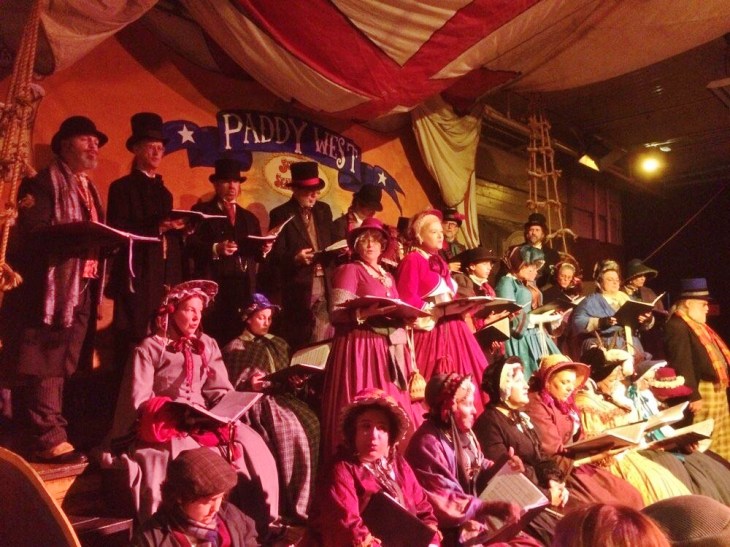
^ Coventry carolers singing my favorite Christmas hymn “Bye Bye lully lullay”

—- —- —-

As a child, I attended a school where during the weeks before Christmas we sang carols at school assembly and rehearsed, then performed, a Christmas pageant. How dearly I loved that pageant, with its cameos and its sweet angel carols sung by a choir of high-soprano girls ! Even today I hear them singing to me, inside my soul, and I feel blessed by the sound. Even today, I join carolers making the rounds singing to neighbors.

My favorite ? The “Coventry Carol,” as it is known, a work originating in that English city and that can be traced to 1392, if not to much earlier : “Oh sisters too, how may we do, For to preserve this day, This poor yongling for whom we sing, By By lully lullay.” And so forth. Hear it once, and you will sing it forever after.

Did singing this carol and so many others (“Of the father’s Love Begotten,” “The First Nowell,” “Oh come ! Emmanuel,” “Hark ! the Herald Angels Sing,” “Adeste Fideles” and more) make me a  Christian ? Not at all. Did singing them enhance my soul ? You bet it did.

It was not until I reached age 18 that I started to wrestle with the idea of God: did such an entity exist ? If so, what, and why ? If not, why not ? I read Nietzsche and William James, Martin Buber and Augustine, Benedict Spinoza, Rene Descartes, and Albert Schweitzer. I read Karl Barth and Reinhold Niebuhr, Bertrand Russell and Martin Luther. I wrote my own, years-long combat story of mind and conscience. To this day, I am still wrestling and writing, reading and arguing. I don’t find, in most organized religions, much wisdom about the matter. Far wiser the solitary thinker, the heretic even. And the scientist.

Of late, I have come to read the works of Erasmus, of Gautama Buddha, of Martin Luther King. I am grateful that these men wrote and that I can engage them in long conversation. If there is a God, or anything higher, I have learned from Erasmus, above all, that higher powers are not all about me; I am all about them.

I also have read the works of Ibn S’na (Avicenna) and Ibn Rush’d (Averroes), Muslim philosophers of the Islamic Golden Aged, along with the works of Moses Maimonides, Peter Abelard (Sic et Non), Epictetus and Seneca. Common to them, and to all the thinkers with whom I have conversed these past 50 years, is uproarious joy in the presence of the unknown, the necessary, unknowable and important.

Yet for all my conversations about God and the idea of God, two things have never taken hold of me : first, I am repelled by the idea of imposing my belief (or my unbelief) up[on any other human being, much less using the law to do so. What devil of pride must possess any person, who thinks he or she has any such right to do ? No one is  subject to anyone else’s speculation or guess about such things. Those who “go out to preach the truth” to people mistake conviction for fact — a disastrous, deadly error to make. Preach it to yourself, if you can.

Second, there has never been a time when I have not relaxed securely on the melodies and voices of those Christmas carols I sang as a child. For they are not about catechism, or orthodoxy, or membership in a congregation. They are about the truth of beauty, just as John Keats wrote over 200 years ago, at an age not much older than me at age 18 : “Beauty is truth, truth beauty — that is all Ye know on earth, and all ye need to know.”

And that, dear reader, is what I do and think about at Christmas, a week for which I am most grateful.

— Mike Freedberg / Here and Sphere

FIXING THE T : TIME NOW FOR MORE REVENUE

FCB

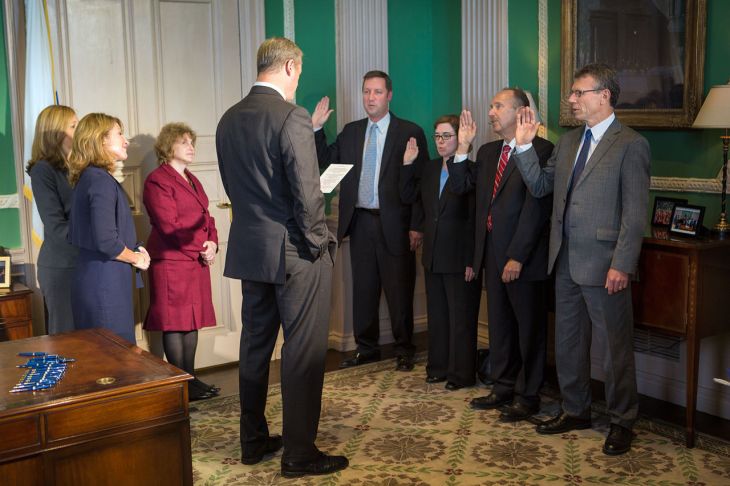
^ Governor Baker swearing in four members of the MBTA FIscal Control Board. Time now to give them the funds they need to expand, not cut back, T service

—- —- —- —-

For the past eleven months all of the MBTA focus has aimed at reform of operations. Governor baker proposed, and, after a brief contretemps, the legislature disposed. Two governing boards answerable to the Governor now oversee the T and manage its day to day work.

The Fiscal Control Board has accomplished much, the operations division even more. It is now a given that T expenditures must meet the test of “a dollar of value for a dollar spent” and that track and signals must work even in record snowfalls of a winter, that trains must leave and arrive “on time.” that Commuter rail fares be fully collected, and that bus trips not be missed except for very good cause.

The mantra of T reform was “reform before revenue” — again, for very good reason. The taxpaying public, before being asked to pony up added funds, needed to know that T management was serious about enforcing diligent performance by T employees and exacting budget oversight by T managers. More remains to be done, but the principle now rules, and the emergency work that remains — signal repair above all — is on a known schedule for completion.

If the T is go farther, it now needs that new revenue we have withheld. There is no avoiding this. It is intolerable to read the Fiscal Control Board calling for service cuts because the money isn’t there. T service should expand, not contract. In particular, the Green Line extension from Lechmere to West Medford must finish. Somerville and Medford have committed their city planning to it; their residents deserve its benefits.

Late night service also deserves to continue. Its riders are few, sure; but what major busy city stops its public transit at all ? The T says that it needs four hours of down time to do track maintenance ? Then use vans, as the T does for senior citizens using “the Ride.” There is no reason whatsoever not to do this. Why else was T management given the power — after much brouhaha — to outsource certain T services ?

The Fiscal Control Board notes that current  T services work a large dollar deficit : fares and community contributions fall multi-millions of dollars short of paying the T’s labor and equipment obligations. But that is how it is with public transit. If operating the T paid for itself, there;’d be no need for it to be a taxpayer assessment. We ask taxpayers to pay the T’s expenses because the economic benefit of having an inexpensive, efficient transport system overrides its cost.

The T is said to require over $ 7 billion to complete repair and upgrading of the entire system, rapid transit buses, and commuter rail. The sooner we budget that money — and assess it — the better and fairer our economic future looks. (If we hesitate, the fix it dollars will increase.) Add to this sum more billions needed to complete Green Line expansion; consider also the costs of linking the Silver Line to the Blue Line in East Boston and the Red Line to the Blue Line. We need to commit to every one of these projects and do so now.

The question of a North Station to South Station AMTRAK and Commuter rail link awaits as well. Should it be built, at a cost of maybe $ 2 billion, or shouldn’t it ? Unless there is more T revenue, the discussion ends.

The Governor presents his FY 2017 budget to the legislature next Spring. It ought to propose significant additional funds for T operation.

There’s another reason why it should do this : on the ballot in 2018 will be a proposal to establish a “millionaires tax,” a surcharge on incomes over that amount, the proceeds of which are designated for transportation and education. We all know that no ballot initiative can bind the legislature’s appropriation preferences, which renders this initiative puzzling.

Yet if the ballot initiative passes — and it will — the revenue will be there. Better by far for Governor Baker to get ahead of its curve by seeking more revenue according to his transportation priorities and performance standards, so that he can accomplish what he wants done, rather than surrender the policy initiative to others (and they are there, trust me), and in the year of his re-election, no less.

—- Mike Freedberg / Here and Sphere
 

ADDICTION : DO WE MEAN “NO STIGMA” OR DON’T WE ?


1 recovery

^ women in recovery : Nicole  (“Colie” in the film) ( l ) and Jessica (r) talk with LtGov Polito and Governor Baker at screening of “Heroin : cape Cod, USA” documentary

—- —- —-

Aggressive in his fight against addiction, Governor Baker has initiated a declaration and a theme : “No stigma for addiction.”  I applaud his determination. Addiction should no more brand a person bad than do diabetes, or chronic bronchitis, arthritis, alcoholism, multiple sclerosis, or depression.

We accept that people afflicted with these burdens incur no social penalty thereby; we are now beginning to add addiction to that list. The entire community appears to recognize that addiction to painkillers and other opiates is not a criminal act; that it’s a matter of health care, including mental health.

Yet one fact obstructs our acceptance of addiction as an illness : the addict becomes addicted, or continues her addiction, by her own act : imbibing the drug to which she is addicted. To those of us who are not addicts, that act looks like a choice, so that addiction becomes a fault. And why should we give empathy to a person who falls into addiction by his own act ?

We are not wrong to ask ; since everybody now knows that use of painkillers, and stronger opiates — heroin especially — can impose addiction, why does anyone take that first step ? That first pill ? That first injection of poison ? is there any young person of today who does not know that injecting heroin into her bloodstream can kill her ? I don’t think there is any such young person. then why does he do it ?

A multitude of reasons come to mind : social pressure, low self esteem, a desire to tempt fate — all of these common to the bravado or the sadness of being young. No one who has read Johann Goethe’s Sorrows of Young Werther, written in the 1770s, should have any doubt that lovelorn youth of all ages can embrace suicide. “I would die for you” is no mere cliche. so why should it be any different for young people today ? Not to suggest that romantic drama is the dominant route to drug use. Escape of all kinds is a mental mechanism almost all of us choose, at some time or other : a land of living dreams : “to the funny farm, where life is beautiful all the time,” in the words of a hit novelty song of the mid 1960s.

Who of us has not wanted, at one time or another, to fly away to a funny farm where life is beautiful all the time ? Unfortunate;ly, the kids who do so by imbibing an opiate often find that they are owned from that moment forward and that getting out of being owned by the drug is almost impossible.

“You either are an addict, or you aren’t,” says my friend Jack Kelly.  Unfortunately, there’s no way of knowing if you are an addict until you imbibe an opiate and find it out — and then it’s too late. You are now possessed by an illness that will always be in you even when, if you are strong enough or lucky enough, you stop feeding the illness and become “clean.”

At this point, we return to Governor Baker’s theme : “no stigma for addiction.” By this mantra we declare that an addict in recovery — an addict clean — is, and has always been, fully part of the entire community with no disqualification on account of her addiction.

But do we live up to the mantra ? Do we in fact treat addicts in recovery the same as we deal with everybody else ? Jack Kelly thinks not. “It’s terribly hard for an addict to get a decent job,” Kelly says. “Once the employer finds out that you’ve done heroin, the job isn’t offered.”

“Addicts in recovery need to know that their strength matters,” says Kelly.  “Employers need to see that all that strength that it takes to become clean, all that energy, is a positive for employment, not an obstacle. And really important jobs, with significant responsibility, almost no one ever gives these to an addict in recovery.”

The mind does start thinking about this. What if the addict relapses ? what if she shoots heroin while on the job ? Steals to support his habit ? What if she injures somebody while driving under drug influence ?

That is how employers think. It’s the same heebie jeebies that prevent employers from giving good jobs to convicts trying to re-enter society. Once a convict, always a convict. You never really stop serving your sentence.

But if addiction is, finally, to no longer be considered a crime, why does the workplace treat them like felons ?

If we really do mean the mantra “no stigma for addiction” — if we don’t just say it because it sounds good — we cannot treat addicts as if their lives will be a worst case scenario. We need to not tattoo the stigma onto their foreheads, not brand them as scarlet letter unemployables. This will be the test of our intentions. All the empathy in the world, all the mental health care and good feedback, won;t mean very much if addicts in recovery make high-level employers forever uncomfortable.

—- Mike Freedberg / Here and Sphere

DOWN INTO THE SINKHOLE OF A LONG LONG DYING

Daniel in the lion's den

^ drug-addicted and drug dealer, con men of vulnerable girl addicts : Daniel is both hero, villain, and living symbol of drugs as living death in documentary “Heroin : Cape Cod USA”

—- —- —-

Last night I attended a screening of a documentary, “Heroin : Cape Cod, USA.” Governor Baker and his wife hosted the screening; almost his entire administrative team saw the same movie that I saw, 75 minutes of camera focus on drug addicts, dealers, parents, town officials, health workers — but mostly the addicts, young people, as they ingest or shoot up the drugs that could very well kill them — and sometimes do kill them.

One sees the broken smiles, the bony torsos, the bruised fingers, the resignation, the coolness with which they feed a hunger whose ravages they know only too well. Many are handsome or beautiful, which makes all the harder watching them self destruct.

One also sees the tears in their parents eyes, the hopeless sad stare, the quiet re-tellings of good times — long past — between parent and child.

One sees the gurneys on which the overdosed die despite vigorous CPR.

Almost the entire documentary takes place at night. Many scenes, of cars rushing along fogged-out streets, or sandwiched by glaring neon, feel more like Amityville Horror, or Silence of the Lambs, than like Cape Cod of an evening. The comparison isn’t merely visual. Most drug assignations take place at night. So does the 160-mile round trip into Boston that one Daniel, an addict and dealer, takes every night to see his supplier.

Daniel is the hero and the villain of the film. He is its symbol, its hopelessness, its sufferer and its instrument of others’ suffering. It is very, very hard to watch him.

No one injects a drug during Daniel’s trip into Boston, yet for me it’s the most painful, most hopeless part of the film.  By what possession does Daniel drive all that distance at a time when most of us are regenerated by sleep ? What control makes him degenerate his health, his body, his soul even, rather than regenerate ?

We see Daniel imploring his girlfriend Colie not to go to detox, not to do what Marissa — as skeletal, spasmodic, and broken-faced as anyone in the film –says an addict seeking recover must do : separate yourself from all that you have been and from everyone you know, and walk through that detox door.

It is a very hard to do, says Marissa. We learn at film’s end that she later died of a drug overdose, at age 23.

Colie walks through that door, however, carrying all of her possessions, like an emigrant, going to another country.

At film’s end we meet her a year later, in full recovery, smiling and working two jobs, grateful — but not boastful at all. Next we see Daniel, now with a new girlfriend, Cassie, broken face ready to cry. She knows where she is : in the valley of the shadow of death. One wants to wring Daniel’s neck; but how can we, when we know that he is just as trapped, helplessly a con man, as any of his girlfriends ?

Daniel is the film’s angel of death, diseased through and through with the dying he brings to broken girls with a gentle smile. He is the film’s symbol for drug use itself : the substance with a smooth smile, a twinkled eye, a kind voice, all of it in pill form, or smoke, or injectible liquid.

To recover from addiction, an addict must leave Daniel far, far away, alone, as he is alone even when accompanied by a drug-weak girl he has conned. Daniel must have the door shut on him. He knows it perhaps more desperately than any of his girlfriends.

The film forced me to ask the question : why them, and not me ? Fifteen years ago I had surgery to fix an umbilical hernia. The hospital pharmacy gave me 40 percoset pills. I used two — later returned the other 38 to the pharmacy; indeed, let nobody know I even had them, because they are worth mucho on the street and I had no intention of seeing them stolen from me. Why was I given 40 ? Pain from a ripped stomach muscle required ,me to use two, but after that, I used ibuprofen : it did not remove the pain, but it eased it enough.

And again : how come the percosets that i did take did not addict me ? Why the people in the film, but not me ? I found nothing in the percoset effect to make me want more of it. I didn’t miss it at all. Why then do addicts come to need painkillers ? What pain do they think they are killing ?

I have no answers for these questions. All I know, from my own life and from the film, is that painkiller drugs act on some people the way a deadly virus acts on others. Until a body is invaded by a virus and becomes victim to it, who knew ? Same for painkillers. There’s nothing at all to distinguish the young people in the Heroin film from any bother young people, except that, a painkiller once taken, they were from then on owned by the need for more of it.

From then on, it’s a race between death and life to see which one will win. The Heroin film suggests that in most cases, death wins, and that even for those who life rescues, it’s thereafter a constant, everyday struggle — just as it is for people afflicted by AIDS, or diabetes, or drug-resistant tuberculosis.

—- Mike Freedberg / Here and Sphere



CRAZIER AND CRAZIER

Jessica

^ Revere’s Jessica Giannino : cannot run for the First Suffolk & Middlesex Senate seat because she hasn’t been a “Democrat” long enough ? Crazy

—- —- —- —-

Soon to be vacant, the First Suffolk and Middlesex Senate seat may be vacant for quite a while. Or it may be taken by the most temporary of aspirants. The situation has gone from crazy to crazier.

An entire beehive of aspirants has buzzed around the seat ever since Anthony Petrucelli announced his forthcoming resignation. The big bees were in, then not in, or not declared, then in. Behind them has trailed an ever increasing conga line of hopefuls, some quite credible, some less likely. And then, last night, came news truly stunning : Byron Hefner, the betrothed (but not yet wedded) of Senate President Stan Rosenberg, announced his interest in running.

This news came barely an hour after Beacon Hill’s State Representative, Jay Livingstone, announced that he’s “IN.” I’m sure that Livingstone people groaned at having the spotlight diverted thus.

There is precedent for affianced couples representing different legislative seats, but it’s far from common. How must Senator Rosenberg feel, at having his love interest put him in a tight spot ? The last thing that Rosenberg — who represents a District bordering the Quabbin Reservoir, 100 miles west of Boston but lives during the week in a Beacon Hill; condo — needs is to have himself thrust into a Senate race that cannot help but be an intense turf battle ?

Presumably Hefner will be taken to the woodshed; but his exit hardly ends the craziness gripping our Senate District.

Jessica Giannino, who topped the Revere City Council ticket in November’s election, and has enough charisma to fuel five candidacies, cannot run in the Democratic primary because she hasn’t been a Democrat for the required period of time. (Note : being a “Democrat” has little significance beyond the requirements of MGL c. 55 because every activist in this District is a Democrat, no matter of what political persuasion. The term thus means absolutely nothing.) Giannino would have been a very strong contender, Revere comprising about 38 percent of the District’s likely turnout.

There might not be a special election at all. Petrucelli’s resignation is scheduled for mid January. That puts election day in May. Secretary of State Bill Galvin is questioning the reasonableness of holding a May election, given that only four months later there would be a regular primary, followed by November’s normal election.

If there is no special election, and the seat goes vacant until the regular election, Jay Livingstone would have to give up his House seat. Would he do that ? Maybe, but in a regular state primary, with a large turnout, he would be a decided underdog in a District designed to elect an East Boston-Winthrop candidate. The same choice would probably keep East Boston’s Representative, Adrian Madaro, on the sidelines.

Madaro would have good reason to defer. He will be completing a first term won in a special election of his own. The 2020 census will almost certainly occasion a significant reshaping of the Senate District, one that will go in his favor. Downtown Boston’s population has grown by at least 25,000 people since the 2011 redistricting. I can easily see this Senate District losing its non-North End Boston precincts; that, or exchanging Revere for Chelsea. This redistricting would solidify our District’s Hispanic character, a community that supports Madaro str0ngly and would love to see him move up.

Putting Revere into the Senate District now centered on Everett has precedent. The two cities formed a Senate District in the 1970s and 1980s, when Joseph DiCarlo, Frank Conte, and then Tom Birmingham represented it. (That seat also included Chelsea.) Beacon Hill, too, has no business being part of a  District centered on the ethnic working class communities north of Boston Harbor. It belongs with Cambridge in a seat that makes ideological and economic sense.

Whichever way the 2011 redistricting goes, it is unlikely to strengthen the position of a Beacon Hill contender were he to win the seat now. If it is Livingstone, he’ll either end up with a Cambridge – Beacon Hill – Back Bay seat, or he will be very much an underdog in a seat almost entirely north of the Harbor.

For all of these reasons, I have to think that if there is no special election, Livingstone will stay put, and a North End or East Boston-Winthrop candidate of strength will run and win. That would solve the absolute craziness now buzzing through a District easily fractured by faction, by the harbor, and by ambition to rise up from the area’s gritty three-deckers, wooden bungalows, tumbledown Victorian mansions, chock-a-block condos, and flat-roofed row boxes.

—- Mike Freedberg / Here and Sphere


HELLO OUT THERE — ANYBODY WANT A SENATE SEAT ?


Mario Umana

^ Mario Umana, iconic voice for an iconic Senate District, way back when.

—- —- —- —-

Does anyone want the State Senate seat — First Suffolk and Middlesex — that will become vacant sometime next month ? The seat that once claimed as its voice Mario Umana, Bob Travaglini, Mike LoPresti Sr and Jr ?

So far the list of possibles is growing large enough to fill Spinelli’s, yet of actual applicants, none.

Not sure I’ve ever seen a situation like this, much less in an emblematic Senate District such as ours. One can easily see a classified ad blazing in the newspaper :

“on offer : one State Senate seat with a prestigious history, original and unrenovated, all applicants considered. Ready for occupancy in the Spring. Apply at Boston City Hall during normal working hours.”

The list of coy aspirants grows : Joe Boncore, Jessica Giannino, Dan Rizzo, Lydia Edwards, Max Tassinari, Jay Livingstone, Aaron Michlewitz, Ed Deveau, Ernani DeAraujo, Philip Frattaroli. Adrian Madaro ? He isn’t saying. I’m not sure the list hasn’t a long way to grow. Why not Paul Rogers ? Jason Aluia ? Pat Moscaritolo ? Veronica Robles ?  Daniel Cordon ? Carlos Rosales ? Francisco Urena ? Frank Conte ? Mary Ellen Welch or Evelyn Morash ? Phil Giffee ? Alice Christopher ? Margaret Farmer ? Celeste Myers ? All well qualified, all admirable activists.

And Cambridge, several precincts of which stand within the district : surely there must be six or seven activists in Cambridgeport ready to rock and roll ?

Only three names seem not to be on offer : Winthrop School Committeeman Tino Capobianco, who tells me he has decided not to run, Joe Ruggiero, who has said the same, and District Councillor Sal LaMattina, who would take a pay cut if he were to move from Council to the Senate and who proclaims himself a city-issues guy. But hey — their deferral is YOUR OPPORTUNITY, dear reader.

You know what ? Maybe I should run. I know the District as well as anyone, and for a much longer time than most (back to 1969), I’m Team Baker, I need a paycheck, my roots in Eastie go back 120 years. (I don’t live in the District yet, but the rules say only that a State Senator must live in the District on election day.)

I’m kidding, of course; I enjoy far too much being an operative to ever do anything as crazy as being a candidate. In fact, I’m all in for Adrian Madaro — if he runs. If not ? I’ll probably have 65 hopefuls calling me up to seek my support. This could get very interesting.

The word I get all day long is “everybody is waiting on Aaron.” That’s Aaron  Michlewitz, who represents the North End, Chinatown, Leather District, and much of the South End, the seat held previously by Sal DiMasi. Michlewitz is universally respected as a nice guy (by me too). Supposedly Michlewitz is “struggling with the decision” to run, knowing that victory would mean giving up a powerful House committee chairmanship (Financial Services) leading perhaps — according to one observer — to being House Speaker; giving all that up to become … a freshman Senator ?

Really ? If Michlewitz is on a path to becoming House Speaker, his decision is no “struggle” at all : he doesn’t run.

So why is he taking long to figure out his future ? I dunno.

And why are the obvious other candidates waiting ? The answer is money. By the most recent OCPF report, Michlewitz has $ 177,254.70 on hand, while Adrain Madaro reports $ 16,745.15 and Jay Livingstone claims $ 35,072.05. Michlewitz’s dollar advantage is larger still : his District includes some of Boston’s highest-income census tracks, while Madaro’s East Boston remains essentially a working class community; the political money in it c0mes chiefly from Massport circles. There’s also Michlewitz’s committee chairmanship and four-term experience versus Madaro the special election freshman.

Money talks and effluent walks. It is unfair, perhaps, to Michlewitz to decry the possibility that a District designed to elect an East Boston person, and which has done so for eons of time, might be purchased from Downtown; but that’s right now the prospect that has so many aspirants hesitating to plunge and others reluctant even to aspire. I hope that that will change.

Meanwhile, an historic, iconic State Senate seat goes on offer, unclaimed.

—- Mike Freedberg / Here and Sphere