The REPUBLICAN STATE COMMITTEE FIGHT : UPDATE

Baker endorse

^ The Baker (and Polito) endorsement : here, Ed McGrath and Janet Leombruno, state committee members seeking re-election from Senator Karen Spilka’s Senate District (Framingham and surrounding towns)

—- —- —- —-

Two months ago I wrote about Governor Baker’s decision to reshape the Republican state Committee, the body designated by Massachusetts law (c. 55, for those who want to look it up) to oversee a political party. As elections to a party’s state committee interest only party activists, the larger voting public rarely takes any interest in them. Nor would I, this time, except that reshaping the state committee of Massachusetts’s Republican party portends significant public policy consequences for all of us.

Among other duties, the state committee of a party drafts that party’s political platform — setting forth what public policy the party advocates. In 2014, some may recall, the Republican State Committee approved a platform rejecting the civil rights advances our state has made these past 15 years, including a disapproval of same sex marriage. As if that were not enough, the platform also rejected women’s reproductive rights.

The platform also rejected several economic reforms, including a higher minimum wage; but it was the platform’s stance on “social” issues that rankled the overwhelming majority of Massachusetts voters — and embarrassed Baker and his running mate Karyn Polito, who, in their Republican campaigns, asserted unshakable support for women’s reproductive rights and marriage equality.

Baker and Polito barely won election; and they were probably right to attribute the closeness of the win at least in part to voters’ rejection of the party platform.

Which is why Baker has moved to defeat those state committee people who doggedly oppose his views.

There are 80 people on the Republican state committee : 40 men and 40 women, one of each elected from each of the State’s 40 Senate districts. 55 of the 80 positions are contested; Baker has his 55, and so do his party opponents. And yes, they exist and are not going quietly away.

The Baker campaign presents a picture of him with his endorsed candidate plus a picture of the letter of endorsement he has given. It is a positive message, in which Baker applauds his endorsee’s record of party activism. Said endorsee is then free to use these photos however he or she thinks most effective : mailing, facebook posting, meet and greets (some of which Baker is attending personally) — or all of these.

It is difficult for Baker’s opposition to fight back. He enjoys a favorable rating of about 70-74 percent among all voters, much higher among Republicans. The opponents cannot directly attack Baker, but they can attack his endorsees. It’s a campaign of smear, basically, and shouting (because shouting, as we see, gets you attention). Ordinarily I wouldn’t give Baker’s opponents a chance in hell of defeating his endorsees. But as we see this year, opposition to “the establishment” is a Republican given, and can there be any Republican more “establishment” than a sitting, popular Governor  who actually gets things done on a bipartisan basis?

The state committee election takes place at our Presidential primary. Will the approximately 40 percent of Massachusetts GOP primary voters who the polls tell us support Trump vote for the Governor’s state committee candidates ? And what of the ten percent who support Ted Cruz ?

Were the state committee campaign to surface and become a huge topic among primary voters, the Governor’s endorsees might be in trouble. Except for three factors almost impossible to counter : first, few Trump voters care about the State House. They are fixated on Washington. Second, the state committee election is not a huge topic of conversation, and most primary voters will probably either vote the candidate’s home town and/or give Baker the benefit of the doubt. Third, Baker has chosen truly superior candidates, activists well known in their community at large (some of them current or former holders of elected public office), people who, like Baker, campaign to all the voters. It will be very difficult for candidates for whom the 80-person state committee is their entire political universe (more dwarf star than universe) to compete with opponents so well known beyond the tiny hallways of state committee affairs.

I said, earlier, that this fight has significant public policy consequences. It does. That Baker wants a party platform aligned with his agenda is just common sense. Why should he tolerate being sniped at by his own party’s bosses ? Speaker DeLeo controls the House utterly; Senate President Stan Rosenberg has working control of his legislative body. If Baker is to bring his full power upon the two legislative drivers, he has got to wield the same level of control over his Republican party. He and only he must speak for it.

During the current legislative session, Baker has not won all the reforms that he sought. In part, he fell short because he holds only partial control of his party (including some Republican members of the House). In addition, Baker has ducked a civil rights issue, public accommodations protection for transgender people — and allowed himself to look weak — at least in part because he lacks it.

Understandably he does not want to make his campaign to control the state committee a referendum on transgender people’s rights, opposed as these are by many GOP activists. He thinks, correctly, that he could well lose his big gamble — one that no Massachusetts GOP Governor has taken on in at least 40 years — if events line up the wrong way. Better, then, to keep the campaign simple : a referendum on Baker’s popularity and standing. The rest can come later.

—- Mike Freedberg / Here and Sphere

THE STATE SENATE MOVES TO OPPOSE


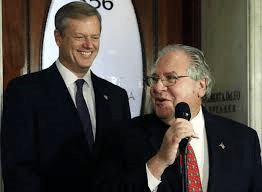
reason to smile

^ smiles, but “paint free” vote yesterday opposition deepens between Senate President Stan Rosenberg (r) and Governor Baker

—- —- —-

For a while now it’s been quite clear that Senate President Stan Rosenberg wants his body to be an institutional base for the “progressive” agenda he espouses. Every day now, the opposition inherent in Rosenberg’s intent looms larger. We saw it yesterday in a vote to impose a “paint fee” on the disposal of used paint cans. The House’s leader, Speaker DeLeo, has joined Governor baker in proclaiming “no new fees or taxes” for the second budget year in a row; thus the Senate’s “paint free” — vote was 25 yes, 11 no — will likely fail.

As I have written a few months ago, Rosenberg doesn’t mind losing theses votes. His game is a long one. His most vocal members criticize Governor Baker’s moves, speak with spite and grumble, pursue the opposite of what the Governor and Speaker have agreed upon. This tactic surely has Rosenberg’s back. It helps clarify his Senate stance on issues and to make it recognized; victories can come later.

My own feeling is that Rosenberg cannot win — the House is four times larger, dominates joint legislative conferences, and will likely be led by a moderate, even conservative Democrat for as many years as I can see ahead — but what if the House does, at some point, become led by a “progressive” ? Then Rosenberg wins. Doubtless such a coalition will incline Massachusetts voters to elect non-Democratic Governors even more surely than they do now; at which point only a Governor’s veto will offer non-“progressives” a defense line.

All of that is for the future. The immediate question that I see in Rosenberg’s stance is one for my Senate District, which is now in the hands of a special election to choose a successor to Anthony Petrucelli. What sort of political agenda will, in the Senate, represent the voters of East Boston, Winthrop, Revere, the North End, Chinatown, and Beacon Hill going forward ? Will our Senator be a Rosenberg ally, or will he or she adhere to the more centrist principles espoused by Speaker DeLeo, who lives in our District and represents one fourth of it ?

As readers of Here and Sphere know, I had every intention of supporting, even working for, an independent candidate, who would on May 10th oppose the winner of the April 12th primary; a candidate who would espouse Governor Baker’s reforms and derive much support from Team-Baker. That candidacy would have assured our District its own voice in the Senate, one as powerfully supported, and grounded, as Rosenberg’s. That candidate would, if successful, have given Speaker DeLeo a presence In the Senate as well as looming over it and would have had the backing, probably, of Governor Baker as well. To me, this candidacy mattered at least in part for its prospects of helping to unite the legislature rather than dfivid9ing it, as Rosenberg’s game does, into opposed camps.

That candidacy did not happen, and what remains to us is six people, of whom maybe one has some sort of direct line to Governor Baker (Dan Rizzo of Revere, the city’s former Mayor, is said to have been liked by members of the Governor’s administration). Do any have links to Speaker DeLeo ? Joe Boncore of Winthrop, the other leading candidate, seems to have them, but who knows ? Boncore does enjoy the support of one or two Baker activists — as does Diane Hwang, whose candidacy at this moment seems more about presence than victory.

Meanwhile Jay Livingstone, the only State Representative in the primary, has as his campaign purpose winning the votes of “progressives.” (Candidate Lydia Edwards seems also to practice the same strategy.) Livingstone will, if successful, almost certainly be a Rosenberg ally. As Livingstone is seen, probably correctly, as the leading contender, those of us who want a Senator allied with the dominant powers on Beacon Hill are likely to be disappointed.

My view is that our District has economic needs that require us to ally with dominant powers. Livingstone’s base, however, is in top-income precincts (Beacon Hill) that do not have such need.

This has been one of the strangest elections I have ever been part of. The District was created to send an East Boston leader to the Senate, and for 60 years it has done so. Now, not one East Boston first-rank leader is running, and all who I speak to, including every one of our non-candidate State Representatives, are staying far, far away from the contest.

I like Jay Livingstone. He is a dedicated citizen, a Boston leader. But I do not see how he can possibly represent a District so different from the precincts that elect him to the House, precincts that were added to our District, cynically by a redistricting committee, for the sole purpose of filling up our population requirement.

Maybe 15 percent of our voters will cast a ballot in the primary. This is not acceptable, but why should anyone but an insider or activist become interested in an election that is about only insiders or activists ? The candidacy I envisioned, for the May 10th election, would have given a much larger voter number — maybe 33 percent — reason to take an interest. As it should be.

For this primary, we are out of it; we feel it, we know it. This primary is not about us.

How out of it are we ? Last night I spoke with Livingstone, who attended the Orient Heights Civic Association’s monthly meeting — the only candidate to do so. I asked him if he had campaigned yet at Adriana’s, Rino’s place, and the Jack Satter House. He had not — indeed, he seemed unsure of Adriana’s importance, or of what the Satter House is. If a candidate as hard-working and aware as Livingstone is — I can attest to this — shows such unfamiliarity with our core of the District, we are going to have a difficult time being understood by a Senator with an agenda most of us don’t share.

Just the way Stan Rosenberg wants it.

—- Mike Freedberg / Here and Sphere

FOR ADDICTED WOMEN, NO MORE FRAMINGHAM PRISON

CB signs

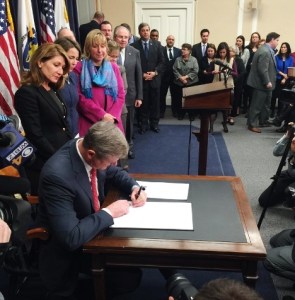
At 3.00 PM today, barely an hour ago, Governor baker signed legislation ending the practice of committing drug-addicted women to Framingham prison. Henceforth, addicted women in the justice system will be committed to hospitals.

It took 30 years of delay for this reform to happen.

This act may seem a small victory in the battle to make addiction a health care issuer rather than a crime, but for the women affected it’s not small at all. Framingham is the state’s only prison for women, and it has long suffered a terrible reputation for mismanagement and worse. It is no place for women with serious — life threatening — health problems. Framingham prison may not be a place even for female criminals (read reporter Scott O’Connell’s MetroWest story from 2012 : http://www.metrowestdailynews.com/article/20120419/news/304199949 ) and that’s a subject to be taken up soon, I hope; but for drug-addicted, non violent women, it’s a venue utterly inappropriate. Framingham, like all prisons, is governed b y fear, intimidation, and guards who control everything about you. In prison you often have no rights at all, not even basic human rights. Whatever the justification for imposing such terror on criminals prisoners, there can be none for subjecting addicted women to it.

Henceforth, addicted women facing civil commitment will no longer face being housed in prison.

The legislation that Governor Baker signed — read its text here : http://www.malegislature.gov/Document/Bill/189/House/H3956.pdf — accompanies the creation of 248 new bed spaces for addicts needing treatment, beds located all over the state, in hospitals, mental hospitals, and community clinics, with Baker’s assurance of many more such beds to come.

Said Baker in his press release, “With the support of the legislature and Attorney General, our administration is proud to have delivered on a promise that took more than 30 years to fulfill. Now, women with substance abuse disorder who are civilly committed will not be sent to MCI Framingham and will have the opportunity to get treatment instead of jail time.”

Speaker DeLeo added these words : “By ending the practice of sending civilly committed women to MCI-Framingham we are taking one more step to helping residents – our sisters, mothers, daughters, wives – recover. I’m proud of the landmark substance addiction legislation we have passed and the unprecedented funding increases for treatment, and I pledge unwavering commitment to fighting this devastating epidemic.”

Senate President Stan Rosenberg said much the same : “The bill ends the practice of treating women with substance abuse issues like criminals. We need to…provide access to treatment in an appropriate setting so these women have an opportunity to get on a path to recovery.”

Attorney General Maura Healey joined the Governor’s signing ceremony and offered her own view : “This new law will end the practice of sending women struggling with addiction to prison without access to the treatment services they need. As we continue to battle this epidemic, it’s critical we get people real help that will give them a fighting chance at a better life.”

Action by the legislature came swiftly. There continues to be controversy about Governor baker’s more interventionist tools for fighting addiction — the 72 hour forced commitment has not found favor with many in the medical establishment, and Baker’s 72-houir pain pill, limitation was eased by the legislature to a one-week limit — but most of Baker’s reforms have taken hold unanimously or almost so. I am hoping that Baker will continue to pressure the legislature — and the medical community — to be ever bolder, ever more ready to intervene, to save the lives of the many thousands of our state’s young people at risk of grave harm, even death.

Even as I write, new strains of street heroin, mhttp://www.malegislature.gov/Document/Bill/189/House/H3956.pdfotent every week, grasp at the cravings of those we must tlry to save.

—- Mike Freedberg / Here and Sphere
WE SAY : YES TO BOUTIQUE FARMING IN MASSACHUSETTS

farming

^ specialty farming comes to Massachusetts : fresh high-quality veggies grown in Grafton’s community gardfens

—- —- —- —-

As GE prepares to move its headquarters to Boston, bringing with it at least 800 top-level jobs; as GE’s move promises boom times for the City’s technology industry, well beyond what it already has; as Boston people’s discretionary spending increases and keeps on doing so, a new opportunity arises for our state’s agriculture. Will we take it ?

Agriculture is a service industry. It supplies food to people who have money to buy what they eat. The more money, the better agri-products they can buy. Just as Starbucks’s and Peet’s $ 4.00 lattes have, in greater Boston, all but sidelined Dunkin Donuts’s $ 2.00 Joe, and just as premium, $ 4.50 – $ 5.50 ice cream has all but bankrupted the cheap, Friendly’s kind, so expensive agriculture of all sorts has found its moment.

This is not new. We already have craft beers by the thousands, many of them brewed in Boston itself, using grains and fruits grown locally too. Expensive restaurants have become the norm too; and much of the foodstuffs what they cook with are premium-level, premium price.  Farmers’ markets abound, in almost every Boston neighborhood; they are not for the short of wallet.

People will pay for top quality food. If not, Steve’s Ice Cream — a staple of Somerville food mavens back in the day — could never have become the long-line destination that it did. Steve’s was then unique; today its business model is the food standard. The new Boston will only make it more so. Top quality, top price : nothing less will do. How can it ? There’s no comparison between a $ 30 meal and an $ 18 one, you can taste the difference instantly. In my neighborhood — East Boston — Rino’s $ 28 to $ 40 meals draw an SRO crowd almost every night; restaurants that cost $ 15 to $ 18 are rarely full.

All of the above is prelude to this article’s premise : agriculture in Massachusetts stands at the threshhold of boom times — IF farmers understand the nature of the opportunity. Grains for craft beer; grapes for local wineries; greenhouse vegetables and fruits for high-price restaurants; pampered cows, pigs, and lambs for premium meats — all are in demand now, more and more of it. And with high quality foods, freshness is a must. It hurts top level food to come to us by long travel, refrigerated transportation. Grow it locally, as locally as possible.

For many decades the idea of Massachusetts as an agriculture state was hard to take seriously. Not so now. There remains plenty of open space even in Essex County; and urban farming in Boston itself has become a major industry. With the new agriculture comes, finally, escape from economic backwardness for Worcester County and the entire Quabbin Reservoir region as well as for farmed portions of Bristol and Middlesex Counties. You want to up the prospects for our “gateway” cities ? Specialty agriculture, it is; because almost all these cities sit in the heart of farm country — and will be right there, at hand, when the state’s newly prospering specialty farmers come to town to buy city stuff.

Fortunately, Governor Baker’s administration has sen the opportunity and is allocating state budget funds to support Massachusetts farming. I would hope that those funds would also include Boston’s urban farming. Why not ? As high-end income earners flock to Boston in ever larger numbers, we should do everything we can to bring them the stuff they have money to buy.

We should also see that those who produce specialty food for well-heeled customers are well paid themselves. Raising the minimum wage to $ 15/hour helps farm workers as well as fast-food and retail employees. Why not give farm workers enough income to buy the new farming’s products ? For me, a $ 15/hour minimum wage makes much more sense economically and as tax policy than the backward-looking millionaires’ tax surcharge that certain well-meaning advocates have proposed. Public policy in Massachusetts should embrace what is coming and new, not what is going and obsolete.


STAYING ON COURSE

FullSizeRender

Where would a journalist be without friends ? Last night I attended Governor Baker’s State of the State speech thanks to the loyalty of a good friend, who secured me a seat despite my not having one of those printed invitations given to the Governor’s list of notables.

I sat in the balcony, directly above the center aisle of the House chamber, almost looking Governor Baker in the eye. I liked what I saw : confident, but at ease; comfortable in his skin, often policy-serious, sometimes good-guy fun.

What I saw, Baker also spoke. He stayed on course, doubled down in fact. He came into office as Mr Fix It, the diligent manager, that’s what he has done, and last night he vowed to continue doing it.

Yes, he has priorities; but they’re the same priorities that he has advocated all along : $ 1 billion for MBTA infrastructure; $ 75 million for career and technical schools; a much stronger opioid addiction bill than the milquetoast law passed by the legislature last week; charter school cap lift; and dramatic increase in hydro power supply. All were needed last year, and they’re still needed.

He also stuck with one of his initiatives that did not pass last year : cutting the Film Tax Credit. Here his proposal has changed. Instead of eliminating the tax, which Speaker DeLeo will not allow, he requested decreasing the tax’s spread. we will see if the Speaker accepts the compromise.

Baker touted several first year successes : getting DCF completely reorganized, with all parties in agreement — no simple task; legislation ending the civil commitment of women to Framingham prison; balancing a budget badly overrun; restoring local aid to its full funding; restructuring management of the T.

Lastly, Baker made clear that “no longer does the state balance its budget on the backs of our cities and towns.” Balance the budget he must, and will; but local aid will not be nicked; may, in fact, see increases, many the result of the Municipal Administration Reform law he has filed.

He held course despite significant pressures to shift. Advocacy groups are pushing for a tax surcharge on high incomes with the money earmarked to education and transportation. Other groups want baker to adopt universal pre-kindergarten schooling, or to embrace substantial MBTA expansion, or to stop charter schools, or to halt further opioid addiction legislation. Some politicals are sniping that Baker is all talk, no action, that he can’t fix the stuff he says he’ll fix — as if the stuff he’s trying to fix can be corrected magically overnight. To all of these, Baker gave his answer last night : I am on the course I believe to be the right one, and I am staying on it.

I fully approve his decision. Baker has changed the conversation about what Massachusetts government is for, and how it should be for it; and the change is all good, as attested by his huge approval rating. The voters want their government to work. The voters want the services state government purports to offer. Getting these services effectively, and within budget, to the people is the bedrock of everything else. It gives the voters confidence in their government.

All across America, voters have lost confidence in their governments, and in the unhinged, irresponsible talk going on in this year’s presidential election, we see the angry, amoral, dangerous result. If baker can build a rock solid foundation of public confidence in Massachusetts state administration, he will accomplish the most vital mission our politics cries out foir.

That is why he was right to double down on his plan of action. That is why he was applauded by everyone in the room — including our two Democratic United States Senators — of both parties or no party. And that is why he is held in uniquely high esteem by the voters of our state.

It was the right speech delivered in the right way.

—- Mike Freedberg / Here and Sphere


THE SURPRISING MR. WALSH, MAYOR

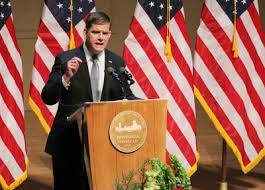
Walsh

^ surprised by Mayor Walsh’s work so far ? You should be.

—- —- —-

In the two years since he won election as Mayor, Marty Walsh has surprised me. I’m hardly the only one. I thought — I think many people thought — that Walsh would be the kind of Mayor that his “progressive” backers wanted : insurgent, a tribune for the poor, a fighter for diversity in city hiring, a Don Berwick fan, a Democrat’s Democrat. Some may even have thought — though I did not — that Walsh would abet the enviro activists’ vision of a green, biker’s and walker’s city in which cars would be noticeably unwelcome and development — if approved at all — would be small scale and very very quiet. People who thought this of Walsh expected him to march on the front lines of minimum wage hike protests. Nor are these all that was assumed of Walsh.

All of it proved wrong. My own expectations too : I had thought that Walsh would be what some pundits called him, a Mayor of “incremental change” — nothing big or transformative. Boy, were we mistaken !

Instead, Walsh has become as revolutionary a leader as Boston has felt since Kevin White at least. Let’s look at how :

First : always the labor leader — he calls himself ‘a labor guy” — he understands, and always has, that labor doesn’t have jobs if businesses don’t hire. Thus Walsh has been the City’s biggest advocate of boom-town development — and of the well rewarded construction jobs accorded by the boom. And a stupendous boom it is, and will be.

Second, Walsh has worked in partnership with “Republican” Governor Baker — and noticeably enjoys doing so — to bring even more construction to Boston, and start up businesses — of which the GE move is only the capstone. Under Walsh and Baker, Boston has become the nation’s entrepot of internet innovation in the device zone, the “internet of things.” You could see it at Mass challenge’s awards ceremony two months ago, at which both Walsh and Baker spoke — as they do a lot, at all sorts of Boston events.

Third, Walsh has worked diligently to bring all kinds of arts and entertainments to Boston, in keeping with what he likes about Montreal, a city which, at a Mayoral forum in 2013, he named as his model for what Boston should become. Walsh failed to secure us the 2024 Olympic games — failed dramatically — but once committed, he went all in, risking his popularity among the enviros  but thrilling those who want our Mayor to be passionate and committed to the benefits he believes in.

Fourth, Walsh has confronted, head on, the entrenched public school establishment, in which union contract work rules, vested school supporters, and dogged teacher union opposition to charter schools have written an achievement gap in stone and seen the ever-increasing school budget swallowed almost entirely by teacher salary raises. True, Walsh has not played fair with school budget increases; he could easily add more dollars so as not to pit teacher salaries against school facilities needs; but he has taken this course as a means of highlighting that Boston schools  cannot simply continue business a usual. Walsh plans a huge capital spending program by which 126 old and energy inefficient schools will be consolidated into 90 new, efficient, larger schools. In addition, he says that once his school consolidation program is established, he will support legislation increasing the number of charter schools — a position bitterly opposed by public school advocates.

Lastly, Walsh has transformed the way City hall and Boston’s citizenry interact about City development. The community review meetings that have been a staple of BRA procedure for decades — and which have become, basically, a forum for opposition only — is being overtopped by ImagineBoston2030, an entirely online review process in which the City seeks citizen comment directly, as one comments on a facebook post; and tens of thousands of such comments have been received and noted, with many more tens of thousands to come. These thousands of citizens input have outflanked NIMBYism, utterly defeated it; and ImagineBoston is proceeding to its enormously transformative destination apace.

I had no idea at all that Walsh, who in 2013 was a self-declared technology newbie, would try to entirely remake the way the City wields its powers — much less that he would succeed, as he clearly has. To get to that, Walsh had to replace his top old-line staffers with a handful of pure technocrats, one of whom, Daniel Koh, is his chief of staff and, to all intents, the most powerful person in City government other than Walsh himself. But can there be much doubt that what helped bring GE to Boston was seeing that City Hall is run on technology principles ? That it has full command of City process ?

As I see it now, Walsh really had little choice but to adopt the method he has chosen. Had he continued to run an old-line City with old-line people — many of them many friends, people passionately dedicated to Boston improvement and to Walsh personally — he would probably have found his changes cornered by forces of status quo at least as shrewd as his own staff. The debacle of Boston 2024 showed just how effective an opposition could be to Walsh using only traditional methods. These, he has now set aside. City Planning by means of Internet Power is proceeding on a front far too broad to be opposed effectively and by means far too expensive for any opposition group to afford or commit to. Mere protests cannot stand against the limitless force of online interface manned 24/7 by City staffers and planners.

Such is the transformed Boston that Mayor Walsh has surprised us with, the City whose pr9ogress he boasted of in h9is second State of the City address. Get used to it; Walsh’s Boston is not your parents’ city; not at all.

—- Mike Freedberg / Here and Sphere



FIRST SUFFOLK & MIDDLESEX : FIELD LOOKS SET BUT VERY DISAPPOINTING

joe boncore

^ probably the least disappointing of a field that will not establish the non-partisan reform politics our District needs

—- —- —-

Those voters of the First Suffolk and Middlesex Senate District who were hoping for an entirely new paradigm (and our District seems ripe to build one) will have to wait longer, probably a lot longer. A great opportunity has been missed.

I say this because the field of candidates looks complete, and none of them offers the change that our District is ready for, and which I very much wanted.

Our District should be the premier Governor Baker district in the immediate Boston region. Baker carried 27 of its 46 precincts in 2014 and would probably carry many more today. His reforms — and his approach to state governance and finance generally — comport well with our District’s majority. Until 2 AM this morning I thought that we had a candidate who would carry the Baker message — a few other positions, too, not precisely Baker’s — and establish a solid ground game in East Boston, Revere, the North End, Chinatown, Beacon Hill, and Winthrop to assure reform politics local staying power. Now that will not happen.

The candidate whose campaign I encouraged and signed up for would have run as an independent, on May 10th, facing one opponent, not six, and thereby assuring the District of a palpable contrast : reform unlimited by party schemes, versus party schemes limiting reform.

That was going to be our bottom line message to the voters, and my candidate had the clout and the fund-raising prowess to be taken very seriously by voters who do not have time for being toyed with. We had made all the connections, him and me, and we were ready to cast aside, for our District, the old limitations that have diminished the significance of politics for most of our District’s voters. And we had lined up plenty of support to do it with.

My candidate has very legitimate family obligations that have cancelled his run. I fully understand. This is how it is in politics. Some can run, some cannot. Campaigning is a sacrifice, a huge one. Some can make it, most cannot.

The result, however, for our District is that we have six candidates who represent the same old. Some are purely factional candidates riding a Democratic party ripple. Others seem personally factional — again, entirely within the Democratic party. Others are motivated by a local rivalry even less edifying.

If you’re an activist Democrat, you’re probably happy to ride six ripples of a rave.

However, if you are a voter merely, who goes to work in the evening, or early before sunrise; or who is retired and at home; or who is young and looking forward to graduating school or college and looking for employment — if you look to your State Senator to advance your needs, and to make government work efficiently for you and to prioritize services for the good of all; if you are any of these, you will almost certainly look at the six and shrug.

Do I really care if the “progressives” call the shots inside the Democratic party, as two of the candidates are vying for ? Frankly, most of the elected “progressives” I follow spend their online time sniping at Governor Baker’s reforms and generally being an unhelpful nuisance. The top “progressive” calls home a precinct carried by Governor Baker, even though he, the “leader,” actively supported Baker’s opponent.

Two others of the candidates seem to be acting out a local rivalry that entertains me a whole lot but which is even less edifying to the voter in me than the “progressives” thing.

Another candidate has gained some duende by having the name of a very prominent, highly expert, properly respected Democrat attached to the back side of her marvelous graphics. Other than that, however, I see nothing in her campaign beyond touting the next Democratic party caucus.

There’s one candidate who seems freer than the others of small time rivalries, who is not hopelessly handcuffed by Democratic party insiderism, and, so far as I can tell, not afflicted with short term stutter. Yet even he gives no indication of readiness for the reform platform I wanted our District to build — and is in no position, running in the Democratic primary, to build it. He is probably the least limited of the six partisans, but why should our District settle for the least handcuffed of the handcuffed ?

This is not to say that the six are bad people. I know four of them well (another one somewhat) and like them. I just find their candidacies to be, in one way or another, business as usual.

Our State Senator should be chosen by ALL the voters, not just those whose fingerprints have a “D” in them. That is how we choose our Governors. It’s how we chose Charlie Baker, the most broadly appealing, almost universally effective Governor of recent times. Our State Senator should be chosen in the same way, by the same voters.

Only all the voters can be counted on to respond to an agenda diverse in its responses, innovative, marvelously inconsistent as is life. It is a shame that that will not now happen in the First Suffolk and Middlesex.

— Mike Freedberg / Here and Sphere

WHY I SUPPORT MOST UNIONS, ESPECIALLY NOW

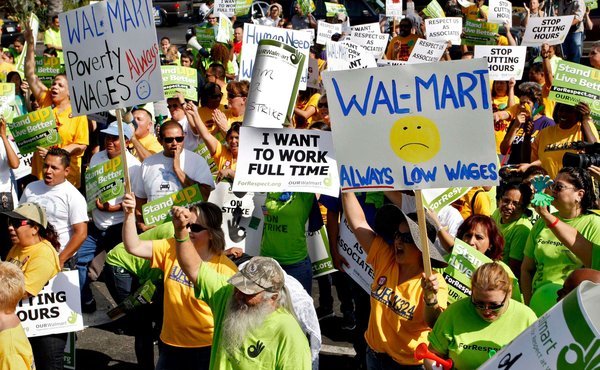
Walmart

^ of course low-paid, at will employees are scared and organizing. Wouldn’t you ?

—- —- —-

The current presidential campaign makes clear to all of us why unions are important and, in most cases, a social plus as well as an economic one.

Wage employees have every reason to worry about job security. Most are very replacable — those who are hard to replace can negotiate an individual contract and thereby acquire well protected rights. Replaceable workers, however, have no such bargain chip. Without the contract protection afforded them only by a union, most can be fired at any time. In law they’re called “at will employees.” and the will involved is the manager’s, not the worker’s.

At-will work is bad work by any standard. What good comes of work done by employees harassed, insecure, distracted, paid little, given no rights ? Those who advocate at-will work see workers wrongly, as a burden and a cost; whereas in fact workers are an enterprise’s most valuable assets.

At-will work is the goal, however, of the hedge speculators who today treat firms as trading blocks.

The existence of this threat is why replaceable workers try to act as a group, by organizing a union, whose leadership then negotiations job terms on behalf of all. Is the power accorded to replaceable workers by unions burdensome for employers ? Some think it is; but why ? I do0n’t think it’s hard to find the reason. Today’s large enterprises — unions only make sense at large ones — are often owned, or pressured, by short term speculators looking yo squeeze value out of the business by various stock market mean and then move on.  Stock market pressures force managements to lay off employees wherever possible, in mergers especially, where the objective is to maximize standardization. Is it any wonder that workers at such enterprises worry about their jobs, their benefits, their pensions ?

Case in point : three or four months ago I saw a lot of angry support for Trump among workers here in Boston.l Then Hillary Clinton came to Faneuil hall and announced a huge, $ 550 billion infrastructure spending plan — a ton of great jobs for the Building Trades folks. Not a peep of worker support for Trump have I seen since.

If we had capitalism in our economy, rather than the current arbitrage dynamic, owners would create long term plans and hold to them, for years and years. Long term planning also places high value on worker retention — turnover is costly and a distraction. In a long-term capitalist economy, workers organized in a union have strong reason to accommodate to managements, as do the Auto Workers; as do the big unions of German big business.

That’s the easy part. Harder by far is the plight of the replaceable worker in an arbitrage economy. She never knows whether her job will still be hers or even if the company she works for will continue to exist. Hardest of all is the situation faced by a worker who has had a secure job in the capitalist economy we used to have, only to find that he now works at the mercy of his firm’s new, arbitrage owners. Of course he is frustrated and angry.

Such a worker has only two choices : one, to be angry and scared and to blame those he sees competing for his arbitraged job; or, second, to help organize a union. The first response is the way of Trump. The second is being done by retail and fast food workers, home health aides, airport workers, hotel workers, and laborers.

Union activists are angry, too; at least that is often how we the public sees them. They have to be, in order to get noticed; nice guy behavior doesn’t get management’s attention. However, as I see it, better by far the organized, confident anger of union members than the anarchic, scared anger of arbitraged non-union workers.

I also happen to believe that the outcome of union activity is better by far than the result of at-will work. Unions bargain much higher wages and benefits for their members than most employers accord to at-will hires. (There are exceptions, thank goodness.) And workers confident of their jobs and their earnings act and vote with much greater stability and discretion than the scared, insecure workers who have flocked to the professional wrestling-type braggadocio of Trump.

All of the above are why I generally support and encourage worker unionization. To which I take two exceptions only : first, most unions are not good at reform. They’re too invested in the hard-fought bargains made to take a chance on re-opening these for change. Second, unions sometimes do abuse their market power, and a few abuse their members. To the second of these, the NLRB has remedial enforcement powers. The first exception, we see happening with public worker unions, as these adjust — often badly — to major structural reforms that often become way overdue because of union resistance. But the fact of these two critiques does not override the larger fact : that well-run unions almost always strengthen a capitalist economy.

—- Mike Freedberg / Here and Sphere
BOSTON SCHOOL BUDGET, 2017 : UNANSWERED QUESTIONS

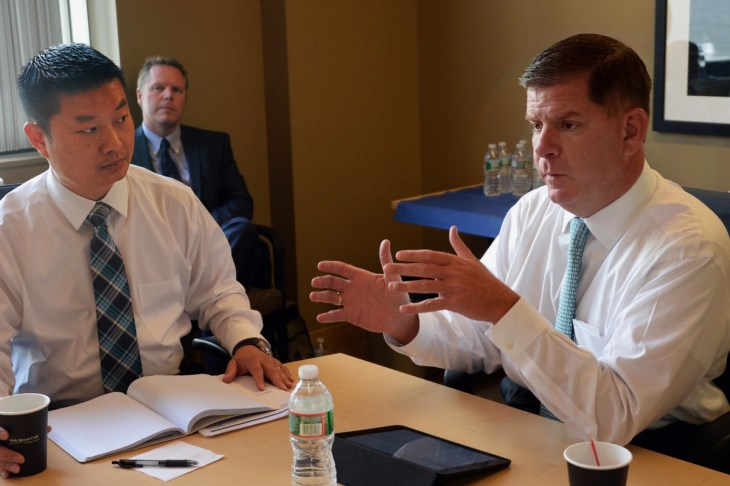
ND4_0515.JPG

^ the man on the right has a plan. The man on the left is taking notes.

—- —- —- —-

This week Boston school Superintendent Tommy Chang announced there would be a $ 50 million shortfall in the upcoming school year budget. The question that I have is, why ?

Chang’s announcement letter tells us his own “why,” and you can read his paragraphs by clicking the link below. Nothing in his letter, however, hints at any answer to my question. (Read Chang’s letter here : http://www.bostonpublicschools.org/site/default.aspx?PageType=3&DomainID=4&ModuleInstanceID=14&ViewID=047E6BE3-6D87-4130-8424-D8E4E9ED6C2A&RenderLoc=0&FlexDataID=9343&PageID=1 )

I’ll get to the reason why I think this shortfall is occurring. Meanwhile, let’s look at some of what Chang actually wrote : “Although the city has increased the budget appropriation for schools by $13.5 million for this year, salary and benefit increases for the School Department are running to $21 million, on top of unforeseen expenses and “investments in core operations, past commitments, and strategic priorities…While the city has continued to invest in the education of our youth, rising expenses are outpacing current revenue sources.

“The projected funding increase will not cover the full cost of our programs and services…especially given our commitment to important investments such as, early childhood education, the hiring of high-quality, diverse teachers and extended learning time.”

Clearly, Chang does not like the upward pressure put upon the school budget by salary and benefit raises. As he writes, these stand directly in opposition to every other item in the budget, some of which are spelled out in the second quoted excerpt.

The contrast that Chang asserts is not new. It was there in John McDonough’s two budgets. It is a fact. School employees form by far the largest dollar item in the city’s schools budget, and it always increases, no matter what. For school employees represented by a union — as are all except management positions — these increases arise from negotiated contracts, and “a deal is a deal is a deal.”

Yet why should unionized school employees’ contracts necessarily cause a $ 50 million budget shortfall ? School employees do not set the school budget, nor, actually, does Superintendent Chang. The Mayor decides the number. Could the Mayor appropriate an additional $ 50 million to his school budget ? Of course he could. Take a look at the City’s FY 2015 budget here : http://www.cityofboston.gov/images_documents/04%20Revenue%20Estimates%20and%20Analysis_tcm3-44075.pdf

We see at this web page that in FY 2015 Boston’s revenue totaled $ 2,73 billion, an increase of $ 121.4 million over previous year. Given the Boston building boom, I doubt that FY 2016’s figures look any worse — probably quite a bit better. The same can almost certainly be said for FY 2017. Nor, in this context, does the billion dollars in tax breaks given to GE, spread over many years, loom very large. So why the $ 50 million school budget shortfall ?

Nothing in writing suggests the answer that occurs to me, but I think it’s quite plain : Mayor Walsh is preparing his response to two major schools events : first, the next teacher’s union contract; and second, his opposition to the Governor’s charter school cap lift.

Mayor Walsh opposes Governor Baker’s charter cap lift bill because — so says Walsh — it comes too soon. Walsh prefers charter cap lift implemented at a later date. An odd request, that. Why so ?

The answer, I think, is that he first wants to negotiate a less inexorable salary and benefits package with the teachers and custodians. To get the public on his side in that negotiation, he is, I think, using his school budget authority to finger teacher and custodian salaries as the bad-guy obstacle to funding everything else that schools must offer.

Walsh also has a second weapon that he is bringing to bear on union employee salaries : his ten year capital budget plan to consolidate 126 smallish schools into 90 larger 0nes. I think that he envisions these 90 larger schools having far fewer custodial employees than today’s 126 smallish schools, and maybe fewer teachers or teacher aides. (Consolidation of school buildings also forecasts far less money spent on energy costs. That saving is a good thing.)

Walsh needs to win this fight, which looks to be intense — last night 300 parents showed up to an “emergency meeting” at School Department headquarters — before he can support charter cap lift, an equally contentious battle, without risking his 2017 re-election.

Complete reorganization of Boston’s schools system is certainly Walsh’s goals, as it is the goal of the city’s employers and of many of the city’s school-kid parents. This cannot possibly be accomplished all at once. You can only reform an entrenched vested interest by chipping away at it, a little at a time. Walsh’s $ 50 million FY 2017 schools short-sheet looks like the first chip in his long term plan.

—- Mike Freedberg / Here and Sphere


GENERAL ELECTRIC COMES TO BOSTON

A sign outside the corporate headquarter

A sign outside the soon to be FORMER corporate headquarters of the General Electric company

—- —- —- —-

It was a front page headline, and it should be. Bringing General Electric’s headquarters to Boston is huge news for our city. There’ll reportedly be 800 jobs right away — doubtless many more to come. As media have pointed out, GE’s move will surely bring sundry other tech-savvy firms to our city.

Some observers credit the presence of Governor baker and his budget-dsicipline agenda or GE’s decison. I applaud Governor Baker, but I don’t see his presence as the cause. I see it and GE’s decision as evidence of these facts :

First, Boston is booming economically and wants to get things done, effectively and well-managed, so that our economy doesn’t face unnecessary obstacles, impediments, contradictions. That’s what Baker is about, and is implementing, and that’s how GE operates, too.

Second, Boston is home to 55 colleges — as GE’s press release mentioned — and world-class technology expertise; and that community of knowledge and innovation, and the ability to make creativity doable are the zeitgeist which generated Baker’s win and GE’s commitment.

Both GE and Baker will now have to see that GE’s presence fuliulls its promise. For GE, the job is under control. The firm merely needs to do what it has already done, with few missteps, ever since Thomas Edison founded it : innovate diligently, exhaustively. Edison is credited with having said that “genius is one tenth inspiration and nine tenths perspiration.” GE well knows how to translate that axiom into successful gadgets.

Baker has by far the harder task ahead. GE’s coming will surely boost Boston’s already high median family income and add to upward pressures on rents and other prices. What will happen to workers not in the technology or GE sphere ? More than ever the $ 15/hour minim um wage is now going to be needed — maybe higher. Will the Governor support an initiative that already has substantial push ? maybe so. I hope he so decides.

That part is the easier for him. Much more difficult is the pressure that GE’s decision puts on the economies of our outlying cities — our so-called “gateway cities.” Boston has already made places like Worcester, Fall River, Spingfield, Fitchburg, and Holyoke look backward. GE’s move widens the gap between them and Boston. Can GE’s move hold any benefit at all or the economies of cities 40, 60, 100 miles from Boston ? I’m not sure how or if.

Yet if GE’s move does not benefit — in some way — our outlying cities, the prosperity gap between them and Boston will widen. Perhaps Baker — and his Secretary of Ecionmoc Development, Jay Ash — c an convince GE to construct some manufacturing facilities in the outlying area. GE once operated a vast factory complex in Pittsfield, a city that has gone through bankruptcy since and needs what GE still has.

That, to me, is the essential. I’m glad, as everyone is, that GE is moving its headuarters tio Boston; but we cannot allow the move to aggravate an income gap already at crisis level.

—- Mike Freedberg / Here and Sphere