GOVERNOR BAKER’S SMART DECISION

CB

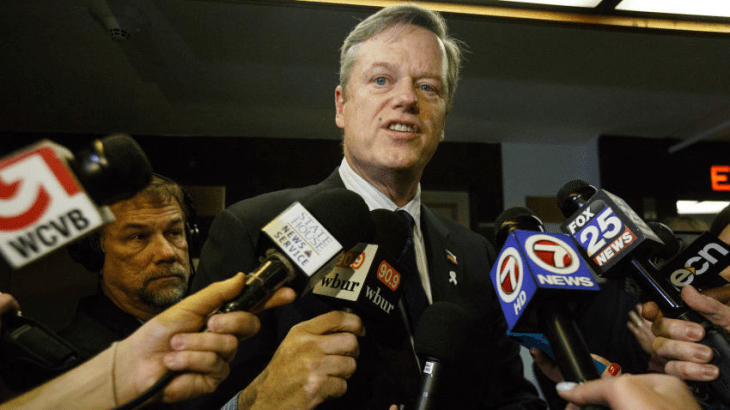
^ Governor Baker : no vote for Donald Trump, no vote for Hillary Clinton

—- —- —-

Three days ago, Governor Baker made his election 2016 decision : he will not vote for Donald Trump nor for Hillary Clinton. We think this the right decision for him to make.

Baker was elected to set Massachusetts state administration right and to chart a new course, of fiscal discipline and effective service. At least 78 percent of his winning 48.5 came fro m voters who are not Republican. These voters did not elect Baker to be a Republican ideologue. They elected him to do the job he is now doing, a job that serves everybody. Injecting himself into a contentious national election can serve no good purpose for him or for us.

Trump partisans don’t like it at all. The comments on facebook run from angry to downright nasty. But a new WBUR/WNEU poll makes clear that Trump partisans are few in Massachusetts. Trump’s favorable-unfavorable numbers stand at 18 / 75 — the exact opposite of Baker’s — and are, says the pollsters, the worst they have ever polled for anyone. Trump rates unfavorable even to Massachusetts Republicans : 51 percent don’t like him. Why should the hugely popular Baker step into this disaster ?

As for Hillary Clinton, what has a Baker vote to offer her ? She will carry Massachusetts by 30 to 38 points, according to recent polls. Baker’s not voting for Clinton costs her nothing, but it does carry out the old political saying, “if you can’t be with me, be neutral.”

Along with his decision to stay neutral in the presidential race, Baker is being critiqued, a bit, because so few GOP candidates are seeking legislative seats this time. Of course Republican activists want to see legislative races contested; but if Trump does in fact lose Massachusetts by 30 points or more, the party will have its hands full trying to avoid losing many of the 34 House and five Senate seats it now holds. Better by far to “hold fire” and go all in next time, when the popular Baker will be up for re-election.

That said, the GOP in Massachusetts simply is not attuned to winning legislative elections except in very Republican-voting areas, which in our state are few. For at least 26 years the Massachusetts GOP has been a “Governor GOP,” great at electing Governors only. The structural and political reasons why this exists are many, and i have written about them at length in these pages. Suffice this time to remind readers that ( 1 ) a Governor has to work with our powerful, overwhelmingly Democratic legislature. He can’t very well work with them while at the same time working to defeat them and ( 2 ) the voters of Massachusetts — 53 percent belong to NO party — don’t care much whether their legislature is Democratic or Republican; they care that it get good things done.

These are the facts. Our state has a politics very different from the politics of every other state. The federal structure of our nation gives Massachusetts full power to go our own way thus. Let us be glad of it. Partisanship has damaged the civic life of many states; partisan agendas have injured many of their citizens. Be glad that our Massachusetts steers very clear of that tempest.

—- Mike Freedberg / Here and Sphere


A SADNESS, BUT NOT A CATASTROPHE

Hillary

^ for the all the Republican-destroying drama of Donald Trump, the Democratic party is the glue that binds the nation’s politics; and it is holding on almost quite well

—- —- —-

Many will want to disagree with our headline. To most GOP leaders, and to many other activist Americans, the conquest of the Republican party by a storm of angry, blatant people who detest our government wreaks cataclysm on one of our two great parties. And they are right : for the GOP, the certain nomination of Donald Trump — John Kasich having quit his campaign just now — means the end of 160 years of well-intentioned reform. The Democratic party, however, remains more or less intact; and for the most part, since 1933, it, not the GOP,m has been the political glue holding the nation together.

The Republican party has almost always been smaller than its opponent. Only the Democrats’ fatal split allowed the GOP to win in 1860; only the secession of eleven states allowed his re-election. As soon as Reconstruction ended, the Democrats became competitive and often won national elections. By 1933 they began a streak of dominance broken only by Dwight Eisenhower and then Ronald Reagan and two Bush presidencies.Even now, with the entire South inside the Republican party, the Democrats control the Electoral college and the demographics; and their control will almost certainly increase. As a result, the collapse of GOP ideology and candidates these past few months has poignancy but not portent. A different opponent than before faces 2016’s Democratic party, but it is hardly a party at all (more a tribe), much less with larger reach.

Trump’s assault upon the GOP’s apparatus, principles, and leaders was not pretty. War never is. He meant to destroy, and he was able to because he had 100 percent name recognition at the outset and an identifiable identity as a heartless taskmaster; and because his vulgar bigotry and insecure bluster matches the traits of a whole host of voters who have, for many years now, felt themselves ignored, disrespected, shafted by those they had expected to lead them. It has always been true that there are far more American voters with small incomes, few prospects, and tainted manners than the opposite; anyone who campaigns a lot sees this. America is not a nation of sophisticates, of smooth professionals and educated reformers. These exist, and wield plenty of influence when they can; but they are way outnumbered by the “most people,” who, 110  years ago, Henry Thoreau said “lead lives of quiet desperation.”

To our politics, Trump is far from unique. In the 1930s vulgar demagogues abounded : think Huey Long, Gerald L. K. Smith, Charles Coughlin. Joe MCCarthy dirtied reputations in the early 1950s. Left wing demagogues helped lose us the war in Vietnam; George Wallace growled segregation and more segregation. Yet these — except for McCarthy at the end of his run –had to deal with a Democratic President, whose party power overtopped theirs. It is different with Trump;. He has savaged the GOP, but the GOP has been, since 2006 at the latest, a fragile party pillared by researchers, tycoons, and theorists : hardly a representative cross section of all America.

The party that Trump has sharked hasn’t much meat on it to sate his hunger. It is home to almost no Blacks, not many Hispanics, few LGBT people, not many Asians. Most Republicans are 50 years old — many much older than that — and overwhelmingly male.  This is not an amazing find. Every observer sees it. The point is that GOP voters exclude almost everyone not compliant to their self-identification. The Republican party is one of dog whistles in every sentence spoken : we are white, we are straight, we are traditionalists, we are Bible readers, etc. This, at least, is what they say.

The GOP has always been a top down, hierarchical party : bosses and workers, ever since the Civil War days. It worked, because America followed its bosses back when Americans believed in the future. Now America despises its bosses : whatever the leaders want must perforce be bad, or a con, or both. Enter Trump, a boss who talks like a worker and has a worker’s gross manners and his ugly resentments, a boss not afraid to toss shade at whomever, where and whenever.

Fortunately for America’s peace, the bottom-up vengeance sought by Trump voters seem vastly outnumbered by those who still follow the Democratic party, still have faith in the future because it is essential Democratic practice to involve its average voters in the mechanism. The current insurgency of Bernie sanders, even at its most abrasive, stops short of excommunicating Hillary voters as some sort of evil turncoat.

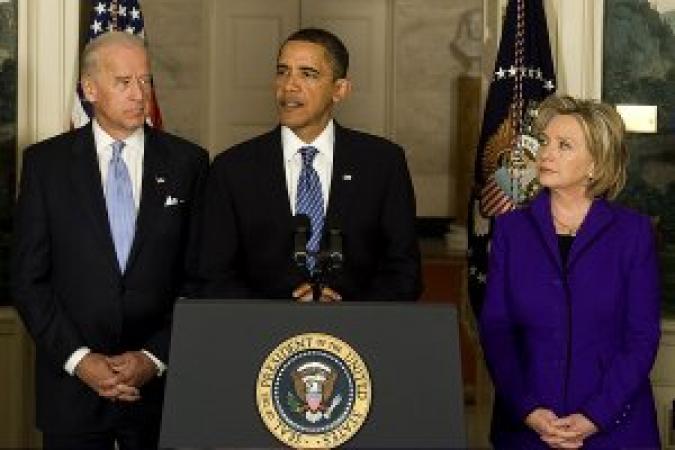
The failure of the GOP portends an almost complete makeover, to which end, it needs a big time-out from this election. There will be terrifying ugliness from Trump and his bitter supporters, but the collapse of America is not coming to a shopping mall near you any time soon. The transition from President Obama to Hillary Clinton may not run as smooth as idealists might like; for the two have large style and policy differences; but these irritations mean very little in the long term or to the direction of policy. The drama and noise on the Republican side is distressing to its activists, no doubt, as it should be; we oursewlves would have liked to see John Kasich have a go at the Presidency. But our disappointment is not the end of things. The Democratic party, swayed somewhat by Senator Sanders, maintains its balance and keeps its eye on the sparrow. The nation will go on, as we know it, holding course with a Democratic helmsman locked onto the future.

—- Mike Freedberg / Here and Sphere

BRINGING BIG ENTERTAINMENTS TO BOSTON

Indycar

^ again, our City fails its test : IndyCar is going to Providence instead

—- —- —-

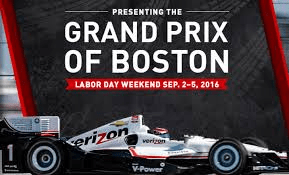
For the second time in less than a year, a big entertainment has been ki-boshed in Boston. We will now not have the IndyCar race that was, we thought, all set for labor Day weekend — and which this writer’s grand-kids were excited about seeing, just as they were almost giddy about seeing the 2024 Olympic games.

Today there’s sadness on my three grand-kids’ faces. As well there should be. Because of the opposition of a very few, who took full advantage of Boston’s clumsy decision making habits, they and thousands of grand-kids like them will now have to travel elsewhere to see shows that we of Boston deserve — more than deserve — to have.

When will the people who govern Boston learn that they cannot submit grand entertainments to the sharks who lurk in the waters of so-called “community,” arrogating to themselves the desires and interests of thousands who did not elect them or appoint them to speak ?

Did not City officials learn from the amateurism of catastrophe that squashed the prospects of “Boston 2024” ? Did they not see that to invite “public comment:” on grand plans is to assemble into a poisonous swarm a host of wasp-sized NIMBYs who, singly, couldn’t sting their way out of a plastic bag ?

Evidently City officials did not learn. Will they learn now ? And take steps to assure that future entertainments will sweep onto the scene before the wasps can swarm, before the stings can get their arsenal, of poisons into place ?

There was some reason, actually, to look skeptically upon Boston 2o24 : its plans were far from worked out when submitted, prematurely, to a public whose doubts the 2024 committee had no idea existed. Perhaps those justified doubts allowed City officials to conclude that no such could possibly attach to IndyCar, which did not include a plan to rebuild an entire neighborhood (Widett Circle). Unfortunately, City officials were wrong.

A year ago I wrote, in these pages, that the long standing BRA process of public comment on proposed developments has lost its usefulness; that it has become a vehicle for opposition to stop stuff, nothing more. Proponents must spend major time and effort gathering support and bringing it to the public comment hearings; if they do not do that, they’re finished : because the opposition always shows up, whereas supporters usually don’t see the need to surrender an evening’s quality time for the sake of a decision they see no problem with.  So it was with IndyCar, magnified many times by the many land-use jurisdictions involved.

I wrote then that the BRA’s development approval process needs radically to be changed; that the online, all-entry system used by imagineBoston2030 was the correct way to solicit and secure public approval. Online, the wasps of opposition get swamped by the vast numbers of people who like development and entertainment. As it should be. Opponents of change talk a lot about “residents”; but neighborhoods serve many interests, not just those of residents. Neighborhoods also serve businesses, customers, visitors, commuters. Why are these interests any less vital than that of such residents as spurn them ? In a big City, you takes your chances; you live in it knowing that you share it with all manner of stuff. If you don’t get that, maybe you shouldn’t reside in a big city at all ?

So what do I recommend to City officials ? So that the next IndyCar that comes along, happens ? Perhaps these steps :

1.Gather all the jursidictional approvals before any public unveiling is attempted.

2.Use eminent domain, if need be, to take proprietary 9albeit temporary) command of the land upon which such entertainments are to play.

3.Use the power of the Mayor’s office to push ordinances through the City Council establishing such entertainments, their location and dates and the parameters of each.

Mayor Walsh has said that he admires Montreal and sees its festivals — which almost always take place in the heart of Downtown and adjacents — as a model for future Boston. I agree; but Montreal City government has the full support of major corporations, Quebec’s province government and that of Canada, financially as well, as it schedules and hosts dozens of festivals set right in the middle of Downtown and everywhere adjacent. The people of Montreal take in millions of tourist and visitor dollars happily spent by millions of festival-goers, who crowd Downtown to the walls, diverting traffic and jamming up the city. I don’t have space enough here to list all the fsestivals that Montreal hosts every year,nor can I count the system that Montrealers seem very happy to take full advantage of.

Unfortunately, Boston people have no clue what it means to be Montreal. The worst failing of America is its isolation from what is going on in other nations and places. Isolation has been our savior in wars; but in the economic world of now, innovating every life aspect, isolation leaves us rather clueless. We will not become Montreal any time soon; it will be difficult even to begin moving Boston in that direction, and impossible to do so unless Mayor Walsh take steps to collapse the toe-jam barriers of “no” that pip and pop to stop us.

—- Mike Freedberg / Here and Sphere


WE MUST COMMIT TO PAY FOR CRIMINAL JUSTICE REFORM

chrispoulos

^ it costs money to assure equal justice to all : from the Sentencing Project article cited below : Chris Poulos with Glenn Martin of Just Leadership, USA

—- —- —- —-

Well-intentioned activists talk these days about the need for criminal justice reform. Some are even working on specific proposals, legislation, objectives. I approve it all; but we cannot kid ourselves : criminal justice reform will; cost money. A lot of money. I doubt we as a society are ready to hear it, much less to commit to it; nonetheless, here I go:

1.A story that I found on my facebook wall this morning makes painfully clear that criminal justice is all about the money. Read how Chris Poulos, who could afford a private lawyer won a decidedly much better outcome than if he had had t9 use bar-appointed counsel : http://www.sentencingproject.org/stories/christopher-poulos

Had Poulos stuck with bar-appointed counsel, he would have sunk into prison life — an eight year sentence as opposed to three — and probably that would have been it. Whereas today he is about to graduate from law school and take his place as a n attorney. Which is the sort of outcome we should want for drug offenders (and others not heinous) who fall afoul of criminal justice. But who will pay for bar-appointed counsel, sufficiently that he or she devotes serious effort to cases they take on ? Today, in MA at least, bar-appointed lawyers are pay little and have to wait for almost a year — sometimes longer — to receive even that little.

The 14th Amendment to our Constitution guarantees equal protection of the laws to all residents of this nation; but Constitutional guarantees are only as good as the credit given them by the guarantors : we the citizens who live by that Constitution. Plenty of people, on the political right especially, talk about the Constitution a lot, but usually such talk is of rights and limitation : almost none of the obligations that the Constitution imposes on us who live by it. We must begin to have that talk.

Criminal justice reform will cost a ton of money. If you read my list of basic and essential reforms, as itemized next, you’ll figure that out petty quickly :

1.The Constitution guarantees counsel to all accused, of offenses that impose imprisonment punishments. This guarantee doesn’t mean much if said counsel is ineffective, or so poorly paid that he or she can’t devote the necessary time to a case, or whose appointed case load is so heavy that the same inadequacy results. Courts are already releasing accused because they can’t get effective or timely counsel. Is that the result that we want ? I doubt it. We need to fund the counsel guarantee we have made, in writing, in the Constitution, because the obligation was one we freely took on and for very good reason. Doing so might add as much as $ 35 million per year to our State budget.

2.Imprisonment is punishment enough. No prison should be administered by guards and wardens who rule by terror. Nor should there ever be privately-run, for profit prisons. Granted that it’s default easy for prison administrators to rule by violence and terror. They re dealing with often violent men maddened by prison confinements to an unbearable degree, men who do horrifying things to one another in the blink of an eye. Still, there is no justification for prison rule to tolerate intentional cruelty, denial of medical services, solitary confinements, bribes, extortion, informants, and beatings. Diligence on duty — interactions that can be trusted — should be prison administration’s first priority; next comes proper classification of inmates, and small cell blocks, so that imprisoned people have less opportunity, or occasion, to harm, one another.

3.Prisoners often go out on work details. Other are hired for jobs within the prison. Can somebody tell me by what legal theory they are not entitled to the benefits of minimum wage laws ?

4.No municipality should ever be allowed to fund its budget by way of traffic fines, bail bonds, and other costs imposed upon those it treats as offenders. Civil rights prosecutions of officials who use such shakedowns must be vigorous and ongoing, so that a heinous practice, the very opposite of “equal protection,” and deeply embedded in our nation’s ways of screwing poor people,. can be driven out.

5.In Germany, so I have read, the principle governing prison administration is that if the prisoner doesn’t make it, back into society, it is the administration’s fault, not the prisoner’s. Why can’t that principle govern our prisons here in America ?

6.Why do we keep in prison people who are elderly and often in need of 24 hour care (which many do not get) ? The cost of keeping 70 to 95 year old prisoners is enormous. Can’t that money be better used to pay Constitutionally guaranteed counsel ? Better trained and schooled prison guards ? In-prison education for inmates ? Accepting minimum wage laws for prisoner work ? Paying bail bondsmen, so that the person being bailed — who likely hasn’t the money — doesn’t have to pay ? (All too often, the person being bailed has to ask his family, if he has one ready, or a friend, to use the week’s food money, or the electric bill, to pay the bondsman’s fee.)

Too much of our criminal justice action arises from revenge, from anger. I understand the emotions of both; but anger does not make whole the injured victim, nor does revenge do any good except, maybe, to the soul of the avenger — and that I doubt strongly. This is why forgiveness is a basic principle of our great religions : the crime must be expunged from one’s heart, and by the community at large, rather than being the starting point for payback. Forgiveness does not mean no culpability. But it do0es mean that the society will not ingest the crime into its future duties.

I doubt that the above principle will ever be fully embraced by the good versus evil gunfight culture whose kept oaths hold us in thrall.

Life is about the future. If it is about oaths, may they be oaths to do better, not to make a right out of two wrongs.

Have we the courage to live up to the Constitutional commitments we have made in this regard ? I hope that pretty soon we will find out.

—- Mike Freedberg / Here and Sphere


ATTENTION TO DETAIL

MBTA card

^ changing the way MBTA fares are paid, so that $ 42 million a year doesn’t disappear

—- —- —-

If there’s anything about Governor Baker that frustrates many people, it’s his caution. Impulsive, he is not. In a hurry, never. In the matter of the transgender rights public accommodations bill now pending, caution has buffeted him — has irked me too. Yet caution usually serves Baker well. He plays the long game, which is the only game that outlasts the dogged resistance of vested interests needing major reform. One thinks of public schools budgets.

Fixing the MBTA will be a long game. This we already knew. Every month seems to uncover yet another money sinkhole. Add fare collection misfeasance to the rest. One problem after another — for the Fiscal Control board, the day to day process management, the T employees’ Pension fund directors. What will be next ?

If the reports are true — that fare collection failure costs the T about $ 42 million — it’s obviously a crisis as serious as management failures highlighted at DCF. How does $ 42 million of rider fares go uncollected ? If I recall, in the Sherlock Holmes story “The Adventure of the Bruce-Partington Plans,” the solution to the crime turns on the impossibility of a rider entering  London subway carriage without a ticket. That was more than 100 years ago. How is it that in 2016, in Boston, $ 42 million of fares can enter a bus, subway, or commuter rail without a paid ticket ?

On the commuter rail, conductors collect — or do not collect — fares. Why do we depend on on-board fare collectors ? Why can’t it be as difficult to enter a commuter train without paying first as it is for the subway ? Same goes for the buses. The driver collects fares. Why should he or she have to do this ? it’s hard enough to drive a big bus through Boston traffic without one’s having to monitor the fare payment of every passenger boarding.

Why can’t the T expand its “Charlie card” program to embrace all T fares ? Make “Add value” to your card the only way to pay. Enter train, bus or subway, swipe your card. If there’s “no enough value” on it, you do not board.

It seems actually that this reform is on the way. Read the story I have linked here : https://www.boston.com/news/local-news/2016/03/28/the-way-you-pay-to-ride-the-mbta-could-change-pretty-quickly

The “conductors” on board commuter trains can be put to work caring for passengers’ needs and comfort. Install free wi-fi in every commuter car, school the “conductors” to be basic tech support people. Let the “conductors” keep the wi-fi online. That would be a far more useful application of their work time than fare collection.

It will doubtless take a long time to establish this work rule change, not to mention the systems installations required. There will surely be opposition every step of the way — because change is difficult, as said John McDonough, Boston’s excellent interim schools superintendent. McDonough played the long game : radical reform, taken one seemingly simple step at a time. That is Governor baker’s method, too. It’s the only way. Bring about huge change in steps so small that one hardly notices the difference in each. They add up, though ! Continents change enormously, don ‘t they ? It takes millions of years, but they alter completely. That is how the baker tactic approaches reform. It may seem sleepy, or boring; but over the extent of its time, it isn’t boring at all. It is enormous transformation.

And now to fix the MBTA Employees’ pension fund, which seemingly over-promises, only to fall prey to disappointments that cost the taxpayer. The reports say the shortfall, is $ 8 million a year. Of taxpayer money., required because T employees contribute a mere five and a half percent (5.5 %) of the required pension fund pay-ins.

—- Mike Freedberg / Here and Sphere

TO BIND OUR NATION, EXPAND VOTING

McAulkiffe

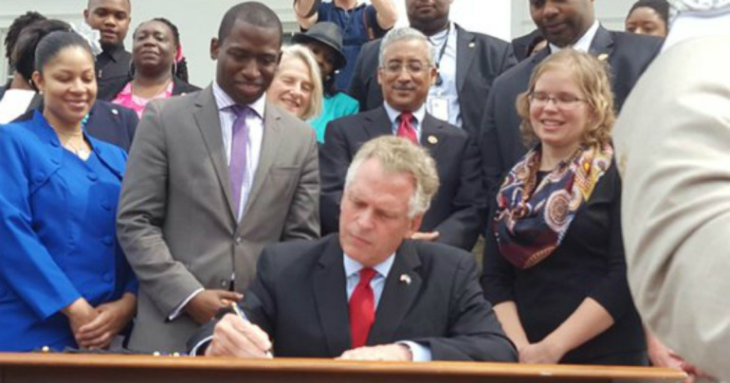
Virginia Governor Terry McAuliffe yesterday issued an executive order restoring the right to vote to all his state’s felons who have completed their sentences. 200,000 appear to be eligible pursuant to the order.

McAuliffe said that his order would finish the work begun by President Lincoln’s 1863 Emancipation Proclamation; that Virginia especially had lagged in this regard. He is right to so say; but that is far from the entire story as I see it.

Voting rights are fundamental to our democracy. Every citizen adult should have them, and safeguarded zealously. And voting rights have importance well beyond the duties of citizenship.

Nothing in our nation’s life more surely commits immigrants to our values than the right to vote. Not language, not religion (or lack thereof), not headscarves or no headscarves, not cuisine or national origin : none of these commit a person to our national soul the way the right to vote does.

When you possess the right to vote, and have actually registered as a voter, candidates seek you out, talk to you, visit you and shake your hand. Your opinion is asked. Your vote is asked for. You become important to the body politic and the entire community that elects it and which it serves. Active in campaigns for decades, I have seen close up the difference in  connection, attitude, and awareness between people who vote and those who aren’t even registered. Long ago, I coached youth sports. We liked to say that engagement in organized sports kept kids from trouble. That was mostly true; and to an even larger degree, participation in voting keeps residents of o0ur nation committed to its laws and ways.

I therefore congratulate Governor McAuliffe. Let his act be a model for Governors everywhere in our nation; and for all of us who make and administer the laws and organizations that create our nation. Let us extend the right to vote to all citizens and see that they register to exercise a right more basic to what we are than anything else you can think of.

—- Mike Freedbrerg / Here and Sphere


SO THERE IT IS …..

Baker

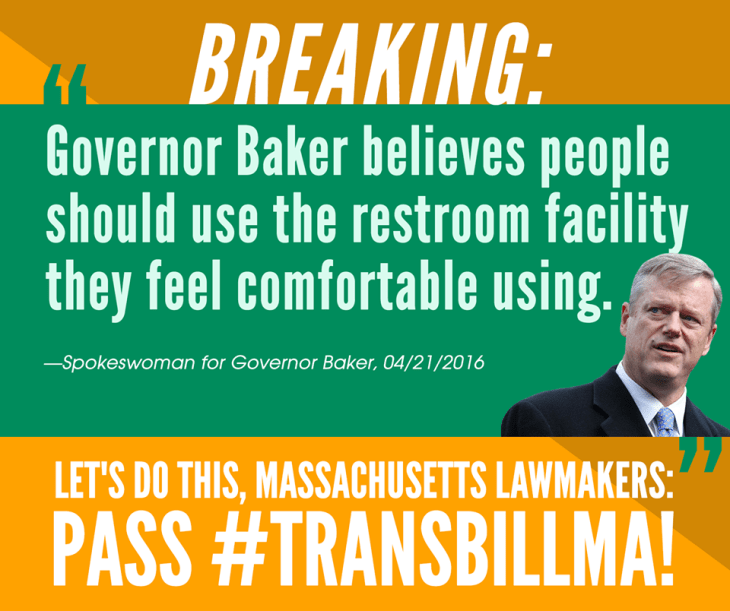
Yes indeed, dear readers. Today, there it is : the statement by Governor Baker relative to bathroom usage, that so many of us have waited so long to hear, the waiting whereof has given rise to much froth and growling, a bit of Alinsky, and a plunk of partisan plonk.

Said Baker via his spokesgal Lizzie Guyton : “people should use the restroom they feel comfortable using.”

And with that simple statement, the “#TransBillMA” now becomes the legislature’s work to pass., and pass with all due speed. So that an issue that should never have become an issue can once again not be an issue any longer.

Thank you, Governor Baker !

The flap about where this or that sort of person should pee has definitely puzzled me. How did it become an issue ? In the 13 Massachusetts communities where Baker’s nine word statement are already the law, where a person chooses to pee has given rise to exactly nothing at all. Or, as one county Sheriff in North Carolina — which state adopted a law telling people which bathroom to pee in — said, “:in my 40 years as Sheriff I’ve never heard of an assault in a bathroom by a transgender. It is a non issue.”

So0 how did this non-issue become an issue ? I do not know. I do know that various media and assorted attention-grabbers have taken to warning us about predators masquerading as transgender in order to assault, little girls in bathrooms. How did this illusion gain traction ? Probably by the same route that horror movies grab : by presenting a kind of narrative hypothetical, backed by imagery, that creates a rhetorical reality overtopping the real reality. Nor is this device new. The 1692 witchcraft scare in Salem, that led to the death by hanging of 20 innocents and the imprisonment of hundreds, grew upon a similar hypothetical narrative bolstered by rhetorical imagery. More recently, in the 1980s, the day care child abuse hysteria exhibited the same devices.

People sometimes want to believe the worst. In times of insecurity, all manner of threats take on a life unjustified by facts. Possibility is all that is needed to be heard; facts get pushed aside. And so the spectre of predators masquerading to assault little girls has haunted much of the nation.

A ridiculous spectre it is ! Impersonate a transgender ? Really ? Stop for a while and ponder just how difficult it is to impersonate a transgender person. Those who would attempt it have first to get to know real transgender people. Presumably, the impersonator would have to be able to “pass,” otherwise he’d never get near a girl’s bathroom. But how is someone who knows nothing about how transpeople transition even begin to grasp how to pretend it ? Of course, merely to ask such questions is to go too far; .the people who believe the transgender impersonator bogeyman have no idea what a transgender person is actually like. Thus any spectre will do, no matter how impossible.

Eventually, hypothetical realities are seen for the fakes they are. Witchcraft trials ended in apology, the day care child abuse hysteria made prosecutors look dangerous; the same will be true of the bathroom assault bogeymen. Transgender people will be able to pee where they feel comfortable doing so, and life will go on as it does do despite all the hassle some of us want to tattoo into it.

In the fight to beat back this latest hysteria there have been many heroes besides Governor Baker. Big business has played a key role; so have District Attorneys, police chiefs, sports teams, parents of transgender children. Especially brave and persuasive have been transgender spokespeople themselves; Attorney General Maura Healey made their cause hers, personally as well as politically. And now, the Governor.

This is a good day in Massachusetts.

— Mike Freedberg / Here and Sphere


PRINCE ROGERS NELSON, 1958-2016

Our “Feelin’ the Music” critic writes this appraisal of the music of Prince, who died yesterday aged 57.

hereandsphere's avatarFEELIN' THE MUSIC------------

prince-planet-earth

^ the entire planet and all of its region were Prince’s musical playground

—- —- —-

It was in 1979 that I first saw Prince, at the Paradise Rock Club in Boston. He was barely 21 years old but had already made a second album, epoynymously Prince, following a first LP named For You, whose sound I had already taken intensely to heart thanks to tracks like “Soft and Wet,” “Crazy for You,m” “Baby,” and “Just As Long As We’re Together.” The second LP was just as fierce — we all know its hits, “I Wanna Be Your Lover,” “Sexy Dancer,” “Why You Wanna Treat Me So bad” — and that night at the Paradise he performed them. And never again was music the same for me. He had footprint and a walk, as an R & B master must, and he had a voice all his own too…

View original post 467 more words

THE DIFFERENCE BETWEN VOTING AND NOT VOTING

FullSizeRender

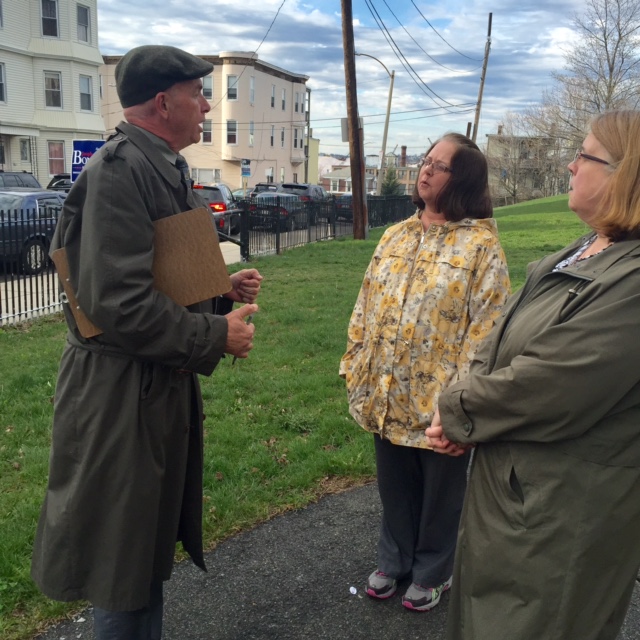
^ Register of Deeds candidate Paul Nutting seeking nomination paper signatures : can’t get them from non voters …

—- —- —-

In local elections here in Massachusetts, hardly anyone votes. Even for Governor, or for Mayor of Boston, only about 37.5 percent of registered voters cast ballots; and not very eligible adult is registered. In the recent special election, to choose a new State Senator for the District I vote in, with no less than seven (7) candidates seeking, barely 17 percent of registered voters participated. The turnout in the Town of Winthrop was about 45 percent, in the rest of the District, barely 12 percent. Add the unregistered, and the actual participating portion might be fewer than one adult in ten.

That so few people vote has major consequences : vested interests almost completely control the outcome. Yet people do not seem to mind, even though they constantly complain about how the system is “rigged.” It is not rigged; but if people do not vote, rigging has an easy path.

For those whose work is politics, or government, those who do not vote do not exist. Same for eligibles who do not register. Candidates go to voters who actually vote : why should they NOT do that ? If you do not vote, you can’t help a candidate win. Campaigns have limited time; it’s hard enough to get to the 12 percent of Boston voters — about 50,000 — who actually do vote all the time — so-called “super voters” — much less trying to reach voters who don’t vote much or at all. The result is that campaigns as a matter of course stick to “super voters” and avoid everyone else; and the more campaigns in which only “super voters” are reached, the less everyone else feels connected to the entire election system. No wonder that, at the local level, we are becoming less a democracy and more an oligarchy.

Non-participation by most voters even affects Presidential elections. Two generations ago, 80 to 90 percent (sometimes even more) of voters balloted for President; today the figure is more like two-thirds. No wonder that so many voters — and all who don’t register at all — feel that our government is not ours.

Yet the dynamics of voting and of government run on paradox, or, should I say, a series of paradoxes, by the divergences of which non-voters find themselves torn :

First : “my one vote doesn’t count.” Not by itself it doesn’t, but in community with the 10,000s of citizens like you, it counts for everything. Politicians don’t only attend to one “super voter” at a time; they are well aware of which communities have many “super voters”: and which do not. Communities with many “super voters” have a whole lot more collective influence than communities with few such.

Second : “the lobbyists decide everything, so why bother ?” Lobbyists do decide a lot of what is done in City Halls and in the legislature. But those who get lobbied are well aware of the “super voter” communities in their Districts and how they will react to this or that lobbed point of view.

Third : voting is not as easy as the civics books tell us it is. You have to register, which means that you have to know here and how to do so, including knowing what identification you will need to produce. Second, once registered, you have to know WHERE to vote, and when. Third, you need to be familiar with the type of ballot used in your voting place. Fourth, you have to feel comfortable about registering, voting, and ball0ting. and about the various officials you will answer to do at each step of the process : officials who you probably do not know and in many cases do not look like you or speak your native language. The opportunities are many for feeling not quite at ease with, or belonging to, the voting system.

Fourth : if your vote counts, as all those wonderful public service posters tell you, how come no one ever asks you to vote for him or her ? If you’re a sometime voter, or newly registered, you are not on a “super voter” list and thus — from a campaign point of view — are a second priority at best. Long ago, local campaigns used to acquire the “supplementary” list, of newly registered voters, and send them a special  mailing welcoming them to the voting process and asking for a vote. Today, few campaigns have the money for such a mailing, and even fewer have a volunteer force available to get such a mailing ready. Most campaigns mailings today are done by professional mail companies. Forty years ago, volunteers did them all : hundreds of volunteers would gather in a huge room and spend hours and hours “doing a mailing.” Volunteers who did that became very, very committed, physically, to the campaign; it was almost a necessity for them to go around their neighborhood talking about the campaign they were in. Today, people do not do that because they work twelve hours a day to pay their bills, or because they aren’t asked, or both. And as the degree of bodily campaign participation has fallen, so has the degree of voting. Forty years ago, most campaign vo0lunteers were adults. Today, most are students : because the adults are out working two jobs, or overtime, and haven’t time to campaign for anyone, maybe not even to vote.

Today, campaigns rely not on staff but on consultants. Campaign specialists know a great deal about micro-targeting voting preferences and about how to frame  campaign messages visually, about opposition research, about design and polling; and yes, all of these are helpful; but the first weapons a candidate needs are staff to do the basic record keeping and outreach, supporters to hold “meet and greets” and to help door-knock, a personal aide to drive the candidate to places and to accompany him or her in all that he or she does, and a solid presence among influential people in the district. It takes years to assemble all these; no consultant can wave a wand and gather it. Consultants are a kind of short cut; and in campaigns there are no short cuts : every voter has one vote to give, and every voter needs to be asked, separately, for his or her vote.

Short cuts are the bane of voter participation. About 20 years ago one of the laziest of short cuts, the “stand out,” became de rigeur. There isn’t much physical effort involved in standing at an intersection holding a sign; but somehow candidates have come to feel that stand-outs are an apple pie thing : waving at drivers who are trying to pay attention to the road, not at you, and who probably don’t live in the district anyway. But “standing out” is easier than door knocking house to house , or than phone-banking, and so stand-outs become the big thing even though to my mind they are almost complete waste of signs and of people. Stand-outs also send the the wrong message to maybe-voters. To vote, you have, physically, to GO TO a voting place and DO the act of balloting. Standing out symbolizes nothing of the kind. If anything, it sends a negative message to voters : ‘we’re here, and you are not. We belong; you don’t.”

To sum up : if only a small percent of adults register AND vote, the people who constitute a special interest group control the outcome : almost always to the detriment of the average voter. Democracy is supposed to be the voice of ALL the people, not just of a special few. Not voting – and perforce, not registering — assures that democracy will look like something you and I and Tom, Dick, Jane and Lisa down the street do not belong to and probably should be very suspicious of. We are at that point now.

—- Mike Freedberg / Here and Sphere

CAUTION MISAPPLIED

1 Baker Booed

^ Governor Baker booed at Spirit’s LGBT Networking event : refusing to lead, you get led. But why did he let this happen to him ?

—- —- —-

Governor Baker’s basic governing strategy is caution. Take no step without knowing all the likely consequences. Be prepared.

It’s a wise principle, prevents Baker from stepping into all kinds of quicksand. But on the matter of public accommodations protection for transgender people, caution has landed Baker in a quagmire.

I have no idea why he has ended up here. I thought I understood his reasons for waiting to take a position. I figured that he did not want to raise a social issue during the long months that he took to battle, and defeat, the social conservative, special interest group whose consultant took over the state’s GOP back in 2012. I assumed, too,  that having won this battle, Baker intended to speak at Spirit magazine’s LGBT Networking gala for the specific purpose of proclaiming support for that “Trans Bill.” I was wrong.

Baker might easily have chosen to fight his GOP state committee control battle on the social issues. There was an entire army of Massachusetts Republican activists, committed to Baker’s team, who were ready and even anxious to fight that fight on the actual matters dividing Baker from his opponents, and not on the anodyne “teamwork” rubric that euphemized what was really going on. It would have beem much, much better for him had he taken that route. He would have won a clear victory, ON THE ISSUES, rather than a merely tactical success, and he would not now be in the squeeze.

Instead, he played it safe.

So what Is going on here ? What IS Governor Baker’s thinking ? Did he really think that, given what is happening to trans people’s rights in Southern states, and his refusal to take a poisition on our own “trans bill,” that transpeople at the Spirit gathering would not voice displeasure ? If he thought that, he — who famously states that he discusses major issues with his staff — is not being well advised. Or else he himself does not understand what being a transperson is all about.

Transgender is a fact and a mystery about both of which many people find themselves bewildered. Discovering that one is transgendered is bewildering to many transgender people too. The ordinary practices of social custom have never prepared a transperson for dealing with his or her gender. Our society is still working out how to represent transgender  in social interactions. Even the pronouns of it are in flux. Still, the fact of transgender stands, for people who are it and those who meet up with it; and that social learning is well along now and cannot, dare not, be reversed.

All of the main arguments opposing transgender people’s civil rights amount to denying that transgender people exist. The argument most mistaken, it seems to me, is the claim that a person is not transgender unless he or she has had sex reassignemt surgery (commonly called “SRS”). Gender is not sex, is not one’s chromosomes, is not physical at all. It is of the mind and of the soul, it is of identity. SRS cannot change a person’s gender, only their bodies; transgender is not about the body. Many transpeople choose not to go through SRS. Why should they ? If you are a woman, your body is a woman’s body. And vice versa.

It would be quite understandable to know that Governor Baker hasn’t figured out transgender. Nor would I expect him to say that if that is the case. But grasping a situation is not the same as the politics of it. The politics of the “Trans Bill,” I DO expect Governor Baker to master, and to lead. I have no idea why on the “trans bill” he has made himself a kind of hermit.

The booing that stopped Baker’s Spirit speech ws not spontaneous. In the midst of the protestors were hyper-partisan, Democratic operatives looking for pounds of Baker’s political flesh. They have been carping at Baker all along, have done so on MBTA reform, and on charter schools cap lift; but until now, nothing they did or said bruised Baker at all. That has changed. And that is his faiult. Caution may have much to recommed it, but about the “trans bill” the time for caution has ended.

It ended when police chiefs, the Suffolk County District attpoery, and the state’s Attorney General all testified in favor of the Trans Bill. It ended when every Boston sports team said Yes to the Trans Bill; when 150 major busineses joined in, and 350 faith leaders; when the Boston City Council voted unaimously to support the bill.

Governor Baker’s silence on the issue has also stopped House Speaker DeLeo. DeLeo supports the bill; but he is clearly chary to bring it forward only to be embarrassed by a reluctant Governor. Until now, DeLeo and Baker have worked hand in hand on every significant legislative matter, including the “no new taxes, no new fees” state budget. DeLeo does ot want that partnership to weaken, given that the State Senate under Stanley Rosenberg’s leadership has gone its own way. Yet the DeLeo and Baker relationship may loosen, given that the Trans Bill will now be voted by the Senate. Even the all powerful Speaker dares not table a bill that has become a symbol for the entire State of social progress.

It need not have come to this. hyper-partisanship, in particular, is the enemy of common sense goverment, of reasonable reform. it is a political sin to allow partisanship, beaten down so successfully, to rise from its well-deserved grave.

—- Mike Freederg / Here and Sphere