SCHOOLS AND THE “T” : A TALE OF TWO REFORMS

FullSizeRender(1)

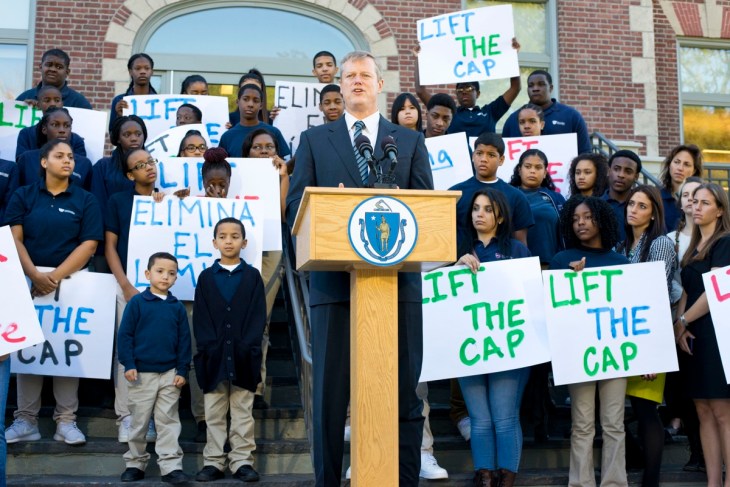
^^ New WBUR poll has the “Yes on 2” ballot question losing 48 to 41. Despite being led by Governor baker. Why that is, we discuss in this article.

—- —- —-

Reconfiguration of the state’s mass transit system, the MBTA, is proceeding full force. Costs and the interests of riders and taxpayers now take precedence over systemic inefficiencies and employees’ manipulations. There’s still an operating deficit, and much repair work unfinished, and management procedures remain unrationalized, but the direction is clear now : your public transit system will deliver you a dollar of service for every dollar of revenue.

Some may question the prospect of operational privatization — I question it too; why NOT invest in upgrading the T’s cashroom equipment, for example ? — but the T now has to prove itself to the riding and taxpaying public : and that is what systems that rely on public money  MUST do. Never should publicly funded systems be allowed to pursue their own path unquestioned, taken for granted. That they frequently come to ignore the public is because any system you can think of for public monitoring of systems is clumsy. The public can only hold publicly funded systems accountable by electing, or refusing to re-0elecvt, office holders charged with monitoring and budgeting responsibility; yet such elections only happen every two or four years and are usually decided on a banquet of issues in which monitori8ng the T, for example, ois on ly one ingredient and rarely the chiefest.

The only reason that Governor baker has been able, politically, to remake the MBTA is that the entire system failed during Winter 2015 — and failed in a very public way. Baker thus had a free hand to do whatever he thought best, to make the T work again.

It’s sort of a political axiom : when reform of a publicly funded system run by an entrenched work-custom culture is needed, it isn’t likely to happen unless there’s complete, T-type collapse. Example : the fight to reform our taxpayer-funded schools system. A new WBUR poll indicates that the ballot initiative by which limitation on charter school authorization will be lifted is losing : 48 percent say no, only 41 percent say yes. Two months ago the numbers were very different : then it was 53 percent yes, about 35 percent no. Why the change ?

There are two answers. The easier is that the “No” people have manged to convince a majority of voters that expanding the number of charter schools means taking money away from standard public schools. This is a lie easy to refute — if a student moves from standard school to charter school, that’s one less student the standard district needs to budget for; so instead of taking money away from the standard schools, charters actually free up standard schools money for better uses. (of course that does not happen; and why ? Because the unions that control schools hiring, work rules, and even facilities maintenance refuse to downsize their staffs or allow for closing under utilized facilities.)

The more difficult answer to why schools reform may fail, where T reform became unstoppable, is that the standard school system has not collapsed. Though it fails many, especially students of color and immigrants, the majority of school districts do an OK job for most parents and their kids. Thus many voters do not see the problem; but they do know that, in most municipalities, the schools system takes up almost half the tax assessed to them; and they do not want to hear that a reform whose necessity they don’t see may force their taxes higher.

All this would surely change were the standard school systems to collapse as did the T. Absent that failure, it is difficult to see how the entrenched feather bedding, facilities absurdity, and work rule backwardness of many publicly funded schools systems can be reformed. Perhaps the one WBUR poll released toady will be turned by another polling agency’s findings. But as long as the campaign for charter reform sweet-talks the parents of color issue and pussy-foots the cynical self-serving endemic to unreformed school districts, the “Yes on 2” campaign doesn’t get it.

—- Mike Freedberg / Here and Sphere

STATE PRIMARY ELECTION: SOME OBSERVATIONS

fullsizerender

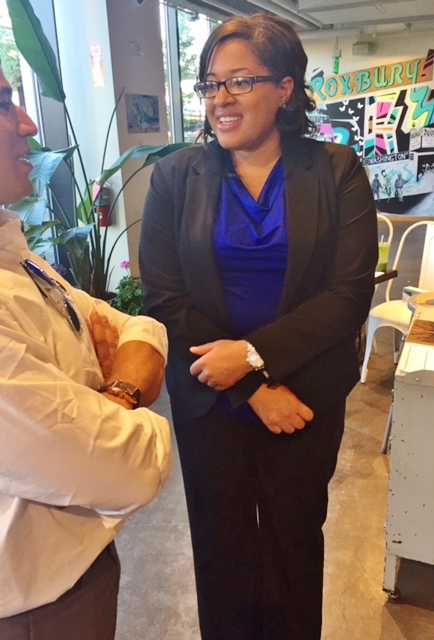
^ A win for the good guys, but on a very small vote : Chynah Tyler will represent the 7th Suffolk State Representative District

—- —- —-

If barely ten percent of the state’s voters participate in our elections, what does that say about democracy ? What does it say, that the majority of those who voted were over 50 ?

One might conclude that there won’t even BE a democracy here much longer.

My statement reads rash, but consider the facts : ( 1 ) few if any campaigns go to all the voters; the mantra is “super voters,” those who always vote. Nobody else even exists ( 2 ) vast pools of PAC money fund selected candidates with dollars that other candidates could never raise ( 3 ) special interests dominate volunteer cadres and thus the entire primary, because if only ten percent of voters vote, the special interests overwhelm. Given these facts, why should the ordinary voter vote ?

During the Primary I oversaw the candidacy of Alex Rhalimi, who ran for Suffolk County Sheriff against the well known present Sheriff, Steve Tompkins. Suffolk County is large, far too large to knock on every voter’s door; but in our targeted neighborhoods, the candidate DID knock on every eligible voting door (he ran in the Democratic Primary, thus Republican voters were not campaigned to). My view is that if you are a registered voter, you deserve to be campaigned to, whether or not you’re a “super voter.” Why should a voter vote if the candidate(s) do not ask for his or her vote ? How do you think a voter becomes a “super voter” if not by being personally campaigned to ? Of course funds are just as important as door knocking. The candidate also needs to follow up his door work. Without serious funding, that’s almost impossible to do : mailings, advertising, staffing, a GOTV phone call on election day. None gets done without significant campaign funds, and Rhalimi, like every candidate not backed by a PAC, raised insufficient campaign money to do it.

But I am not here to write about just that one campaign. I mean to speak generally. The decision of most candidates to campaign only to “super voters” is a major reason why we have Trump. It’s bad enough that the economy, and the culture, have seemed to leave behind many thousands of voters who see no option but the vengeance/anger that Trump voices. From the defeated, why would we not hear defeatism ? (I speak, of course, of those Trump people who aren’t actual bigots.) Politicians share the blame for the rise of Trump. In a democracy, you HAVE to campaign to all the voters. Not doing so justifies their telling you to go to hell.

Not voting at all is just as much a “go to hell !” as voting for a Trump.

Sure, it’s enormously time consuming, and exhausting, to campaign to all the voters. That’s no excuse for not doing it. Once you become a candidate, it’s your civic duty to campaign to all the voters.

Sometimes there are issues that arouse significant numbers of voters even when they aren’t being directly campaigned to. An anti-LGBT voting record got Lawrence State Representative Marcos Devers defeated by newcomer Juana Matias. The same deficiency made State Senate hopeful Walter Timilty’s newcomer opponent Nora Harrington a serious candidate. (disclosure : we endorsed Harrington.) Likewise, in the three way contest to choose Gloria Fox’s successor in the 7th Suffolk State Representative district, Chynah Tyler’s support of the state’s “lift the cap,” charter school expansion question gained her significant volunteers as well as PAC money — enough of each that she defeated the candidate endorsed by the local City Councillor, by Sheriff Tompkins, and by the Boston Globe.

Even so, voter participation in the five contested Boston state representative districts failed badly. In the Tyler district, 2105 voters showed up (Tyler 901, Cannon 794, Tuitt 364); Evandro Carvalho gained re-election 1250 to 379 in the 5th Suffolk District, where only 1785 voters showed up. In the 11th Suffolk, 3210 votes cast (Liz Malia re-0electded over Charles Clemons, 2172 to 889); in the 12the District, 3330 votes (Dan Cullinane re-elected, 1660 to 1211; a third candidate received 344); in the 14th Suffolk District,m 3466 votes recorded (Angelo Scaccia re-elected, 2069 to Virak Uy’s 970. Third candidate received 230).

Every State Representative district in Massachusetts counts about 41,000 people, of whom about 12,000 to 18,000 register to vote. What good is it, if barely 20 to 25 percent of them vote even in a contest as intense as those of the Dan Cullinane and Angelo Scaccia districts ? For example, Readville — Angelo Scaccia’s lifelong home.  In the 2013 Mayor race, 985 Readville voters took a ballot in the Mayoral primary. Even in the low-interest 2015 City Council election, 524 Readvillers voted. This time, only 353 showed up despite their neighbor’s re-election much in doubt and him campaigning hard.

A voter who does not vote says “the election does not matter.” How do we change that perception ? That’s the challenge our political establishment faces. They may not care. As long as they can be re-elected, no matter by how few, they have the law on their side. Yet the law is not all there is to democracy. A government of votes is a government of participation. If participants are few — if voters do not think that it matters – there’s scant legitimacy no matter how legal the selection.

We’re seeing it with Trump. He insults everyone and everything, cozies with Putin, defrauds ordinary people, scams campaign funds, bribes officials, and lies about everything, yet he draws about 40 percent of voters.  To these voters, our government is illegitimate, our society alien, our future phony. We should heed their hate. It is directed at our way of doing things.

—- Mike Freedberg / Here and Sphere


LABOR MORE THAN EVER

image

Once again we at Here and Sphere celebrate Labor Day. It’s a holiday honoring not just work but labor unions : their successes and their significance. Simply put ; without unions, workers would face conditions that shock the conscience. Child labor, unsafe workplaces, company towns, pittance wages, withheld wages, 70 hour work weeks, early death by industrial disease. Every society with strong labor unions has put paid to these mortal exploitations.

Thus we honor and thank the men and women of organized Labor.  Last year we wrote an editorial for Labor Day that still matters much : https://hereandsphere.com/2015/09/06/our-message-for-labor-day/

Labor unions are not perfect. They’re often not great t reform. But today is not the proper time to discuss Labor’s failings. Today is for celebrating its successes :

1.the forty hour work week, with overtime pay for working more hours than 40.

2.safety in the workplace and Federal Laws that mandate it.

3.benefits : paid vacation, sick days, personal days, retirement plans, grievance procedures

4.collective bargaining of wage and work rules

5.the power, collectively, to iunfluence elections and thereby shape public policy for the workplace

6.the Federal NLRB, which oversees union certification elections and also unfair labor practices of many kinds. Also the Norris-LaGuardia Anti-injunction Act.

7.most importantly, wages sufficient to permit workers and their families to participate in the discretionary economy, even to prosper.

Labor people are not only employees. They’re also consumers. By earning strong paychecks, labor’s men and women are able to spend significant money — and they do that, boosting the economy. Today the disconnect between executive pay and employee wages threatens the greater economy. 10,000 workers earning $ 75,000 each can and do spend a lot more into the economy than 100 CEOs earning $ 7,500,000. Most of a seven-figure salary goes to savings. It doesn’t become customer purchases. The opposite is true of a worker’s $ 75,000 yearly income. Nearly all of it gets spent.

When ordinary workers don’t earn enough to be big spenders, the firms whose CEOs want a $ 10 million pay check can’t sell enough stuff to support it. This isn’t rocket science. It’s a fact.

Thank Labor unions for accomplishing all of the above. Service workers and industrial employees should almost always form, unions and work their collective market power. Today we celebrate all of that.

— Mike Freedberg / Here and Sphere


9th CD : O’Malley versus Alliegro

1-ma-9th-district-congressional-map

^ Massachusetts’s South Shore and South Coast : the nation’s most Portuguese Congressional District

—- —-

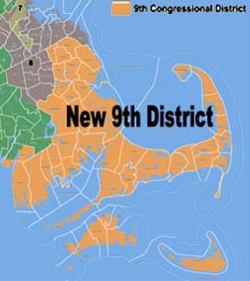
Two years ago we wrote about the Republican Primary in the 9th Congressional District, which covers the South Coast and the shoreline communities of Plymouth County south of Scituate. This link takes you what we wrote back then : https://hereandsphere.com/2014/04/13/9th-congress-district-a-campaign-that-is-no-campaign-at-all/

Then, it was four candidates vying to face the District’s Congressman, Bill Keating. This time there’s but two Republicans on offer : Tom O’Malley of Marshfield, and Mark Alliegro, who was one of 2014’s four. Alliegro finished second last time to the winner, John Chapman.

We called the 2014 GOP primary “a campaign that is no campaign at all.” We so opined because it seemed to us that none of the four men addressed the major concerns of the 9th Congress District, nor did they have much chance of winning. They seemed more interested in each other than in Mr. Keating.

I don’t see much difference this time, except that the followers of O’Malley and of Alliegro don’t seem particularly to like one another, or the opposing candidate. That happens in primaries.

Sometimes the bad blood has to do with issues. This time it seems more a matter of temperament. Mr. Alliegro — who blocked this writer on facebook two years ago — appears comfortable running a Trumpist candidacy replete with insult and confrontation. Mr. O’Malley, meanwhile, hews to the graciousness one saw in John Kasich. This writer prefers the Kasich approach. Yet on the issue tops in the Trump world — immigration — Mr. O’Malley’s position reads a whole lot more like Trump than does Alliegro’s : http://www.omalleyforcongress.com/border-security-immigration-reform.

As the “9th CD” is the nation’s most Portuguese, including all of New Bedford and the south half of Fall River, not to overlook Wareham, Plymouth, and the Outer Cape, a candidate who talks, as does O’Malley, of “illegals’ and decries that today’s immigrants do not “assimilate” seems ill suited to represent it. the “9th CD” is alive with Azorean culture, Madeiran food, Cape Verdean commerce, and fishermen from all over the world of Portugal and its diaspora. The “Festa” on Madeira Avenue in New Bedford draws tens of thousands from all over the South Coast; and Fall River offers authentic Azorean and Madeiran cuisine all over town as well as Portuguese-American dance music in its many nightclubs. Mr. Alliegro, one expects to not care much about it; but O’Malley, you would think, would espouse sort version of the Dream Act, if not Jeb Bush’s all embracing welcome f or immigrants who come here as “an act of love.”

Embracing the vibrant immigrant society of the “9th CD” would seem a first principle for Mr. O’Malley. Nor does the challenge to his candidacy stop there. Read, for example, what O’Malley has to say about the opioid addiction problem, highlighted for Cape Cod in a documentary movie sponsored last year by Governor Baker: http://omalleyforcongress.com/opiate-and-drug-problem.

O’Malley doesn’t mention the Cape Cod heroin movie, nor does he talk in any way about the significant opioid addiction legislation enacted by our legislature this year. The South Coast hosts one of our state’s most effective drug addiction response organizations, not to mention being home to the Chris Herren Initiative (Herren is a Fall River native). Has O’Malley visited either ? Does he know of them ? Has he spoken to advocates in District Attorney Quinn’s office ? His brief and superficial statement suggests he has not.

Mark Alliegro’s response to the opiate addiction crisis is actually much, much more detailed and better informed than O’Malley’s : http://www.markalliegroforcongress.org/opiate_abuse

On the other hand, Alliegro’s only comment about immigration is that we need “a rational immigration system.” Nor does he do much to bring me aboard when he says about President Obama that “During this Administration’s time in office, we have seen inaction, deception, and missteps all of which weaken us at home and abroad. We give aid and comfort to our enemies, while our military, our allies and our foreign service professionals get little of each.” He is mistaken. Not to mention that the President whom he insults carried the “9th CD” by almost 20 points both times. Whoever wins the GOP Primary will need a ton of pro-Obama voters if he is to come close to defeating Mr. Keating. I do not see how Mr. Alliegro’s sweeping dismissal helps his cause.

O’Malley does address the jobs issue that everybody tells pollsters is their top concern. His focus of national infrastructure repair is a wise one. His solution — use people on welfare — may not be so wise. Much road, bridge, and rail lineconstruction work is skilled and is often done by union labor. I doubt that unions will find O’Malley’s “workfare” suggestion a friendly one. Says he : “One way to get on the road to fixing the economy is a program to undertake the repairs necessary to upgrade our national infrastructure.  Roads and bridges in this country, and even right here in this district, are crumbling before our very eyes.  They have been mostly ignored for too long and I have a plan to reverse that trend and a by-product would be an economic stimulus that actually works.  Using a system of workfare, people on welfare will receive government assistance in return  for their labor on public works projects i.e. bridges, roads, dams, highways The by-product will be a real economic stimulus.This project will include non welfare recipients and will require the development of additional well paying jobs both in the district and nationwide. It is a win-win and a solution to an issue.  This would get people off the rolls of the un-employed and get our roads and bridges fixed!  It worked after the Great Depression.”

That said, Mr. Alliegro’s “Jobs” discussion, on his campaign website, insists that taxes and government regulations are the problem. This sounds tiresomely familiar. Alliegro also ( 1 ) opposes the Common Core Curriculum that the nation’s 50 governors adopted 20 years ago in order to assure that every child, no matter her zip code, graduated with the same basic knowledge vital to securing real employment ( 2 ) opposes women’s reproductive choice  and ( 3 ) voices the gun absolutists’  view that the Second Amendment gives individuals an unlimitable right to carry loaded weapons wherever and whenever they choose.

Lastly, Alliegro opposes the 1954 “Johnson Amendment whereby organizations seeking tax-exempt status cannot engage in political campaigns on behalf of a particular candidate. Most of you may not know the “Johnson Amendment.” It is the basis of the now fully accepted notion that one cannot enjoy exemption from the taxes we all must pay and then use that exempt money to support a politician. Despite the huge exceptions enabled by the Citizens United decision, the Johnson Amendment prevents campaign organizations from abusing their protected income. Mr. Alliegro’s opposition on this matter alone would be sufficient reason to reject his candidacy.

O’Malley also lists as a key issue support for Israel. Unfortunately, his Israel policy is instead an Iran policy : “The Iran nuclear deal is just horrible. According to GovTrack.us 2015 report card, the incumbent voted in favor of the deal where we get nothing and they get everything they want, including a path to nuclear weapons.”

Support for Israel is certainly a significant foreign policy obligation. It may interest O’Malley to know that Israeli intelligence and military leaders say that Iran is not an existential threat to Israel (of course it isn’t. the mullahs know very well would happen were they to attempt all out war on Israel); but the nation’s internal divisions, say these experts, are existential indeed. One Israeli intelligence chief only recently opined that the nation is so divided it verges on civil war. A diligent perusal of Israeli media reports over the past two years supports this view. The Netanyahu government is marginalizing Israeli Arabs; pursuing an entirely colonialist settlement policy in the West bank; and legitimizing an ultra-Orthodox Judaism not much different from Saudi Wah’habism or Iran’s Guardian Council.

So much for the two candidates’ pluses or minuses. John Chapman, who won the 2014 GOP primary, lost to Congressman Keating by ten (10) points in a very good GOP year. This time will be anything but a  good GOP year. The winner of Thursday’s primary might easily lose by 20 points. In which case, what is the point ? Just this : the GOP needs badly to recover its competence, its policy realism, its recognition of who are the voters and who will soon be voters. It needs not to disparage the President but to explain what it might do better, as well as congratulate Obama on what he has succeeded at. A political party cannot move forward, or free itself from self imposed shackles, if it disputes everything the other party does or says. No party gets it right all the time, nor wrong. Congratulate the right, and you win some legitimacy for criticizing the wrong.

—- Mike Freedberg / Here and Sphere


MASSACHUSETTS: REPUBLICANS IN THE LEGISLATURE

diva

^ Taunton’s State Representative Shaunna O’Connell (middle) : The #MAGOP’s top diva has a serious opponent now

—- —- —-

Republican members of our state’s legislature face a huge challenge. His name is Donald Trump.

We all know, in this depressing election year, what Donald Trump means. Most of us despise it. In Massachusetts, he seems on track to win barely 33 percent of the vote. Hillary Clinton polls 55 to 58 percent. That’s an awfully large disparity. In order to win re election, our state’s 40 Republican legislators probably must win a momentous number of Hillary Clinton  voters or they’re out of a job.

Their challenge isn’t as steep as it might be, however. Most of the 40 (34 House members, 6 Senators) represent districts where Trump won’t be beaten by 25 to 30 points. Yet I can’t think of ANY legislative district that Trump can win; and given the virulence and amateurism of his campaign, many voters who are not aboard Trump’s train seem to be washing their hands of all things Republican. I cannot blame them for wanting the GOP gone; but  they are making a mistake. In this editorial I will try to explain why non-Trump voters should reconsider dismissing down-ballot Republicans out of hand.

In Massachusetts, Republican legislators often have positive reforms to offer: budget discipline, administrative efficiency, local control of local matters. GOP legislators also sometimes support social issue reforms, providing them bipartisan legitimacy. For example : the “TransBill” passed in this year’s session would be on shaky ground had its 117 House supporters not included 9 of that chamber’s 34 GOP members. I give special credit to those nine — Shawn Dooley, Kim Ferguson, Paul Frost, Sheila Harrington, Randy Hunt, Hannah Kane, Jim Kelcourse, David Muradian, and Susannah Whipps lee — but by no means does that leave the other 25 GOP House members begging. In particular, Keiko Orrall, newly elected as the state’s Republican national Committeewoman, has dramatically improved that office’s influence in party affairs. And most of the other 24 matter a lot to Governor Baker’s state house clout.

Likewise in the Senate, where members Patrick O’Connor and Richard Ross have supported major reforms, both men thinking “outside the box.”

Several of the state’s best GOP legislators have no November opponent : Shawn Dooley, Hannah Kane, Randy Hunt, Kevin Kuros, Joe McKenna, Kim Ferguson, Tim Whalen, Elizabeth Poirier, Keiko Orrall among them. (Trump state chairman Geoff Diehl also has no opponent.) But Sheila Harrington, Jim Kelcourse, Susannah Whipps Lee, and Kate Campanale all face significant opponents. So does Saugus’s House member, Donald Wong. And Taunton’s sometimes controversial House member, Shaunna O’Connell, has now acquired her own serious opponent: City Councillor Estele Borges.

Challengers also face Andover’s Jim Lyons, Bristol County House members Jay Barrows and Steve Howitt, Marc Lombardo of Billerica, Plymouth’s Matt Muratore, Susan Gifford, and David DeCoste.

While I differ with the legislative records of many who face Democratic opponents, the most important component of almost any Republican legislator is support for Governor Baker’s agenda. So far, almost all of his major legislation has been adopted unanimously; but there have been occasions, including the “TransBill” and the FY 2017 Budget, when support for the Governor’s position has depended on all or at least some of the 34 Republican House members. It would reduce Governor Baker’s ability to work an independent course on state reforms were the number of Republican legislators to decline by much. (I speak chiefly of the House because State Senators are almost impossible to defeat. Of the six GOP Senators, only Donald Humason of Westfield faces a serious opponent.)

It’s also important to re-elect as many of the 40 as feasible because elected Republicans provide realism to a party whose activists have not always resisted the inflammatory cry of Trump, or the pressure of social issue anti’s. It is crucial that the GOP going forward retain, maybe even grow, its electoral realists. Too much of the GOP in Massachusetts has chased chimeras and issues positions rejected by an overwhelming majority. That sort of unrealism threatens Governor baker’s effectiveness and renders future Governor hopefuls underdogs from the get-go. And that is bad not only for Republicans but for all our voters; because a Governor free of the special interest pressures that control the Democratic primary is a boon to objective good governance.

And now to my ratings of who is most at risk in November. Read my estimate of what percentage of Hillary Clinton voters each major opposed GOP House member needs to win to be re-elected:

Sheila Harrington : 33 to 35 percent of her area’s Clinton  voters; Jim Kelcourse: 35 to 38 percent of his district’s Clinton voters; Susannah Whipps Lee : 30 to 33 percent of her western Massachusetts Clinton voters; Kate Campanale: 38 to 42 percent of her Worcester City’s Clinton voters; Donald Wong : 33 to 35 percent of Saugus and Revere’s Clinton voters; Shaunna O’Connell : 38 to 42 percent of Taunton and maybe 15 percent of Easton Precinct 6’s Clinton voters; Jim Lyons: 30 to 33 percent of his conservative Essex County district’s Clinton voters; Jay Barrows and Steve Howitt, 28 to 32 percent of their Clinton voters; Marc Lombardo: 20 to 22 percent of Billerica’s Clinton voters (if there’s a Trump-leaning town inside Route 495, Billerica is it); David DeCoste: 35 to 38 percent of his Northern Plymouth’s Clinton voters; Matt Muratore and Susan Gifford : 30 to 33 percent of their districts’ Clinton voters.

Who of these are most at risk ? Some House members face more spirited opponents, some less. From less to more, I’d rate the GOP risk this way :  Lombardo, Gifford, Howitt, Barrows, Whipps Lee, Muratore, Lyons — all at moderate risk; Wong, DeCoste, Kelcourse and Campanale — high risk. Both Kelcourse and Campanale won their 2014 races by less than 100 votes. Campanale’s district includes her home town of Leicester, yes; but its Worcester component reaches into some of that city’s most Democratic precincts, areas southwest of City Center that you’d expect to find in Mary Keefe’s adjacent district. For 30 prior years the seat had been John Binienda’s. Campanale will have all she can handle if Moses Dixon wins the Democratic primary.

Kate Campanale

^ the 17th Worcester’s Kate Campanale

Please note that the above figures are not unusual for GOP legislators in Massachusetts. They always need, in a Presidential election, to appeal to voters favoring a Democratic President. This is a major reason why our state’s GOP legislators tend to bipartisanship rather than obstruction. But this year their appeal will be more difficult, maybe much more difficult. I doubt that all will survive. But I do ask my readers to consider the advantage of “ticket splitting” upon the prospects for state government  reforms.

— Mike Freedberg / Here and Sphere


THE RISE OF ANTI-AMERICAN AMERICANS

Klan

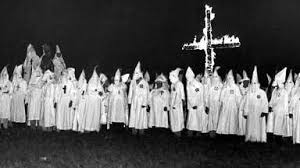
^ compared to today’s anti-American word-poison terrorists, these guys were amateurs

—- —- —-

In 1860, 12 states were willing to leave the Union for the sake of slavery. There has certainly been great political division since the Civil War, but actual anti-Americanism, when it existed at all, has retreated to the fringe. Even the Ku Klux Klan, terrorists and criminals, did not propose destroying the nation. Of actual anti-Americanism, only the Communist movement and various Nazi and neo-Nazi cults made any impression; and that impression generated almost universal citizen disgust.

Not so today. Hatred of the actual nation, of its political leadership, its agenda and its composition, has become the overriding rant of a very large minority of citizens. This we see in the Trump campaign. Who among us could have imagined, a year ago, that a campaign of almost universal insult and demonization of people, violations of Constitutional norms, and kudos for Vladimir Putin, could garner anything but a fringe support ?

We know better now. Trump has the toxics with him, he is himself a mouth full of syllabic cyanide.  Compared to him and his word poison terrorists of today, the Ku Kluxers were junior varsity.

Today what began as talk show hucksterism — saying outrageous things to get attention and thus advertising dollars –has become an agenda that millions voice proudly. It all begins, of course, with racial hatred; in that regard, the mindset of 1860 Rebels lives on. And it does. It was a fantasy then, a killer fantasy, and it’s a fantasy now, and, maybe, again a killer. People have died on its account, and many more have been assaulted, and even when Trump is beaten, the anti-Americanism and its racist underpinnings will not slink away. The persistence of talk show hucksterism assures it.

The one hopeful aspect of today’s pervasive, racist anti-Americanism is that it has almost no legs among younger citizens. Hillary Clinton leads Trump, in almost every poll, by huge numbers among voters under age 45, and by even larger numbers among those under 35. For every young racist, looking to get rich as a talk show troll, 600 young voters ignore and block.

When we stop giving the new anti-Americanism attention, it stops having legs. It becomes boring. It is, after all, only an attitude looking for a payday.

They will not go gentle into that long dark night; but go, they will.

SUFFOLK COUNTY : PRIMARY ENDORSEMENTS SOON

FullSizeRender

^ State Representative Liz Malia and challenger Charles Clemons Muhammad at last night’s Wards 11 and 19 candidates’ Forum

—- —- —-

Understandably everybody is focused on November’s election of a new President. Let us not, however, disregard the rapidly approaching September 8th contests afoot on Suffolk County ballots. There are many. As always, Here and Sphere will endorse where appropriate.

We will publish our endorsements just before Labor Day. This isn’t a great choice to make, but there isn’t much we can do. Before labor Day everybody’s on vacation; but after Labor Day there’s only 48 hours remaining before voting time. So be it.

The following contests attract our attention :

Suffolk Sheriff. As a two candidate contest between incumbent Steve Tompkins and challenger Alex Rhalimi, it offers plenty of drama and a clear contrast between two very different men. (NOTE : We will NOT be endorsing in this race, as I am consulting to the Rhalimi campaign and am thus unable to offer an objective recommendation.)

Suffolk Register of Deeds. Seven candidates for the Democratic nomination to face two independent candidates on the November ballot: Doug Bennett; Stephanie Everett; Katie Forde; Michael Mackan; Paul Nutting; Jeff Ross; former Boston City Councillor Stephen Murphy. We WILL endorse in this race.

State Representative, 5th Suffolk : this district covers Uphams Corner, Meeting House Hill, Four Corners, and part of the Fields Corner area, all of it in Dorchester. Incumbent Evandro Carvalho faces a primary challenger, Melinda Stewart. We WILL endorse a candidate.

State Representative, 7th Suffolk : the retirement of 17-term Gloria Fox opens up a district covering the Fenway and most of central Roxbury. Three candidates seek the seat : Monica Cannon, Mary-dith Tuitt, and Chynah Tyler. We WILL endorse fort this race.

State Representative, 11th Suffolk : this district represents most of Fort Hill, almost all of Jamaica Plain and parts of Roslindale. Incumbent Liz Malia has a challenger, Charles Clemons Muhammad. We WILL endorse in this race.

State Representative, 12th Suffolk District : incumbent Dan Cullinane faces two challengers, Jovan Lacet and Carlotta Williams, in a district representing most of Mattapan, Lower Mills, and the Eliot Street section of Milton. We WILL endorse in this race.

State Representative, Fourteenth Suffolk District : incumbent Angelo Scaccia has represented Readville, central Hyde Park and most of Roslindale since 1972 except for one term, 1978 to 1980. He has two challengers, Virak Uy and Anthony Solimine. We will NOT be endorsing in this race, as this writer is a long time friend of Angelo Scaccia and is working for his re-election.

Governor’s Councillor, 6th Council District : incumbent Terence Kennedy faces North End resident Stephen Borelli in a contest covering only one part of Suffolk County : the First Suffolk and Middlesex Senate District. We will endorse in this race,

Please note that though we will not be endorsing certain contests, we will nonetheless write about the candidates and the race. We DO want all of our readers who live in Suffolk County (Boston, Revere, Winthrop, and Chelsea) to vote in the primary. Voting day is a Thursday this time. Mark your calendars !

—- Mike Freedberg / Here and Sphere


FLASH POINT

JohnsonWeld-750x400

^ Bill Weld and Gary Johnson : leaders of one of the two parties — one localist, the other socialist — that may well replace the mortally wounded Republican party

—- —- —-

It isn’t hard to see that America’s political alignment has reached crisis. I’m hardly the only observer who feels that the Republican party is just about finished, or that a new political party will likely replace it. But how will that turn out ? there, observers differ big time. What follows is my own view.

First, the Democratic party. It has become the only party of serious governance. The major issues being debated by the nation were debated within it. Unions, big banks or not, trade, immigration reform, economic fairness, LGBT civil rights, justice for African Americans, reasonable gun regulation, infrastructure repair, whether or not to borrow Federal dollars : for all these, the Democratic primary offered a forum; by the 16 Republicans, hardly anything of substance — except by John Kasich and, at times, Jeb Bush, was said about any of them. Most of the 16 rejected every rational response to all.

While the Republican campaign, such as it is, even today spends all of its time trying to convict Hillary Clinton of 17,000 crimes, and offers nothing but gloom and doom, exclusion and insult, the Democratic party offers plans — detailed plans — for solving American problems. Debate could well be offered about those plans, but I hear none.

It isn’t hard to see why the Republican party has collapsed — has had every one of its surreal think tank putatives debunked by a charlatan. Though a solid minority of Republicans retains the quaint notion that governance and accommodation are what a political party does, all the dynamics in the Republican universe derives from talk show hucksterism : saying outrageous things to get attention, and bogarding fantasies, and thus win advertising dollars for one’s “talk show.”

That’s not policy, and it’s not politics.

John Kasich found that out. Kasich talked policy, and he talked moral leadership; and he talked modernization, of a party for whom time does not exist, only rant.

Researchers also tell us that young voters want nothing at all to do with rant. Or with talk shows. How could they ? Young voters are far too busy working to listen to talk shows or to read right win policy papers. For every young person who decides it’s cool to be a troll, 1000 young people ignore and then block. Hillary Clinton leads the Republican nominee almost two to one among voters under age 45. During the primary, her opponent had an even bigger margin among young voters — hardly any chose the Republican side.

For the time being, the Democratic primary will be the arena in which actual policy debates take place. This is true in the states as well as the nation. Young people, people of color, immigrants, women, and the college-educated — an ever increasing percentage, because without a college education, modern work is almost unreachable –have nowhere else to go — yet.

I doubt that this situation will continue, however. The Democratic party’s reliance upon Federal governance to solve all of our problems doesn’t square with our Constitutional system of local primacy. In the internet age we live globally but also locally. The Federal government is neither, and the tension between it and locality on the one hand and global on the other is likely to increase. A political party espousing local solutions first has legs. (John Kasich talked, realistically, about entrusting to the states several matters that people like to see handled locally, but Kssich was playing in the Republican talk show arena, not in a real political venue.)

Thus the attention now being given to the Libertarians, for whom local control is mantra.

Yet locality isn’t everything. The global is just as significant in our borderless world of money and trade, knowledge and social connectedness. Thus t.he attraction, after decades of nowhere, of a socialist politics. The left has always rejected national borders. This was its one brilliant vision. All people really are equal, with the same rights; and a politics that secures those rights only within one nation falls short, maybe immorally so.

I do not say that I adhere to the cause of new socialism. Politics is still the art of the possible, and localism seems much more possible to get to than global equity. Thus I’m far more favorable to the Libertarian view than the socialist. I do, however, expect both views to grow adherents, and in the not too distant future to replace the now purposeless Republican party as Americas’ alternatives to the Democrats’ “natural party of governance.”

This is the flash point. A political party that changed America for the much, much better, and did so for many decades, has finally reaped the ignominy of a long ignoble fall from its own ideals and its legacy of reform. These will forever stand as victories for progress; but new victories are needed, and other armies will now be fighting for them.

—- Mike Freedberg / Here and Sphere


DEMOCRATS SCHOOLS FAIL; SJC MAKES GAS ENERGY DIFFICULT


Two ucharlie-baker-2

^ ” #LiftTheCap ” is a fight that Governor Baker — and the voters — will win. So why did the Democratic State Committee vote to oppose it ?

—- —- —-

Two unfortunate recent events, one political, the other legal, have made civic governance unnecessarily difficult. First was the vote by the Democratic Party’s State Committee to oppose Ballot Question 2; second was yesterday’s decision by the state’s Supreme Judicial Court negating Governor Baker’s legislation to assess electric utility ratepayers part of the costs of building new natural gas capacity for our state.

First, the Supreme Court case, in which Justice Cordy finds that in Massachusetts an electric company cannot purchase gas nor a gas company purchase electricity, nor can the ratepayers of one be assessed for the purchase of the other,m because the legislative history, in our state, of gas and electric utility regulation, going back to 1926, requires that gas and electric be altogether separate. You may read Justice Cordy’s full opinion here : http://www.mass.gov/courts/docs/sjc/reporter-of-decisions/new-opinions/12051.pdf

Activists who want the state to cease its use of natural gas — it being a fossil fuel, whose use they oppose — applaud this decision. That it prevents the state’s utilities from accessing more natural gas, and thus lancing the boil of high gas costs to consumers, doies not seem to trouble these activists.

Justice Cordy is saying, in essenece, that if the Department of Energy wants to approve electric company purchases of additional gas, it needs the legislature to change the law (c. 94A) that Cordy interprets. Is this likely to happen ? I doubt it. The activists who oppose the state using natural gas will raise the hue and cry, and as special interests control most elections to our legislature, which are decided in low-turnout primaries, activist opposition will likely determine.

I applaud the Governor for trying hard to find a solution to our state’s natural gas shortage and resulting high costs to ratepayers. It was worth the effort.

Second, the Democratic State Committee’s vote to oppose Ballot Question 2, by which proponents seek to change the state’s charter school cap law so as to lift the cap by allowing twelve new charter schools in each calendar year, said schools to be allowed only in School Districts designated by the State Department of Education as performing in the bottom 25 percent of all districts.

It is appalling, I suppose, that those who preside over the state’s Democratic party should oppose a measure which will give every parent who desires school choice the choice that they seek. One presumes that schools answer to parents first and always. One hopes that no political body would support having school;s answerable to any other interest. But evidently one would  be mistaken so to hope.

Any such hope was given the bum’s rush by a vote taken — evidently by intimidation, according to what I have read on social media — on behalf not of parents but of teachers’ unions. Supporters of ” #liftTheCap ” are right to blast the Democratic State Committee for its vested interest subservience — adopting a position opposed by a clear majority of the state’s voters. Teachers’ unions have demonstrated an irresponsible stubbornness about any kind of schools reform. Their resistance to budget reform, longer school days, performance evaluation, curriculum innovation, overcapacity reform, and other common sense reforms should not have legs with any political party. Especially not the party that claims three times as many Massachusetts adherents as the party opposite.

Nonetheless : before Republicans and others condemn the Democrats too hotly, they should remember that not two years ago, the Republican State Committee adopted issues positions — on social issues — equally enslaved to vested interests unpopular with a majority of the voters. It took an enormous effort, by a sitting GOP Governor, to pry leadership of the Republican State Committee away from these folks.

Fortunately for governance reforms in Massachusetts, our political party state committees speak only for themselves. The voters still determine our state’s course of reform and progress, and that is how hopefully it will always be.


DE-ESCALATING THE POLICE ARSENAL

Bill Evans 2

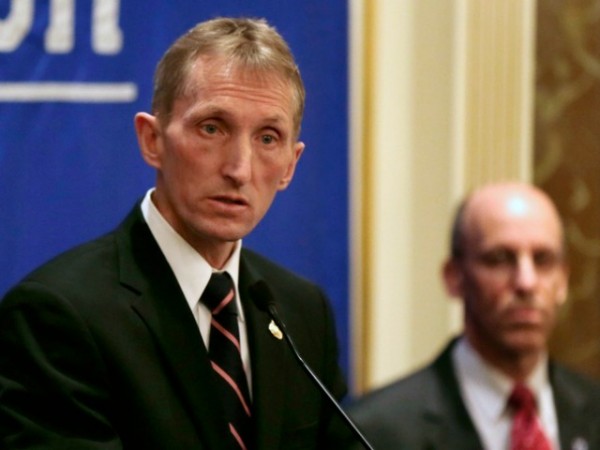
^ Boston Police Commissioner Bill Evans : his de-escalation or the patrolmen’s long guns ?

—- —- —-

Boston Police Department (BPD) practice appears right now to proceed in opposite directions at the same time: on t.he one hand, de-escalation of confrontations; on the other, a request by the Patrolmen to carry long guns.

By “de-escalation” the BPD means, in the words of Commissioner Bill Evans, “just because you CAN shoot doesn’t mean you HAVE TO shoot.” There is risk here. Not shooting an armed person right away invites that person to shoot first. Not shooting a suspect who may not be armed risks that suspect being armed and taking the first shot. Of course no one, police or civilian, wants to be shot. Yet de-escalation seems to work. The BPD does not “shoot first and ask questions later” unless the danger is clear and immediate; and that restraint has led to a degree of trust between the BPD and people of color.

Late last year, the Boston Globe put it this way : https://www.google.com/url?sa=t&rct=j&q=&esrc=s&source=web&cd=1&cad=rja&uact=8&ved=0ahUKEwjD-7Xdy77OAhUGqB4KHVrfBdwQFggcMAA&url=https%3A%2F%2Fwww.bostonglobe.com%2Fnews%2Fnation%2F2015%2F12%2F12%2Fcullen%2FFq3paOXrSqrYa1HD0k4VgK%2Fstory.html&usg=AFQjCNE4Et1kbBHjBE-fn90nFYfnpcVbTQ&sig2=m9nYoTZuJRkDDbzEyVDgNA&bvm=bv.129422649,d.dmo

So why the request to arm up with rifles ? I suppose the BPD thinks that intimidation makes de-escalation less risky. I disagree with the premise. My experience of a long lifetime tells me that intimidation engenders resentment at best, vengeance more sure. The intimidated person may not shoot you this time; but he (most criminals are male) may very well arm himself up for a next time. In short, an arms race. In Chicago, that’s where things stand. Heavily militarized police who react often brutally to suspects face heavily armed suspects; and so it goes.

Boston would be foolish to start down the road to Chicago policing. My own suggestion is for the BPD to do just the opposite : de-escalate its weaponry just as it de-escalates its use thereof. It is not a given that police forces should be armed. London’s “Bobbies” until not long ago carried only a nightstick; they were monitors, not gun-fighters. Clearly, today,. in America, with 315 million guns afoot, an unarmed police force would find itself disadvantaged often. Yet to step back is not to eliminate; and my suggestion is, yes, that the BPD step back. Not every officer needs be armed with Glocks and the like. Plain clothes detectives can certainly make do with a small pocket pistol. I find it enormously scary to see the massive black killer handguns that loom at the belt side of every officer I encounter, at coffee shop or on duty. SWAT teams, I suppose, have valid reasons for carrying deadly handguns; but could not BPD’s line officers, at least, retreat to the pocket pistol ?

Few young people go about armed even in “hot” zones; fewer still use the guns they do carry. I doubt there are many kids at risk who don’t mind getting shot. Their first response, when seeing a BPD officer, should never be “he’s gonna shoot me.” If that’s the reaction to an armed BPD officer, what follows may easily not end well. Far better, I think, for the reaction to a BPD line officer to be “oh well, the fuzz. Act cool.” (we may not like to face that that’s how most young people think of the police, and not just in neighborhoods at risk. But real is real.) It is far preferable for kids and BPD officers to be wary, rather than scared, of one another.

I do not see why the strategy of de-escalation cannot be extended to armament as well as use thereof. Certainly we do not want there to be a police versus criminals arms race. All the momentum right now, in criminal justice reform, is toward de-escalation, of punishment, weapons use, and occupation of territory. Boston’s police, under the guidance of Bill Evans, walk in the forefront of this reform movement. Let us not arm Boston’s police with long guns.


—- Mike Freedberg / Here and Sphere