OF CHECKS AND BALANCES

falling

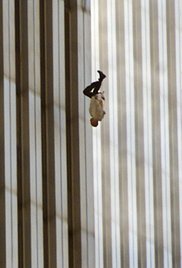
^ the falling man of 9/11 : emblem for when a system of checks and balances falls out of balance

—- —- —-

We who live in the USA and write of its politics take for granted what we call “checks and balances.” We applaud the Constitution for installing this basic principle : the Congress balances the Executive, and the High Court checks both : thereby assuring that no part of our governmental enjoys plenary power, which, as Amendment 10 says, is left to “the people.”

Myself, I’m not so sanguine about the principle. Too easily we forget that balance is a fragile thing. Think a tightrope walker walking his rope, balance pole in hand : tip himself even the slightest bit out of balance and he’s done for. same it is with a government founded in balances. Either the balance fails — as it has done during the President of 45 until recently — because one side of the pole collapses because it wants to, or it becomes so rigid — as it did from the day that President Obama took office — that it blocks the tightrope walker from walking at all.

To work, the system of check and balance has to accept two corollary principles : ( 1 ) those who would walk its tightrope must be extremely subservient to the tiny margin of error and ( 2 ) everyone involved must commit to the tightrope walker actually walking, all the way across the abyss.

If those who impose a government of checks and balances upon themselves do not commit to these two corollaries, or if they cease to commit to them, the tightrope walker falls to his death, or else doesn’t walk at all. Something of both has happened to our Constitutional arrangement these past nine years or so, and we see the consequences: anarchy and tyranny, both of which those who drafted and agreed to our Constitution sought to avoid.

They were not naive. They knew that the system they were agreeing to required good faith of those who sought to work it. They often said so, bluntly.

Checks and balances lead to nothing at all getting done if they become tactics to exploit, or if the balances become ends in themselves rather than prods to a resolution of differences.

The consequences of overreach, we see : nothing that needs be done gets done, yet life goes on, ad hoc, and thus the longer that nothing governmental. gets done, the more that ad hoc decisions come to be the norm, each one fraying the balance tight rope a little bit more, until there isn’t any rope at all and thus no Constitution. (or, better said, a Constitution in name only, nice words on parchment).

Principally we now experience three failures of balance, with the attendant consequences : ( 1 ) we impose a political agenda upon the Supreme Court, which as an un-elected body was never intended to have any political duties ( 2 ) we allow the legislative to aggravate social controversy rather than resolve it and ( 3 ) we force the executive to do the legislative resolving that we refuse to let the legislature do. All three failures compound one another, which is what happens when balance is lost : it is never lost only in one sector, because every sector of balance requires equilibrium of all.

Worse, today we have in power, and supported in that power, persons whose objective is to exploit the imbalances to their agenda’s advantage, forgetting that when a balance system goes out of balance, there is no advantage : one sided of a falling body may hit the ground first, but the rest of the body follows fatally with it. And thus the famous falling body photo that heads this column stands as a gruesome emblem of where we are now in an America whose Constitution is falling to the ground, both because it is an out of balance design and because imbalance is eagerly embraced by those who imagine that falling to the ground will kill only their opponents.

Niccolo Macchiavelli, in The Discourses, wrote brilliantly that divided government strengthens a political entity., He was the first writer to see the point, which is why we still read him 500 years after he wrote. What he did not say, because it was then only too obvious, is that divided government also means war of a sort with many casualties : many were banished, some were assassinated, and many more suffered economic disaster as faction prevailed over faction. Yet he was right. Divided government meant controversy, and controversy meant that there could never be only one truth,m one agenda, one creed. We are a free people today because divided government, in medieval Italy (from about 1200 to about 1550) established a model for defeating the agenda despotism of that era’s Papacy and, thus, of all agenda dictatorships that have arisen since.

We would be very wise to read The Discourtses again, along with Guicciardini’s history of Italy in that period, a record of conflict that can easily weary one’s sense of optimism about politics. But no more wearying than the political era — of obstruction, prerogative, and misuse of justice — in which we now live.

—- Mike Freedberg / Here and Sphere


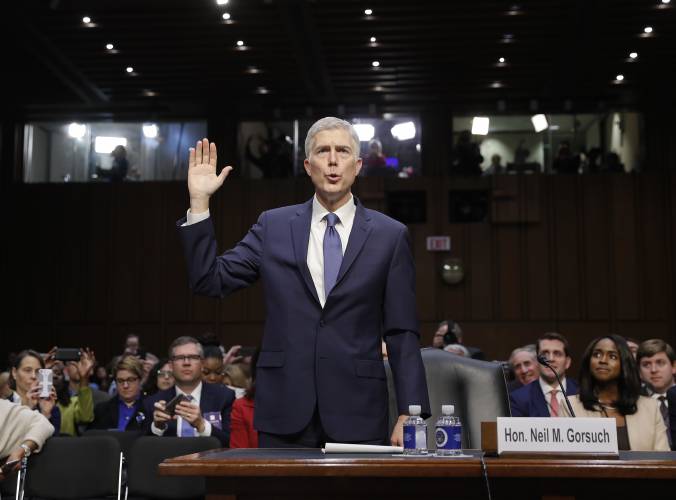
THE GORSUCH NOMINATION : NORMALITY; AND, THE “ADMINISTRATIVE STATE”

Neil Gorsuch

Right now the number one urgent need for politics in the United Stares is to reclaim normality. Those who are asking that Judge Neil Gorsuch, nominated to be a Supreme Court Justice, be blocked, or angry that hearings are even occurring, aggravate the abnormal situation we’ve had to endure now since the beginning of the Trump campaign, worsened by the Senate’s refusal last year to take up the Justice nomination of Judge Merrick Garland. Irresponsibility of this sort I condemned at the time. i condemn it now.

That the Gorsuch nomination exists solely because of the irresponsible act of last year;’s Senate is unfortunate, but said lack of fortune is no excuse, none at all, for deploying yet more politics of bad faith. It is good to see that most Democratic Senators are not taking that course. The loudest voices of activists now shout at us that the Gorsuch nomination must be put on hold because the President who nominated him is under FBI investigation for acts which, if proved, amount to treason. I disagree with this view. As long as Mr. Trump holds the office of Presi9dewnt, acts that he does pursuant, unquestionably, to his Constitutional powers, must be responded to with the same degree of Constitutional good faith.

If Mr. Trump is found to have committed acts which amount to impeachable offenses, and if he is then impeached, he will cease to hold the office of President; and no act of his thereafter will have any Constitutional effect. Until such event, t.he opposite must hold : that his acts have all the effect that Article 2 of the Constitution directs that they have.

The above seems almost too obvious to have to state; but it bears stating because our current politics so grievously lacks normality that even the most boringly normal of it needs to be called to the spotlight. Thus have I done.

The nomination of Judge Gorsuch is equally obvious. Hearings on conformation are obvious. It is good that the majority of Democrats are operating obviously. By doing so, they are helping to restore the nation to political health.

So much for the kudos. I wish I could say as much about the Gorsuch hearing itself. I cannot. The questions I have seen Democratic Senators ask have nothing to do with a Justice’s duties. Asking him if he will give a workingman as much of a shake as he might give to a corporation — as Senator Feinstein of California asked him — is fairly beside the point. A Supreme Court Justice’s job isn’t to give ANYONE a “shake,” it’s to decide how Constitutional precepts, if they’re at issue in a case, apply to the case. How they end up affecting a particular litigant is second hand; the Constitution’s principles and directives may not support the outcome that you want.  After all, there are always (at least) two sides to a case or controversy; and in our law, each side has an equal chance of having the Court decide for it, or against it. It may be great politics to advocate for “the little guy” — one should always stand for the underdog — but Court decisions shouldn’t be mainly political (politics will always be a factor in them, because politics generally arise from disputes), they should be mainly judicial. One hopes that before the Gorsuch hearings end he will be asked about his jurisprudential principles: because he does have them, and to an advanced degree, and because the principles that he holds matter, a lot.

So far I have heard no questioner focus on the REAL import of the Gorsuch nomination. More about that below. First I wnat to offer two links for furtyher research :   (1 ) Yesterday I posted at facebook, on my own page, several of Judge Gorsuch;’s 10th Circuit opinions and concurrences. (You can read many of them here : http://www.gibsondunn.com/publications/Pages/Summaries-of-Opinions-of-Supreme-Court-Nominee-Judge-Neil-Gorsuch.aspx   ( 2 ) You can also read Eric Citron’s in-depth examination of Gorsuch;’s jurisprudence in action at SCOTUSblog here : http://www.scotusblog.com/2017/01/potential-nominee-profile-neil-gorsuch/

What do we learn from reading these two summaries and analyses ? Chiefly this : Gorsuch’s most significant opinions affect Administrative Law. His view is that administrative agencies may not develop their own interpretations of Federal Laws under which they administer, and , especially, may not set aside a Supreme Court ruling governing administrative regulation, but must, instead, write regulations conformable to such Supreme Court opinion. Gorsuch applies this restriction upon administrative prescription even where the applicable Law is worded ambiguously.

Given Mr. Trump’s active dislike of “the administrative state,” is it a stretch to conclude that it is for his administrative law rigor that Gorsuch was nominated ? Limiting the “administrative state,” we have seen, is a key objective of Mr. Trump’s top advisor, Steve Bannon.

Is Gorsuch’s textual rigor about administrative regulations issued pursuant to a Law a bad thing ? That depends on where your interests lie. Constitutionally, it is indisputable that under Article 2, a President must “take care that the laws be faithfully executed.” By what argument is it allowable, under that standard, that an executive agency “executing the Laws” add its own interpretation of a Law to its enforcement ?

This is hardly an obscure question. Agency power in our age of complex, ubiquitous Federal Law affects almost everybody. How many of us have not had encounters with a Federal agency ? How many of these encounters end up not frustrating you, or making your life or work more difficult ? For businesses, which create all kinds of processes spread over many jurisdictions, conflict with this or that administrative rule is almost a daily event. Certainly it is crucial that agencies charged with “faithfully executing the Laws” must have rules and must use them, or the Laws are nothing but paper tigers; yet Gorsuch has a point : if we who are subject to agency regulations intended as a faithful execution of the Laws cannot rely on their consistent application — if instead we are met by arbitrary and/or changing enforcements — the Laws become an impediment to, not a safeguard of. our responsibility to the society. Such would seem to be Gorsuch’s view. We have agreed to the Laws enacted by Congress; we have not willy nilly agreed to how the agencies enforcing them see them.

Your view of agency law may differ from Gorusch’s. Mine may differ from it too. But his view is a serious one entitled to be respected by the other eight Justices if he is confirmed. His view certainly belongs in the Court’s deliberations. In any case, this is the Gorsuch whose jurisprudence ought be questioned in his confirmation hearing. So far I have heard nothing to indicate that the Judiciary Committee even gets the point.

—- Mike Freedberg / Here and Sphere


THE GREATNESS OF CHUCK BERRY

https://www.google.com/url?sa=t&rct=j&q=&esrc=s&source=video&cd=2&cad=rja&uact=8&ved=0ahUKEwjj_qGXquXSAhXn7YMKHZ1WA4oQtwIIIDAB&url=https%3A%2F%2Fwww.youtube.com%2Fwatch%3Fv%3D9jKrHzps0XM&usg=AFQjCNGVM55q-ELCNdB_KDiIjbzEj-REaQ&bvm=bv.149760088,d.amc

^ Chuck Berry at his hot-rodding, duck walking fiercest

—- —- —-

Chuck Berry died this weekend, well into his 90th year. His songs wrote pretty much the story of my youth, and probably of yours as well.

How great was he ? Just consider : he invented an entirely new musical framework : fast tenpos, two-string guitar licks, a storyteller’s voice as biracial as his audience, lyrics that you instantly remembered, lines that spoke your life better than you could — which is what a great pet does. Berry was a great poet.

From May 1955, when his first hit “Maybellene” was released, until late 1964, when his last batch of major songs reached us — “No Particular Place to Go,” “Nadine,” “Marie” — he ruled my generation. The car radio was our connection. It was a car radio age. What an iphone is to today’s youth — Snapchat and Whatsapp etc. — the car radio was for us, and the car itself, a fast moving joy room in which we could “motorvate” without parents saying no. Berry sang about car radios, ab out cars, about going to school and the bell that ended school days, about the juke joints where we could drop a coin into the slot and play his stuff, and about car chases, speed, the sound of speed, the feel of it. He sang it, and his guitar and band played its soundtracks.

No one else had us anywhere near as completely as he. After “Maybellene” came “Roll Over Beethoven,” “You Can’t catch Me,” “Reelin’ and Rockin’,” “School Days,” “Rock and Roll Music,” “Sweet Little Sixteen,’ “Johnny B. Goode” — each one a celebration of what we did and of who we were and wanted to be. His songs focused it all.

There were others who we liked, of course. We raved with Little Richard, swooned with Fats Domino and Frankie Lymon, lusted with Gene Vincent and Elvis Presley, joked with the Coasters, sang lullabies with a dozen great doo-wop vocal groups. Yet none took command of us as did Chuck Berry.

I said that his reign lasted from 1955 to 1964, but that’s not entirely so. Early in 1957 a very different kind of voice, fronting a very different kind of beat and tempo — Chuck Willis, doing his version of “C. C. Rider”  — proved irresistible to most of us. We slowed down and sang upward rather than straight ahead. Yet if Berry now had to share the highway with the big hall dance floor, his passing lane music gave way to center-lane funk : “Little Queenie,” “Memphis,” “Carol,” and “30 Days” thumped as well as flew, and it was all that Chuck Willis — his own follow up hits kept the pressure on — could do to stave off Berry’s lumpy new story songs. Berry’s wry wit funk style was stronger, musically, than his first fast flourish. He held his own well into the new, 1960s era of soul styles, James Brown, and Motown slick : “Promised Land,” “You Never Can Tell,” “Too Much Monkey Business,” “Back in the USA,” These were some of his greatest songs, lyrics as visionary as they were pithy.

After 1964, however, we were no longer living in, by, and for cars and the car radio, and as Curtis Mayfield, James Brtown, Otis Redding, Motown, and surfin’ music became our musical standards, Berry’s world of cars and high school slipped to memory status: though he continued, occasionally, to craft wonderful songs in the manner of 1952-1954 slow drag blues that he had rendered obsolete (and from which he lifted more moves than he would ever admit to). He had always done such songs, but as B sides to his inventions; now they became his calling card, songs to last a long while rather than flash hot for a month or two: “Beer Drinking Woman,” “It Wasn’t Me,” “Have Mercy Judge,” “Aimlessly Drifting,” “Ramona, Say Yes.”

Songs of this type came naturally to an artist who knew the history of Black American and country music as well as anyone ever, sources from which he constantly drew and whose pith he reshaped. In particular, count the number of songs that he wrote on the venerable “poor boy long ways from home” theme.

He also knew his guitar hsito9ry. He took from T-Bone Walker, Gatemouth Brown, Pat hare,m Guitar Slim, and Muddy Waters, to name the most obvious; and every.one whose work he grabbed came out sounding completely different when Berry did his Berrying.

Berry often told interviewers that he made the music that “the market” wanted. He was every inch an entrepreneuir, a salesman, a provider to those who needed provisions. He did not confront or oppose. Pleasing those who wanted music to be pleased by was good enough to make him the great artistic inventor — who also succeeded in inventing us.

—- Mike Freedberg / Hered and Sp-0here

FRAMINGHAM : CHARTER CHANGE WINS THE ARGUMENT

FullSizeRender

Last night I attended one of the many public comment hearings being hosted by the Framingham Charter Change Commission. If what I heard said, by the two sides, is any indication of the entire debate, it’s no contest : the change proponents win.

At the Joseph P. Keefe Technical School, on Winter Street hard by Framingham’s commuter rail line, about 75 people gathered to listen to the Charter Commission’s presentation and then to ask questions. There were many. Two hours into the meeting — at which pointy I left, having heard enough to write this story — questioners were still lining up. I would be surprised if this isn’t how it is at every hearing the Commission schedules.

Of the several questions that were asked during my two hours of witness, the most interesting questioned the effectiveness of the present town meeting, town manager arrangement and its inability to respond efficiently to applications for development, or even for simple budget proposals. For these, the Commission’s sole dissenter, Teri Banerjee, had no answer. In particular, to a question posed by Mike Gatlin, wh0 directs Framingham’s Economic Development group, Banerjee fumbled badly even to frame any sort of response. The lack of preparation said it all.

About one quarter of the attendees represented the “Not This Charter” opposition. If those whom I saw are a fair sample, it’s basically current town meeting members — all of whom wi, lose their positions — many of them elderly in the wrong sort of way. It’s no crime to be old — heck, I am old — but it’s a grave lack to be unready, and evidently unable to grasp that things aren’t what they were in the 1950s (a decade explicitly referred to by one town meeting member, from precinct 7, who responded to discussion of imbalance in the location of Framingham’s schools by citing that in the 1950s, those location s were thought correct). I’m sorry, but that level of answer won’t do.

What was this about ? It turns out that three quarters of Framingham’s schools are located north of Route 9 — the big highway which more or less divides the town in half — while three quarters of the actual students come from south of Route 9. For solving this imbalance, the charter opponents had no answer other than the 1950 argument I have mentioned.

Much of the stated opposition to making Framingham a city, with a much smaller City Council — eleven members, not 215 town meeting members, 12 for each of 18 precincts — reminded me of arguments made by opponents of ratifying the United States Constitution; and made for much the same reasons : fear of big money, of powerful offices, of major economic change and efficiency. Odd it felt, to hear these 230 year old arguments made today, in all seriousness. What reasonable objection can be made for creating a government, for a community of at least 70,000 people, that makes civic development easier, more effective, and more worth pursuing politically as well as economically ?

Here, a brief digression seems in order :

Missing at this hearing was even one person from Framingham’s large Brazilian community. The town is at least 25 percent Brazilian, including almost the emntgi9rety of its downtown, but there isn’t one Brazilian on the charter commission and I saw none at the hearing. Will it be different at the upcoming hearing on the “South Side:” at the Woodrow Wilson School ? Fact : not one of Framingham’s current elected officials is Brazilian. Not one. (Indeed, from what i am t,old, most come from just two — 2– of the town’s 18 precincts.)

That will change under thew charter. The two “South Side: city council seats, at the very least, will surely attract ambitious Brazilian-Framingham candidates; maybe a few might even find their way the at large seats, and, eventually, the Mayor position. This is how it’s done in our democracy.Give the voters offices worth running for, and they will seek them vigorously.

Now back to my main argument:

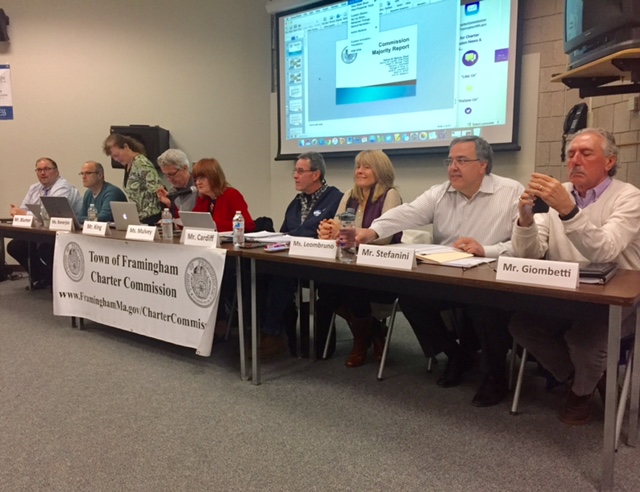
Three days ago I wrote my first argument in support of the charter change, and I adduced many, many reasons why I find it a very good change. last night’s hearing confirmed my opinion. Indeed, every one of the arguments brought forth against the change by its opponents, I find to be a positive argument why that change should take place. Add to them the palpable lack of preparation or argument demonstrated last night by the opposition, in contrast to the remarkable conviction and profound preparation  shown by the charter Commission — John Stefanini and Dennis Giombetti in particular.

Chance really does favor the prepared mind. In Framingham, it should favor the prepared argument.

—- Mike Freedberg / Here and Sphere


The Most Powerful Person In the Room


Guyana_oil

^ the power of oil

—- —- —-

Some may remember the story of the Enron collapse, an energy corporation disaster that now seems a distant memory. Lots of people lost their life savings in that, and Ken Lay, the head of the company, lost his life. The smartest guys in the room…turned out not to be.

In 2017, energy companies are more powerful than ever. Executives come and go, but some companies stay. If we look at energy as power, think this : Politics is a form of power, power over the people, and the lines between corporate power and political power have never been so clearly defined, and clearly blurred.

When it comes to government power we tend to think of the United States- the most powerful nation in the world. But when it comes to the impersonal beast that is big business power, we may think of Big Oil. What does it mean when those two powers…governmental and business…literally become the arms of one man?

Many supporters of Trump think he is powerful; he’s a successful business man and President of the United States. He projects power, which appeals to some people. I’d like to point out there’s a difference between projecting power…and being power. But I’ll come back to that in a bit.

Much of government is a revolving door; someone works in the private sector, does well for a certain industry, then leaves that industry to go work for the government, at a significant reduction in pay. Why would they do that? Answer: because their industry pays them to.

They go to work regulating the industry they used to work for.  Sounds like a conflict of interest, huh? So it is. And systemic.

After they’ve made money in their industry, they go to work for the overseers of their industry- the federal government. Then they go back to the private sector, often in the same job for the same company that employed them before. This trick is called “a revolving door”. One particular perk of it : when someone agrees to accept a public sector position, low-paying and all, they must divest any stocks they have relating to their industry beforehand.

They get to sell whatever stocks they have tax-free.

Let’s say you have $450mil in Goldman Sachs stocks and you accept the president’s appointment to Secretary of Treasury, as did Hank Paulson under Bush 43. That’s $450mil you don’t have to pay taxes on. Nice, huh? It gets nicer.

These newly-appointed cabinet members then get to re-invest that money upon returning to private sector. They literally benefit coming and going. They get to sell and re-invest and completely avoid taxes.

That makes Trump’s kind of tax dodge look dumb.

So why is this important? Because our world now literally hangs in the balance because of it.

Vladimir Putin rose to power in his country by combining his political power and his ability to take oil power. He  took control of Russia by taking over all the oil companies in Russia, mostly by force, and now he’s the single richest man in the world. Since he’s a president…and an oil company owner at the same time…is he effectively the most powerful man in the world ?

Let me say this- if he were to become President of the United States, the answer would be indisputably yes.

I’ll let that sink in. For a moment.

Let’s return to the United States and our revolving door employment policy. The current suspicion is that Putin and Russia influenced our election, literally placing Donald Trump as President, for the benefit of who? Putin? Maybe. After all, he’s president of a country…he places someone under him as acting president of the United States…and wha-bam- he’s the most powerful man in the world, right? The Russian Kaiser Soze.

Trump, in the past, has applauded Putin as “really smart”, which could equate to “the smartest man in the room”. Let’s see if that’s true.

In the United States, the energy equation lately centers around Keystone XL and Dakota pipelines. They stand to make the US less dependent on foreign oil (which, by the way, is Putin’s main commodity). As these pipelines struggle to come online, who benefits from this venture with Transcanada? One particular company of note: Exxon. The biggest oil company in the world.

Perhaps Exxon, leading the way, needed to install someone in the US government to make way for these pipelines massive profit potential. Remember, power is a two-sided animal- government and business. Exxon is an American company, and America is the most powerful country on earth. Since oil is the biggest business on earth, its interests have always driven foreign policy and, literally, war. War is always about oil.

A few years ago a movie called American Gangster starred Denzel Washington. In it his character sternly admonishes his brother for going out in public wearing a pimp-ish fur coat and looking like Super Fly, when that was the first rule of Gangsterism you don’t break.

The loudest one in the room is the weakest in the room.”

Never flaunt your power. Keep it hidden, lest you become a target.

If we apply this movie wisdom, we immediately see who, in our real world, might be the weakest in the room. Cuz he can’t stop tweeting for attention.

So who is the quietest?

Putin seems rather quiet, but he’s infamous, and often comically portrayed on SNL. He spreads propaganda of himself doing macho things, shirtless. That doesn’t sound like the quietest man in the room. Powerful and dangerous, but not the quietest.

So who is?

Who has Trump installed, from the private sector, in a major position of note and has said barely two words to the American people? Trump, who talks about himself in third person, picked said man as his Secretary of State, now literally the third person in line to the presidency.

This person left a lucrative job at Exxon to go to work for the United States government, with a severance package worth $180mil and some $54mil in stock which he gets, per the agreement with the Federal government, to sell without paying taxes.

See this link : http://dailym.ai/2n505X5

So why am I not saying his name? Because it isn’t about him. It’s about power.

The quietest one is the most powerful one in the room. He shakes hands with presidents, of the United States and Russia. He is from Exxon Mobil but not of it. Exxon has pipelines poised in the US and in Russia, which he will need to oversee and make decisions on…yet recuse himself at the same time. The United States still has sanctions prohibiting oil drilled in Russia, drilling heavily invested in by Exxon.

So as Putin already appears to be in control of Trump, the question becomes who controls Trump and Putin. Consider that it may not be a person. It may be a power.

Return for the moment to a previous idea- “the smartest men in the room.” Maybe smartest refers to something other than cleverness, like perhaps hurting, as in “that smarts”. The men in the room who cause the most hurt. And after that, consider it isn’t one man, but instead something far more powerful. Kaiser Soze was one man and never said anything, but he wasn’t real. He was the unusual suspect.

Maybe this time, he isn’t. Maybe he is oil, itself. Personified.

And he is real.

—- Christopher Mugglebee / The Mugglebee Report at Here and Sphere


IMMIGRANTS, REFUGEES & TRAVELERS

author

^ Mem Fox, an Australian children’s book author recalls her treatment by customs agents recently :

<!– <!–esi –>
https://assets.guim.co.uk/javascripts/20a74291cbb1fcd86e8799eaaf98732d/es5-html5.js

“I have never in my life been spoken to with such insolence, treated with such disdain, with so many insults and with so much gratuitous impoliteness,” Fox said.

“I felt like I had been physically assaulted which is why, when I got to my hotel room, I completely collapsed and sobbed like a baby, and I’m 70 years old.”

—– —- —- —-

Read the above caption again. I hope that it makes you as angry as it should make all of us.

Somehow, by some twist of history’s knife, America, the nation made by, of, and for immigrants, and by refugees, and even by travelers, has turned its back on itself.

This is the political regime we now live with. The hate is real; the cruelty, the spite, the vengeance; the scapegoats.

We have liked to think that America is humanity’s escape route from the earthquakes of history, and so, often, it has served us. But there IS no escape from the evil in human hearts, there never has been, there never will be. All that people of good will can do is to fight back; to fight and defeat the evils that take hold of some of us some of the time, even in the sanctuary we have called America.

Today the fight is urgent. Immigrants are being harassed at the border and within our communities; harassed and, for the unlucky among them, persecuted. Refugees, who have always had a claim upon our nation’s welcome, now find the welcome mat burned, the open door locked shut. Travelers to America, who have made our tourism industry a fount of prosperity and whose stories of American dynamism and genius, taken back to their homes, have made our nation admired all over the world, are being subjected to intimidation, profiling, condescension, and refusal.

No wonder that many are now cancelling plans to visit here or to apply for refugee status. Student groups have come to the border only to have one or more of their group refused entry. Who wants to risk that happening ? No one I know of.

If you’re Muslim, or of Arabic or Persian origin, expect even worse. Ask Ben Zand, a journalist from Liverpool who was born in England but has Persian ancestry. This is part of his recent tweetstorm:

“…he said they’re told to stop people who look Arabic or Persian, or have an Arabic or Persian sounding name.”

The reverse is happening as well. Green card holders –legal permanent residents — are afraid to leave for fear they won’t be allowed back. Citizens, too, face, when returning from travel broad, the prospect of having customs agents demanding their personal cell phones for searching. For all of us America is now a prison.

For all of the above there is no just reason. All of it has been imposed by the usurper in  Washington to satisfy his fears, his whims, his desire to intimidate and alienate everyone he can. The entire regime is unConstitutional, and no doubt it will eventually be forced out by our one remaining bulwark, the Federal Courts. In the meantime, however, all kinds of evil has sprouted : a thousand bigotries, a sea of hates, a cacophany of groundless grievances given voice by a leader who is a walking hulk of bigotries and hates.

Wor\st of all is the gloating cruelty of his mob. One reads it every day on twitter, the social media platform for journalism and news. One need only surf the comments on Chelsea Clinton’s tweets to see the vulgarity. Hundreds of raw verbal sewage pours into those threads, leaving, for anyone who reads it, shocking demonstration that a large mob of gratuitous evil — glorying in insult, proud of ignorance, sulfurous contempt — has sucked dry our nation’s soul.

Chelsea Clinton can take it. She’s heard versions of it for decades. Our immigrants, refugees, and travelers, however, have far fewer resources to fight the hate. They are the most defenseless among us. It’s hard for travelers to exercise Constitutional rights, harder still for immigrants, almost impossible for refugees. The regime in Washington can assail these almost with impunity, and it is doing so, aggressively, and seeming to glory in it.

Do not imagine that the harassments and persecutions will stop at travelers,. refugees, and immigrants. Be very sure that what is being done to these will soon enough be done to the rest of us if we do not fight back and win, if we do not stop the evil at its beachhead. Because immigrants, refugees, and travelers are us. They are what America is made of. If we value America, we must value them, cherish them, fight for them. They are the future of us.

—- Mike Freedbertg / Here and Sphere


WILL FRAMINGHAM BECOME A CITY ?

Framingham

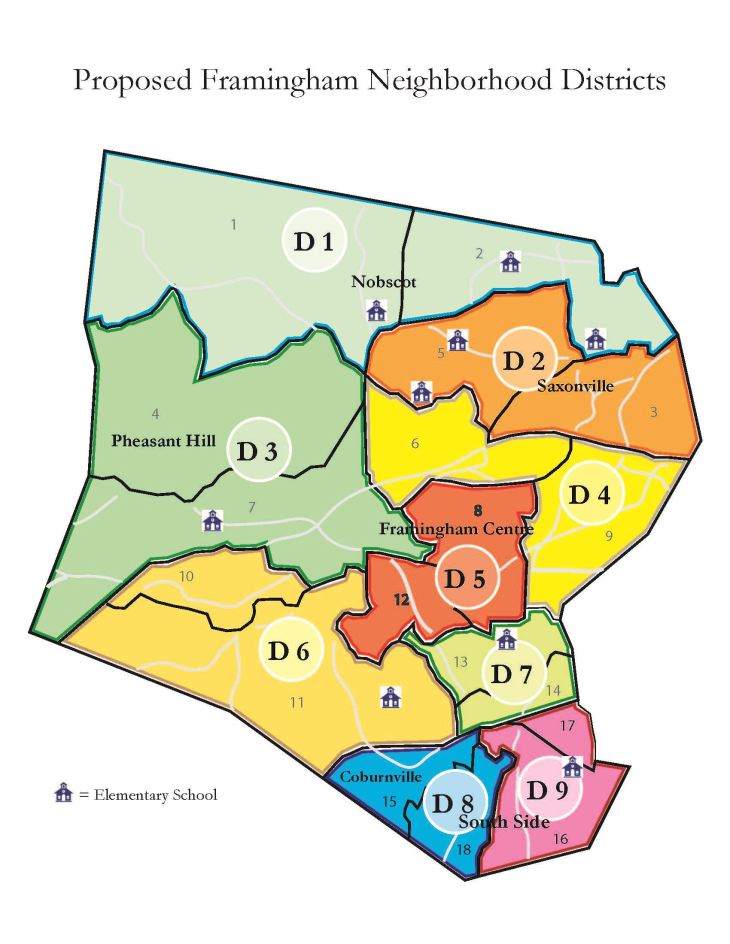
^ the nine City Council districts proposed by Framingham’s charter commission. (there will also be two councillors elected at large.) Voting on whether to approve Framingham as a city takes place on April 4th.

—- —- —-

20 miles west of Boston, bisected by the traffic swarms on Route 9, lies the town of Framingham. The 2010 census found 68,318 people living within its 26.41 square miles. That’s a lot of people for a town government to handle, and Framingham leaders, understanding this, are moving to change it from town to city.

Will Framingham become a city ? Tuesday, April 4th is the day the voters decide. A “yes” vote is not a slam-dunk. Eight of the nine charter commission members voted “yes” to present a charter to the voters, but the lone “no” vote — Teri Banerjee — has presented a written dissent.

How does the town moderator feel ? In the town meeting system provided by Massachusetts law, town moderators have tremendous power. They run the annual town meeting; they set its agenda; they can move decisions on town meeting items. Teri Banerjee is the Framingham’s town moderator.

I will discuss the charter proposal next; but before I do, it will be helpful to read the commission’s full website information here : http://www.framinghamma.gov/2067/Charter-Commission and here :  http://www.framinghamma.gov/2069/Charter-Commission-Documents

You should also read the final charter report here : http://www.framinghamma.gov/DocumentCenter/View/25515 as well as commission member Teri Banerjee’s Minority report here : http://www.framinghamma.gov/DocumentCenter/View/25516

And now to my discussion of the decision to be made by Framingham voters:

I do not live in Framingham, but I know it well. I’ve worked Framingham political campaigns, have socialized in Framingham, shopped there, and — as have most of my readers — driven within and through Framingham quite often. A quick glance at a map of Massachusetts shows that Framingham isn’t just any large community. It is the very heart of “Metro West,” the halfway point between Boston and Worcester and connected economically to each. Yet today, Framingham hasn’t the degree of control over its centrality that it should have. It was once a thriving mill community, back when the road from Boston to Worcester was much smaller and distances much harder to negotiate; but those days are long gone; the Framingham we know today feels overpowered by through-way traffic, a community that still behaves like a suburb of commuters who sleep there, and maybe go to school there, but don’t do much else there.

This must change. It is already changing. As ambitious people move to the central parts of bustling commercial cities, Framingham’s service as a bedroom suburb lacks muscle. To cut to the chase: Framingham’s size and location demand that it become a central Downtown, like Boston and like Worcester; a community with a thriving, center core-based technology, an enterprise district. The town meeting form of government contravenes this purpose. Strong central cities need a strong central government. The charter’s strong Mayor and district council proposal meets that need.

Teri Banerjee’s Minority report complains that elections for the charter’s nine district council seats will be expensive; that the volunteer participation that fuels the town meeting system will give way to professional campaigns and big=ticket politicians. She complains even more about the proposed strong Mayor. She is right. That will happen. To me, it’s a good thing; it’s what is needed.

Entrepreneurs and developers shy away from dealing with cumbersome approval processes and their unpredictability. Who wants to spend millions of dollars and years of effort preparing a zoning change, or a large development, only to have it come before a 200 member town meeting peopled by extremely local particularisms ? The process is difficult even in a strong Mayor city. Far more efficient to have a zoning board and a City Council representing entire districts, or the entire city — the big picture gets a fair shot to make its case against 200 tiny snapshots.

The big picture is crucial. Neighborhoods aren’t limited only to their residents. People who work in a neighborhood,k who shop there, who visit there, and those who will do so when the neighborhood changes, are all just as much a part of a neighborhood as those who reside within it.

This, at least, is how city neighborhoods live, and it is WHY they prosper.

The proposed strong mayor and elected council system also has political consequences. People with serious political ambition will run for these larger, more singular offices. Their serious campaigns will draw serious media attention and thus serious political attention. Whoever becomes the Mayor of Framingham will instantly be a major figure of political influence. Inevitably his or her election will make the entire political and economic community take notice. At which point Framingham’s 68,318 people — probably many more by now — will maximize their political and economic clout.

One last consequence of Framingham being a city : its drawing power will extend the Boston economic boom west to Worcester and beyond. Bringing the “Boston miracle” to points west has been a pre-occupation of the Baker administration since he was first elected. It’s a vital goal for the city of Worcester too. Baker and Worcester’s Mayor Joe Petty have established non-stop Boston to Worcester train service; but it’s still a long way — economically and socially –from one city to the other. Creating a Framingham business city will shore up the distance and help to forge a continuous Boston – Framingham – Worcester business corridor. All the communities that border this corridor will perk up when that happens.

Framingham is not broken. Teri Banerjee is right to point that out. But it is far from being what it can be, should be, and will be, because change is coming, whether the community approves it or not. The campaign for change is hotting up. In  our next report we will let you know how things look for voting day.

—- Mike Freedberg / Here and Sphere
CHARLIE BAKER WILL LIKELY BE RE-ELECTED. BUT WILL HE BE OUR LAST GOP GOVERNOR ?

FullSizeRender

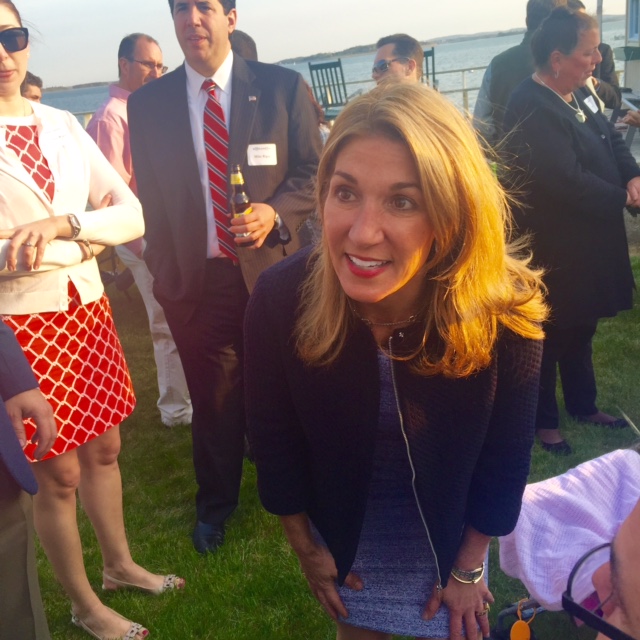
^ can Karyn Polito be a next Republican Governor, after Charlie Baker’s likely re-election ? Can anyone be a next GOP Governor of Massachjusetts ?

—- — —-

There’s been talk about whether a devotee of Mr. Trump will try to “primary” our decidedly NON-Trump Governor, Charlie Baker. I’ve heard rumblings, but the Globe recently quoted a few of Baker’s Trump-ish opponents dismissive of the likelihood. Perhaps that’s the case. Perhaps they are right, and I was wrong. Their case is a strong one: ( 1 ) Mr. Trump needs all the support his fans can give him ( 2 ) Senator Warren, whom Trump fans despise, has her own re-election for them to do battle with and ( 3 ) Baker haters seem resigned to the prospect of his very likely re-election, given his polls and his voluminous campaign funds.

I agree that Baker is likely to win re-election comfortably. He has done the job he said he was going to do; his caution frustrates some but aggravates few; and he has put himself on the side of our vast majority of voters on every hot-button issue that has arisen. He has stood with Attorney General Maura Healey on her challenges to Mr. Trump’s immigration and travel ban orders. He stands with Planned Parenthood. He vigorously opposed the South Boston Veterans’ original vote to bar the OUT Vets from marching in next Sunday’s Saint Patrick’s Day Parade. Baker and Boston Mayor Walsh have partnered on most Boston developments; they continue to do so.

Baker has targeted state funds to environmental matters and to municipal needs. His very numerous judicial nominations have faced little or no opposition. Where scandal has arisen in his administration, he has taken swift action to end it. He works with whoever needs to be worked with : legislators, business leaders, unions. It’s hard to think of any major interest that he has disappointed. Even immigrants’ rights advocates, who would like Baker to agree to grant driver licenses to undocumented people, and to declare Massachusetts a sanctuary state, acknowledge that he has made no moves at all in the direction of Mr. Trump’s war on those who actually reside here.

All of the above has led to baker winning big approval in every poll taken : 59 favorable, 19 unfavorable in the moist re cent sounding. His numbers come out better – much better — even than the supposedly beloved Senator Warren. Only 44 percent told the most recent pollster that Warren deserves re-election; 53 percent said the same of Baker. Warren will do quite better than 44 percent next year; she will probably approach 60 percent of voters,. But so will Baker.

And then what ? After Baker finishes his two terms, at age 66, will the next Governor also be a Republican ? Lieutenant Governor Karyn Polito would, I am sure, love to succeed Baker, and she has everything it takes, including unmatched experience of our municipal governments, to be a successful election winner. (Disclosure : she and I are friends.) But things do not stay the same, and the platform whence her election launches — the Republican party — is not getting stronger; and whatever new strength it is acquiring from Trump fans actually disadvantages it in Massachusetts elections, as Mr. Trump won only 33 percent of our state’s vote, and his positions and persona are anathema to almost every voter who voted against him.

Massachusetts has elected Republican Governors ever since Bill Weld won in 1990, with only Deval Patrick as an exception, in large part because our Republican nominees have been good government, reformist, referee types : and Baker epitomizes the Governor as nonpartisan referee. The very smallness of the local GOP, only eleven percent of all voters, assures the state’s Democrats that no GOP Governor can ever implement a partisan, GOP agenda; while his not being a Democrat assures that he is free of the many fractures that split the state’s dominant political party. But this system has worked — this situation of electing Governors from a very small political group — only because the local GOP has chosen electability over ideology. I’m not bullish that this realism will continue.

The Trump interest is not a realist one. Baker’s caution offends their recklessness. They do not want to win elections, they want to change how elections are run. Trump’s fans prefer that only property owners vote. They reject the welfare state, including the social safety net;  they want less legal immigration (as well as no undocumented), they dislike inconvenient people; and they insist on saying all these things, loudly and with insult. None of this is calculated to win any Massachusetts election in our lifetimes.  As our state’s aging Republican cadres continue to age, and to die — go to almost any GOP committee event. the average age of those attending is easily 65, sometimes over 70 –the only young people you see showing up are the Trump fans, the very few, all of them aware of their man’s pariah status and proud of it.

How will a Karyn Polito, s progressive as any GOP office holder these past 25 years, win the support of these insurgents ? How will anybody else gain it, other than their insult confreres ? If the GOP of Massachusetts cannot somehow win large numbers of ordinary activists to its side — and remember, eleven percent of our voters is still a lot of people, about 450,000 of them — there will, by 2022, be few, if anyone,  in the Massachusetts GOP capable of winning a statewide election after winning a primary decided by Trumpians. For the rest of us are not fools. We know anathema when we hear it spoken. Our state has elected almost only Republican Governors thanks to a political understanding unique to Massachusetts, an understanding built upon the wise realism of our political classes bolstered by some and shrewd convenience on the part of a majority of voters. I doubt that such a delicate bipartisanship can long survive the reckless radicalism of Mr. Trump and his cadre of wreckers who will perforce be all that is left of local GOP activism once the warfare of Trump and his Mad Maxes against the regular party has bled itself dry.

—- Mike Freedberg / Here and Sphere


THE TRUMP FILES : OVERPRICED PURCHASES AND RUSSIAN FINAGLES

Putin

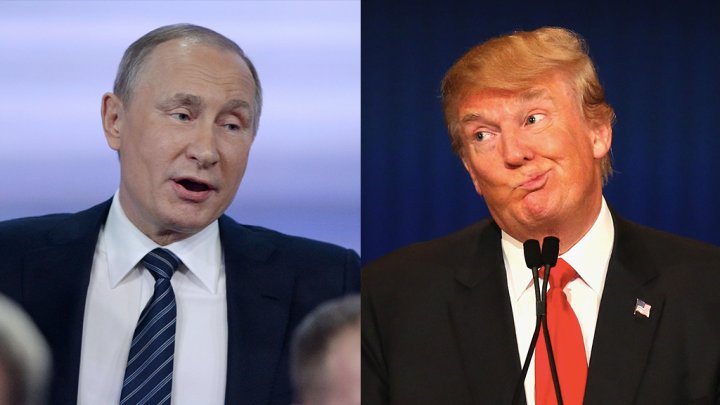
^ on the trail of an allegedly profitable finagle : mysteries surround the relationship of Mr. Putin to Mr. Trump — and vice-versa

————

The Art of the Deal is Real The art world is a strange one, in regards to art as investment. Many people pay very high prices for art work for the very simple reason of parking their money. This idea invariably drives the prices of art up…drastically. The more the better. Because the more it’s worth, the more they get to avoid paying taxes on their wealth.

Recent revelations that Trump bought a certain house in Florida in 2004 for 40 million dollars became notable lately — the subsequent sale of that home having netted him a substantial profit. This is the property that he sold to a certain Russian Oligarch for 95 millions, more than doubling his money.

Why would someone pay a price deemed to be way over market value? That’s the question. This kind of sale is not unknown; these kind of arrangements are a common tactic by which people sink their money into countries like the US, paying way above actual value to do it. How does over-paying for a property make business sense for the buyer? There are two reasons. Number one, the money may need to be laundered because it is not legit. The second reason has regard to the first. The person selling the property agrees to kick back the buyer some of that excessive profit after the sale.

So, did Trump do that in FL? In NYC? No one seems to have that info, because no one gets to see Trump’s tax returns.

The same recent story I have alluded to highlights how Deutsche Bank and Cyprus bank dealt with Russian Oligarchs to launder money, in what the story calls a major case of “follow the money”. What stood out most was the identity of one member of those transactions, a person the story claimed to have facilitated the laundering: a head of the Cyprus Bank, an American : Mr. Trump’s recently-appointed Commerce Secretary.

So why does that matter? Perhaps Trump is installing people already involved in international Russian money-laundering. If so, why ? Trump previously met with Russians to discuss his brand-name hotels/casinos in Russia: all of which is well-documented, but which now, viewed in this light matters more than had Mr. Trump not been elected President.

Before taking office, this was just Trump’s way of franchising his name- he doesn’t actually own buildings, he just rents his name on them. The name is a brand, perhaps one that Russian Oligarchs appear to have wanted use of for making their own money. But maybe there is more to it.

Where this became complicated was when he became the actual President of the United States. The conflicts of interest are obvious for him, but what of others involved whom might benefit from him as president? This is a major question. What is another major question is what if his name becomes a liability? What if he’s a disaster (he is)? Do all these people who’ve invested in his name lose? Maybe. But maybe not. Let me back up. He ran for president, successfully. But did he actually plan to be? The reason I raise that question is there is much evidence that he did not. His cabinet has been in disarray since inauguration, and key positions in the state department have yet to be filled. Another indicator he may not have planned to be president is how ill-conceived his agenda and how easily it’s falling apart. One reason he ran for president was to bolster his brand, that much is apparent. Actually being president…that’s another thing entirely. A man with such extensive conflicts of interest financially gets little to no discernible benefit from actually being President. In simple terms, it requires him to…well…be president. To do the work, which is extensive to put it mildly.

But what if that’s not what he actually wanted? The question would then be “Why is he accepting the presidency?” That may seem like a dumb question…if you’re not really looking at the evidence. He seems inclined to make money, even in association with Russian persons of questionable background. Running for president became an obvious money-maker as well.

Everybody, it seems, was making money on running for president in 2016, most knowing damn well they had slim to zero chance of ever actually becoming POTUS. The money-generating potential was huge. But he campaigned on the idea he was using his own money. Is that true? If so, what would be considered his “own money”? Profits from a certain house sale?

The idea he didn’t actually want to be president is a controversial one, but in this case I feel it matters. We know Russian hacking seems to have been targeting HRC and to benefit Trump, but why? How would they benefit? The sanctions, right? Yeah, but maybe that’s not the only angle. Maybe that’s the obvious one, but maybe there’s another angle, a wholly financial one, that isn’t receiving as much attention.

Based on Trump’s legal-but-questionable money-laundering of property purchased from him by Russian oligarchs in the United States, transactions which seem to cast a growing shadow over now-President Trump, is it possible these transactions indicate a wider financial deal, one that set something in motion that even Trump himself at the time did not grasp, but thought nothing of beyond a healthy sale to a generous foreign national ?

Something he thought, at the time, he could distance himself from and control ?

Something he never imagined was as widespread and profitable that it might motivate cyber-terrorist efforts to meddle in an election of the President of the United States. Now that he’s President, these financial deals he has ties to he not only has been trying to hide but literally now has to hide. Because they indicate something way beyond conflict of interest. Did Russia work to make him president even if he himself never expected to be? If so, this would indicate something remarkable: there is a Russian gun to his head. The gun may be an international entanglement beyond our wildest imagination. The true art of the deal is just that- art. And Russian money. Money they’re parking in America.

Oligarch. That word kind of says it all. Trump helped these Oligarchs park their money, and made lots of money doing so. He figured he’d come out shiny blonde…but he turned orange. In doing so, perhaps what he didn’t know, or didn’t wanna know, was the scope of this art deal. The deal that Putin was the main Oligarch worth some $85bil and needed somewhere to park his wealth. Maybe Trump knew, maybe he didn’t, but either way what’s done is done. Now he’s president and not only is he literally hoping this all just goes away (it won’t), but he has to run this country and he doesn’t know how to govern much less run a country. He’s in a very tough spot: he can’t help the Russians without drawing attention, like he was able to before. And he can’t sell them any more over-priced art. Which begs the question: was meddling in the election the second phase of the original money-laundering art-parking scheme? And if so, what can Russia now buy from the President of the United States? Something tells me this painting is a fake, and we’re finding out far too late.

—- Christopher Mugglebee / The Mugglebee Files for Here and Sphere

COUNCIL DISTRICT 2 : FIRST LOOK MONEY REPORT

Mike Kelley

the money leader right now : Mike Kelley campaigns in “Southie” with our mutual friend Marcella Sliney (center)

—- —- —-

Money for the five-way contest to choose  a new Councillor for District 2 lines up like this as of March 1, 2017:

Michael Sean Kelley has 48,694.36, including big donations from several major Boston political and real estate names : John Affuso, Bob Beal, Harry Collings, Suzanne Iannella, Dennis Kanin, Henry Kara, Steve Kunian, Marc Savatsky, and Peter Welsh. The real estate community generally provided a very major percentage of Kelley’s money so far.

Ed Flynn has yet to file a new report. His last was from 2006, when he ran for this City Council seat in a race won by Bill Linehan.

Cory Dinopoulos reports 2,404.27, including a donation from former governor candidate Juliette Kayyem, who served on the Boston 2024 committee that Dinopoulos helped found. Cory had his campaign kickoff on March 2nd; we will soon see the money results thereof. It was very well attended.

Peter Lin-Marcus has formed a campaign committee but has yet to file a money report.

A fifth candidate, Frank Ulip, reports $ 25.00 as of March 1st.

— Mike Freedberg / Here and Sphere