IS AUTOMATIC VOTER REGISTRATION A REFORM OR A STEP BACK ?

AVR Briefing

^ do you support this ? Not so sure. Read our argument why not.

—- —- —-

On my 21st birthday I registered to vote. The City Clerk personally swore me in, because he and my Dad were friends, and our city was small enough that that personal connection could be honored. Why did I register ? I did it because my Dad insisted. I guess that i also felt a bit of pride, that I was now an adult and confident to do my duty.

That was a long time ago. Much has changed since. Electeds in many states, who call themselves Republicans but in fact violate the Republican party’s founding missions, have engaged in all sorts of skull-duggery. to “depress” the vote. They have taken voters off the list for small administrative quirks; required people to show certain kinds of state ID’s that they may not have, or may not be able to travel long distances to acquire; refused to restore voting rights to convicts who have done their time; moved polling places so that unfavored vo9ters have a hard time getting to them. And many more such moves to deny citizens their most basic civil right, the right to vote.

Misdeeds of this sort disgust most of us, and should. Registering to vote should be straight-0forward and unburdened with detours. Polling places should be centrally located within a precinct. Ballots should be easy to use and probably paper, so that they can’t be hacked by malfeasors or foreign governments. Moves to intimidate voters as they arrive to vote, such as those perpetrated by a right wing group known as “True the Vote,” must be dealt with severely. I think most of us agree with all of these assertions.

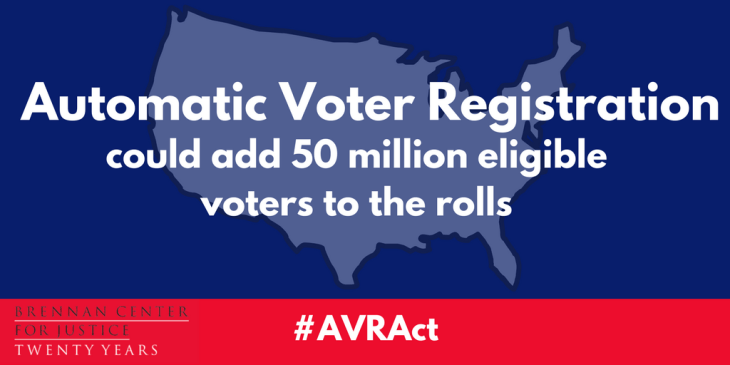
What, then, ought we to decide about a new proposal, whose purpose is to assure that every eligible person is registered as a voter ? I refer to ‘automatic voter registration.” It goes thus in Massachusetts : when a person comes to the Registry of Motor Vehicles (RMV) to obtain or renew a license or register a vehicle, he or she can register then and there: but she has to ask. Under Automatic Voter Registration, the person signing in at the RMV window is registered by signing in; she may OPT OUT of registering, but otherwise is registered.

My own view is that registration that requires no act at all by the registrant weakens the vote. I strongly believe that a person must make a positive, conscious decision to register, just as she must make a deliberate decision to go and vote. I see our system as participatory: but it is participatory by effort. Though obstacles should never block a person’s decision to participate, the presence of decision seems to me vital. We can allow voting by mail, or even voting online, and either of these reforms — used by many states already — requires the voter to do stuff — to take action. It certainly isn’t heavy lifting, nothing that the legendary John Henry would have to die with his hammer in hand for, but actions they are. Automatic  voter registration is the absence of action. The person does nothing; it is done To him. To me, that is not participation. It is not a deliberate resolve to get involved. And involvement is what a healthy democracy requires.

—- Mike Freedberg / Here and Sphere


CUSTOMERS ARE THE ECONOMY, SO PUT MORE MONEY IN THEIR PAYCHECKS

ABOOK-Aug-2017-PCE-Real-PI-Excl-Xfers-Real-GDP

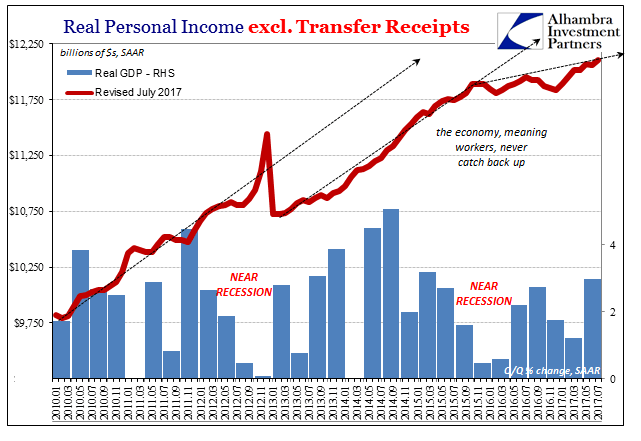
Are you fed up with hearing about the trouble our nation’s economy is in ? I sure am. Well: if so, the solution is simple: consumers, whose buying represents two-thirds of the entire  economy, just don’t have enough money to support their part of it all. This especially holds true in the big cities, into which almost everything economic is now concentrating : good jobs, lots of them; shopping, night clubs, restaurants; residence, transportation, innovation. In the big cites, everything is booming — except wages, other than for the lucky.

In Boston today, $ 3,000 to $ 4,500 a month rents, for tiny apartments, has become almost the norm. Few are the neighborhoods in which a house can be bought for less than $ 600,000; close to Downtown, the price is more likely to be $ 899,000 or even $ 1,000,000 and up. No one earning less than $ 100, 000 a year can afford these rents; few who earn less than $ 150,000 can afford to buy.

As with real estate, so with everything else. A decent meal now costs at least $ 20 if you add a tip; $ 27 to $ 30 if you add wine or beer. You can’t get to a Downtown restaurant, in any case, without shelling out $ 20 to $ 25 for parking. Nightclub entertainment costs $ 30 to $ 60. Clothing purchases in Downtown malls or single stores will run you $ 100 to $ 2500, more often the higher end than not. Food isn’t cheap: at least $ 700 a month for two. Then there’s utilities : $ 99 (plus taxes) for a cell phone line, $ 172 for any cable TV other than basic $ 200 for electric service, $ 125 for gas heat. Food, home furnishings, haircuts, the MBTA — add these, as well as home repair. Cars ? Some do without, but if you have a car, there’s the monthly finance charge, an insurance bill at least $ 200 a month, and parking, if you can find it.

Assuming you earn enough to pay all of these — the above bills add up to about $ 6200 a month after taxes; add taxes and the paycheck total looks like close to $ 10,000 a month — how are you going to buy anything else ? Granted that your city life funds restaurants, car dealers, car financers, utility companies, night club employees, clothing retailers and manufacturers, is that all there is ? Who will buy house repairs, summer camp for the kids, boats, vacation trips, furniture ? Who will pay for child care ? Doctor and dentist bills ? The kids’ education ? And savings : who will have money to save ? After all, the median family income in Boston is about $ 62,000 a year. Yet the expenses I have listed require double that.

Then there’s those who earn less than the median. The state’s minimum age right now stands at $ 11/hour. A current proposal would raise that to $ 15/hour by 2022. At $ 15/hour, a worker without overtime earns $ 600 a week, $ 31,200 a year. Two minimum wage workers living together barely manage the median income. That sounds OK, but at $ 62,000 a year — $ 5166 a month — said family can afford a rent no higher than $ 1800 a month, which means living in Boston’s barest neighborhoods, in which City services are skimped and few people have stay at home time to care for kids. $ 5166 a month also means a barebones life :

—> taxes, 1200 a month; rent, 1800; cell phones for two, $ 189; cable TV, $ 172; utilities, $ 300; clothing, $ 300; food, $ 700; transportation (MBTA), $ 80. That leaves about $ 400 a month with which to fund repairs, kids’ sports, emergencies, maybe a weekend vacation. It does not allow a car, or health care co-pays, or Christmas, any entertainment at all. Or savings. I also did not allow for purchase of a laptop or for wi-fi hot spots.

Most of all, the $ 15/hour minimum wage doesn’t offer those who earn it much opportunity to buy in the discretionary economy. You go to any mall and marvel at the plenteous goods on offer, not to mention services: but who can buy them very often ? Our economy isn’t fulfilling its potential if all that it supplies to the vast majority of consumers is basic needs. Discretionary spending allows innovative goods and services to prosper. It allows creators’ skills to advance. It allows for savings, investment, development. Our economy needs to find a way to put more money — MUCH more money — into the paychecks of most workers. And not just our money economy. People who earn more — who can enjoy the discretionary economy — feel better about themselves and thus enjoy better health, longer lives, participation in the community, a bit of the tastes of freedom.

One can, it is true, move away from the big cities into small cities with a much cheaper economy. Fall River is a perfect Massachusetts example. Rents there are less than half of the Boston price; buying a house costs almost two-thirds less. Yet there is no way even for a Fall River to buy goods and services in the wider economy. These cost the same wherever they are on offer. If you pay $ 900 rent, as is typical for Fall River, or buy a house for $ 125,000, you definitely can afford to earn less. But you’ll still have to pay the same price for cell phones, cars, utilities, food, clothes, and vacation as you would pay in Boston. And if you choose Fall River’s much cheaper housing costs, while maintaining a Boston job at a Boston paycheck, you have a 55 mile commute in the morning and back at night, which means a car and gasoline and car insurance, not to mention three hours every day wasted on the road.

There has to be a way to up the median Boston income to $ 90,000, and to raise the minimum wage to $ 21/hour, without having landlords, restaurants, and real estate speculators jack up the market accordingly. If City life is not to drive out those who earn modest salaries, we have to achieve this. Extend the earned income tax credit ? Perhaps that. Somehow we must allow the vast majority of residents to afford the innovation economy.

—- Mike Freedberg / Here and Sphere

A PROPOSAL FOR RESOLVING THE AIR BnB ISSUE

untitled

^ an Air BnB hotel room : NOT to be coming to your NEIGHBORHOOD if we can help it

—- —- —-

People in Boston have talked for at least a year about the impact of Air BnB on our City’s housing crunch. It’s not a new matter at all. The question has been, what to do about this loss of housing to the short term rental; market ? We’re not concerned about residents who decide to rent out a room to BnB guests — that’s their fright — but about whole buildings of apartments being bought up by investors — or speculators — solely to rent out for very short terms. THAT is the issue that has activists up in arms.

The Air BnB people want you to think that opposition to this new, short-term rental industry is an attack on the rights of homeowners. This, dear reader, is horse effluent.

The company has thrown this bit of garbage at City Councillor Michelle Wu, who has advocated restrictions on short term renting. It’s all over twitter. This too, is horse effluent.

Air BnB’s push-back has garnered significant support, most of it derived from the misrepresentation of Wu’s position. What Air BnB has claimed against Wu is untrue.

End of story.

Perhaps now we can proceed, as the City is trying to do, to propose regulations that will preserve homeowners’ rights while regulating what amounts to illegal hotels and rooming houses.

The City already has a hotel code and a rooming house code. They’re part of the City Ordinances, available online: you can read them, and you should. Thus my proposal is a simple one:

( 1 ) every owner or purchaser of a real property that contains more than four residential units must secure a permit from the City allowing him or her to rent a residential unit for a term less than month to month. An owner who fails to obtain such permit but rents anyway for shorter terms, is in violation of the zoning code provision that prohibits same and is subject to the filing of a housing-criminal complaint, just as would be the case for an owner who violates the state sanitary code.

( 2 ) every property containing more than six residential units shall be deemed a hotel or rooming house, as the case may be, for the purposes of regulating short-term rentals therein, and said property shall be subject to the City Ordinances regulating such properties.

Bed-and-breakfast apartment buildings exist, and are advertised on travel websites, in almost every big city. They provide a much cheaper alternative to traditional hotels: no room service, no housekeeping, just rental of a space. Perhaps these buildings work in other cities. In Boston, however, where housing for actual residents is scarce and ever more costly — as I write, rents approximate about 40 percent of median family income, and home prices equal about 12 times annual income — we simply cannot allow existing housing to be bought up for hotel-like purposes. If such units are to be available, they should be built as such, and in currently less utilized sections of the City — not at all in areas already experiencing rent price surges. Residents may have to compete with each other for housing, but there is no public policy reason whatsoever why residents must have to compete with hotels.

—– Mike Freedberg / Here and Sphere

EVALUATING THE FY 2019 BOSTON SCHOOLS BUDGET

tommy-wide

^ Boston Schools Superintendent Tommy Chang : has a budget memorandum for you. Read it and judge the situation accordingly

—- —- —-

Before I delve into the details of the Mayor’s proposed — now final — $ 1.109 billion dollar schools budget for the coming year, it might be helpful to read Superintendent Chang’s memorandum of justification:

https://drive.google.com/file/d/17VTDAj1-7HtyQKaytMmCL2rrURYqAzob/view

The budget itself merits serious study, as always; but there is enough information in Superintendent Chang’s memorandum to conclude much about Boston’s schools (“BPS”) agenda. Let’s itemize and briefly question some of its assertions:

( 1 ) the increased funding, $ 48 million, represents the smallest percentage increase, by far, of any year’s budget since Mayor Walsh became Mayor. The usual increase has amounted to almost double that. Last year, with a smaller budget, the increase was $ 50 million.

( 2 ) Superintendent Chang’s memo chides the Governor for a state budget providing less state aid, pursuant to MGL c,. 70, than in the prior year. But why, I might ask, should the State increase its aid to Boston given the enormous rise in real estate tax assessments occasioned by skyrocketing real estate values in most of the City ? Indeed : given what is happening in Boston, I am puzzled why the Mayor did not allocate an increase much larger than last year’s $ 50 mil;lion, rather than less.

( 3 ) The Superintendent goes out of his way to applaud that BPS teachers are among the highest-salaried in the state and nation. Doubtless he says this in order to head off teacher salary demands at the next Teachers’ Union contract negotiation: yet hasn’t it been a long-standing sore point that almost 86 percent of the Boston schools budget goes to staff salaries, leaving everything else, from classroom supplies to utilities to transportation and travel or research, to fight over a mere 14 percent ?

( 4 ) The Superintendent also praises BPS for its high level of school success, noting how many schools in the District now perform at Levels One and Two, per State Board of Education standards. I cannot tell if he has it right, but assuming that he does have it right, why is more State aid needed, given the Equal Protection limitations placed on c. 70 compensatory funding ?

( 5 ) Mr. Chang’s memorandum also notes “under-utilized schools” as a recipient of state funds. The under-utilization of some school buildings is nothing new. It’s been a discussion point for at least all of Mayor Walsh’s years in office. Why hasn’t the District consolidated the many under-utilized school buildings, closing some entirely and thus saving about $ 50 million in maintenance costs and utilities expenditure ?

( 6 ) The memorandum also notes that 57 BPS schools now practice an extra 40 minute school day and that the extra time costs the District some $ 17 million. Why hasn’t the Superintendent expanded the 40 extra minute reform to every school in the District while utilizing the cost savings from consolidation to pay for it ? Indeed, why is Boston’s school day still one of the shortest in the state ? Most school Districts use a school day more than an hour longer than Boston’s 57 extended day schools.

I have no doubt that all of the above questions will continue to be fruitlessly asked, and that the City’s future budget allocations will continue to lag well behind the increases in tax assessments, and that very little will be done. BPS will continue to fund anomalies and live with them because the will to reform them isn’t there, nor the political alignment. That said, to the extent that Boston schools achieve Level One or Level two performance, I applaud the teachers who under Union President Jessica Tang’s leadership, understand what is expected of them, and I congratulate the students for working so diligently that kudos given them are well founded.

—- Mike Freedberg / Here and Sphere


SOCIAL MEDIA NEED NOT FEED LONELINENESS

kids-watching-screen

^ lonely ? watching your laptop screen ? No need to be, the ‘net offers you a big, connected world whenever you want it

—- —- —-

David Brooks, writing in today’s New York Times, bewails the impact that use of the internet has had on community connectedness. He may well be right; but there is an opposite side to the story, one that he never mentions : social media has enabled all kinds of connectedness that never existed before or which imposed membership gateways.

I see it every hour that I peruse my facebook page — facebook especially. In Boston alone there’s more community facebook pages and discussion groups than I can count. I belong to at least thirty, and thereby I have connected to hundreds of people I could not otherwise have talked with, from every corner of Boston.

Said facebook groups don’t exist only only online. They meet, often regularly. I can attend, and often I do. In my own Boston neighborhood, East Boston, facebook interaction enables me to reach over 10,000 people. Probably other neighborhoods of Boston approximate a similar number.

On these pages one learns of all kinds of public meetings : campaign forums, City of Boston BPDA hearings, Mayor’s Coffee Hours; neighborhood association meetings; outings and days of action; rallies for this cause and that; dinners and breakfasts in the community. There is absolutely no reason why surfing the internet should bolster loneliness. Join facebook, reach out. It’s all there.

In social media you can also connect to people you knew but have lost touch with. I’ve reconnected with college friends, prep school classmates, kids I hung out with in the summers by the ocean, grammar school friends. Until social media came to be, there was hardly any way of finding them. Thanks to social media, I found my entire family of first cousins, most of them living in California or Europe — people that close to me who without facebook and google I could never have found without hiring  private investigator.

Churches and bowling leagues, scouting and Kiwanis, Rotary and the Elks connected people 30, 40, 50 years ago, yes; but the connections achieve via the internet and social media.

Kids who spend all day looking at their laptop screens may well be lonely; but if so, it’s by their choice, in one way or another. The connected world of social media is available to them whenever they decide to want it — just as it is available to you, and you, and you, and me.

—- Mike Freedberg / Here and Sphere

SIGNING THE CRIMINAL JUSTICE REFORM BILL

Baker signs

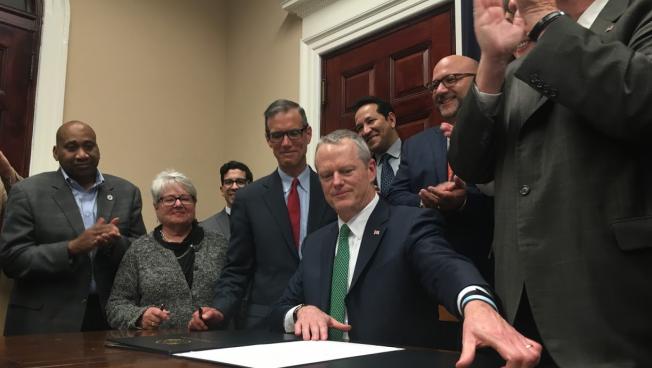
Yesterday, at 3 pm, Governor Baker signed the big Criminal Justice Reform bills that the legislature has been working on for a year. It was a big win, and a big win for him, too — people I spoke to in my own neighborhood, East Boston, were well pleased by his signing it. Despite which, Baker said that he had some criticisms of them that he hoped to correct. My own view : “it’s a win for the state, and it’s a win for us too,” (I am working on the Governor’s re-election campaign, unpaid, by the way) “so let’s enjoy the win !”

Let us enjoy the win, indeed. The bill H. 4012 won approval by the House, 154 to 5, and S. 2371 by the Senate, 37 to 0. It was not a close call, or controversial.

There has been criticism of the bill, from some Sheriffs and prosecutors. A week ago, when State Representative Sheila Harrington (who was on the committee shepherding the final, amended House bill to the House floor) posted on facebook celebrating the House’s vote, I shared her post; and Bristol County Sheriff Tom Hodgson soon came onto my post — yes, mine; why mine ? — commenting several times upon the bill in dire terms and at length.

What might any objections be, to bills enacted almost unanimously by our legislature ? Of sufficient seriousness that Governor Baker feels the need to say “yes, but” even to bills whose signing ceremony was well attended and which he and others posted, on social media,. in quite celebratory words ?

As is my usual practice, let’s, before we discuss further, read the actual language of the acts, S. 2371 and H. 4012 :

S. 2371 here : https://malegislature.gov/Bills/190/S2371

H. 4012 here : file:///C:/Users/nick%20shaheen/Downloads/H4012.pdf

The Senate bill, which is definitely a long read, includes, inter alia, a great deal of administrative procedure applied to sex crime data acquisition and evaluation; much detail about assessment of the gender and mental needs of youthful offenders; explicit directions to police departments barring any sort of identity profiling and requiring de-escalation tactics when responding to 911 calls.

The House bill details, and extensively re-writes, the State’s incarceration, parole, probation, and good-time credits systems. One can understand the annoyance that some sheriffs may feel about this comprehensive re-write of supervisory rules that they and the their staffs must now master. I fail, however, to understand objections based upon a theory of laxity. The detailed rules set forth in the act are onerous for any prisoner eligible for them (and some prisoners are not eligible at all) to adjust to, much less succeed at.

That said, the bills do change the overall theory of Massachusetts criminal procedure from one of imprisonment to one of treatment. I quote from MassLive’s coverage of the legislation :

Among the many provisions: The new law eliminates a handful of mandatory minimum sentences for drug dealing. It creates a process for records to be expunged for juveniles and young adults and for convictions for offenses that are no longer crimes, like marijuana possession.

The bill raises the minimum age of criminal responsibility from seven to 12 years old and decriminalizes some minor offenses for juveniles. It changes the way bail and fines and fees are levied to take into account someone’s ability to pay. It raises the threshold at which theft is considered a felony. It requires more humane conditions for inmates in solitary confinement.

Baker also signed a separate bill, which was the result of a year-long task force examining recidivism in Massachusetts. That bill enhances the programming available in prison and jails, enhances community supervision and expands behavioral health resources.

Thus the general direction of the legislation is to burden treatment and hospitals while de-emphasizing the corrections system itself. There will now be fewer people incarcerated, and for shorter periods of time. I can understand that some sheriffs find this prospect unhappy. The same can be said for corrections officers, always a politically powerful interest. There may well be layoffs. There definitely WILL be greater restraint on what corrections officers can do to prisoners, and their conduct will be closely monitored. Corrections officers may well object : but the level of control they exercise over imprisoned people is hardly limited by words of laws: the phrase “terrible things happen in prison” didn’t comer about by accident. If even one prisoner is saved from being raped or beaten because of the new laws, that is, in my mind, a positive thing.

Clearly, Baker has heard the complaints made by some sheriffs and some prosecutors and doesn’t want to be seen as dismissive of them. That’s OK. The larger fact is that he signed the bills, and did so in a big ceremony.

As he said at the signing, “The very positive elements of the bill far outweigh some of the concerns we have.”

—- Mike Freedberg / Here and Sphere


INNOVATIONISM

FullSizeRender (21)

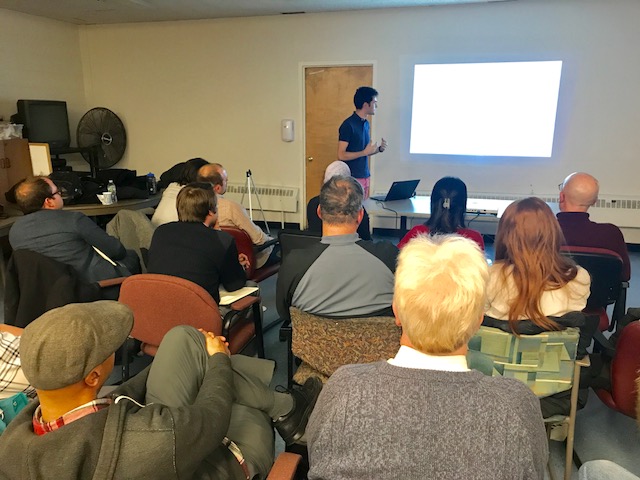
^ sea rise / climate activists listening to a presentation at a recent Harborkeepers forum in East Boston

—- —- —-

Beyond the familiar opposition of “progressive” and “conservative” politics, I propose a new category : “innovationism.”

What do I mean by innovationism ? Simply this : a political arena in which ad  hoc, on site, unstaged suggestions can be made for resolving some of the challenges that face the city in which I live and which tactic I suspect will apply just as well to other cities.

In Boston I’ve seen it work. An emblematic example was a recent design forum sponsored by The Harborkeepers, an East Boston – South Boston citizens group that has, these past two years,. taken on the challenges posed by sea rise and big storm flooding. At said forum, many designs and principles were proposed for accommodating the water that all but surrounds both neighborhoods.

That forum’s discussion did not sound political at all. No “progressive” economics were advanced, no “conservative” customs argued for. There was a problem — water encroachment — and suggestions for curbing it, even making social utility of it. Much of what was proposed calls to mind what the Dutch have done, in their nation so much of it below sea level, to make high water work for them without destroying their communities. Holland has done it all : seawalls that retract and then close, houses on piles, houses that float, water that gets let in to make great harbors, water that is kept out when sea rise looms.

In Holland the task of taming the North Sea has no party identity. I call what the Dutch have done “innovationism,” I apply the same to what is being debated in East Boston and South Boston, and I suggest innovationism as a welcome remedy to the progressive-conservative trap that has stultified so much of our reform work and rendered it difficult if not impossible, when what is needed is reform of everything.

—- Mike Freedberg / Here and Sphere

THE DEMOCRATIC “BASE” IS NOW IN THE SUBURBS, NOT THE CITIES. HERE’s WHY.

patty schlachter

^ Wisconsin State Senator Patty Schlachter : ten point victor, flipping a legislative seat in what had been extremely “red” territory far from any Democratic city

—- —- —- —-

A major shift has taken place in the Democratic party’s locus of force. For at least 150 years, since the Civil War, big cites were the Democratic party’s foundation (also the South, a phenomenon that ended about 20 years ago.) Today, however, cities no longer control Democratic energy as they once did. It’s the suburbs’ turn, and a very specific kind of suburb at that. It’s in the suburbs that were until quite recently Republican that one finds the Democratic fires burning hottest.

Why is this so ? Let me explain.

The new Democrats — the “woke” constituency — is a fairly well to do, almost exclusively Caucasian constituency. Lunch bucket issues aren’t its thing. Those are city matters; and city voters have, mostly, been Democrats for 50 to 150 years. The longer a city has been Democratic, the less likely its Democratic voters are to be ‘woke.” To them, the Democratic party is the establishment, personal and ancestral, often paychecked. The Democratic primary works for these voters. In it they elect those who govern cities and represent cities in Congress.  Because the Democratic primary is where every elected office is decided, anyone who cares to pursue a political career or play a part in politics votes in that primary, no matter what his or her ideology might be. “Resist” is only one among many such Democratic options.

It was different for suburban voters. When voters first started moving to suburbs, after World War II, most of them became Republicans, because it was then assumed that the Republican party would hold the line on taxes, which was the primary issue for people now earning more and having larger savings accounts. Recently, however, the Republican party has become known for religious zealotry, anti immigrant bias, and attacks upon the social safety net. As older suburban voters enjoy social security and medicare, and as few suburban voters are wedded to religion or wish to interfere with women deciding what to do about a pregnancy — the suburbs are built upon everyone minding his or her own business, not upon community solidarity, which is the way of cities — the current Republican agenda violates the live and let live, entitlement lives that most suburbanites like.

Many such suburban voters have fled the Republican party, or refused it, and have turning instead to the Democrats. They have the zeal of converts. Like St. Paul on the road to Damascus, they have seen the light and ever since, have zealously gathered or joined a following.

To the suburban converts one adds the world of academia, which, like the suburbs,was almost exclusively Republican right up to the late 1960s. Opposition to the Viet Nam war converted them, too, as it did NOT change the voting allegiance of city voters, many of whom fought in the war, or had family in combat. It is no accident that, in Massachusetts, the most idealistic Democrats are concentrated, not in Boston — maybe the nation’s archetypal Democratic city — but in academia and the suburbs surrounding the academy : Cambridge, Lexington, Arlington, Medford, Somerville, Watertown, Belmont, Carlisle. Lincoln, Concord, Wayland, Melrose, Salem (and even Winchester, not so long ago a moderate Republican heartland): all of which have become the local Democratic party’s “base.”

All of the above is why we have recently seen Democratic candidates do so well in very Republican states — the more Republican the state, the better the Democratic candidates have done; and the more “resist” and suburban those Democrats, the better still. Perhaps the most extreme instance of this voter movement was the 10-point victory won by Democrat Patty Schlachter in a exurban Wisconsin State Senate seat that had been Republican for decades. A similar shift has moved four legislative seats from Republican to Democrat in Oklahoma, which had, during the past three decades,  become maybe the “reddest” state in the nation.

In Alabama’s US Senate race, though won by a centrist Democrat, the greatest voting shift occurred in suburban counties. The same proved true in last week’s 18th Pennsylvania Congress District: although the very centrist Democrat, Conor Lamb, did much better than recent Democrats in some fairly rural parts of his electorate, his biggest plus came in suburban Pittsburgh.

But yesterday, in the Illinois primary, one saw something quite different. Suburban, “resist” Democrats challenged not in a two party election but in the Democratic primary, which meant taking on Democratic opponents who were not convers but established; and in all three emblem cases, the established, non-convert, non-“resist” candidate won : incumbent, Chicago-based Congressman Dan Lipinski over suburban challenger Marie Newman (Illinois CD 3); Seth Casten, a mainstream executive, over five suburban women rivals, one of whom was backed by EMILY’s list; and in the Governor race, established Jay Pritzker over “resist” favorite Chris Kennedy and an equally left State Senator, Dan Biss. (In Chicago, Biss’s support came almost all from the high income “north Side,” Pritzker’s vote from everywhere else.) Converts are far, far less numerous in Cities like Chicago then are non-ideological, centrist Democrats.

As I see it, the “resistance”‘s converts number about the same in every state and city, but their share of the Democratic vote varies as I have said above : the “redder” the District, the more influential the “resist” vote. My axiom may prove too much, but electeds who stand in the way of convert voters better heed well the arrival of a generation of Saint Paul-style apostles.

—- Mike Freedberg / Here and Sphere


COMMUNITY PRESERVATION COMES TO EAST BOSTON

FullSizeRender

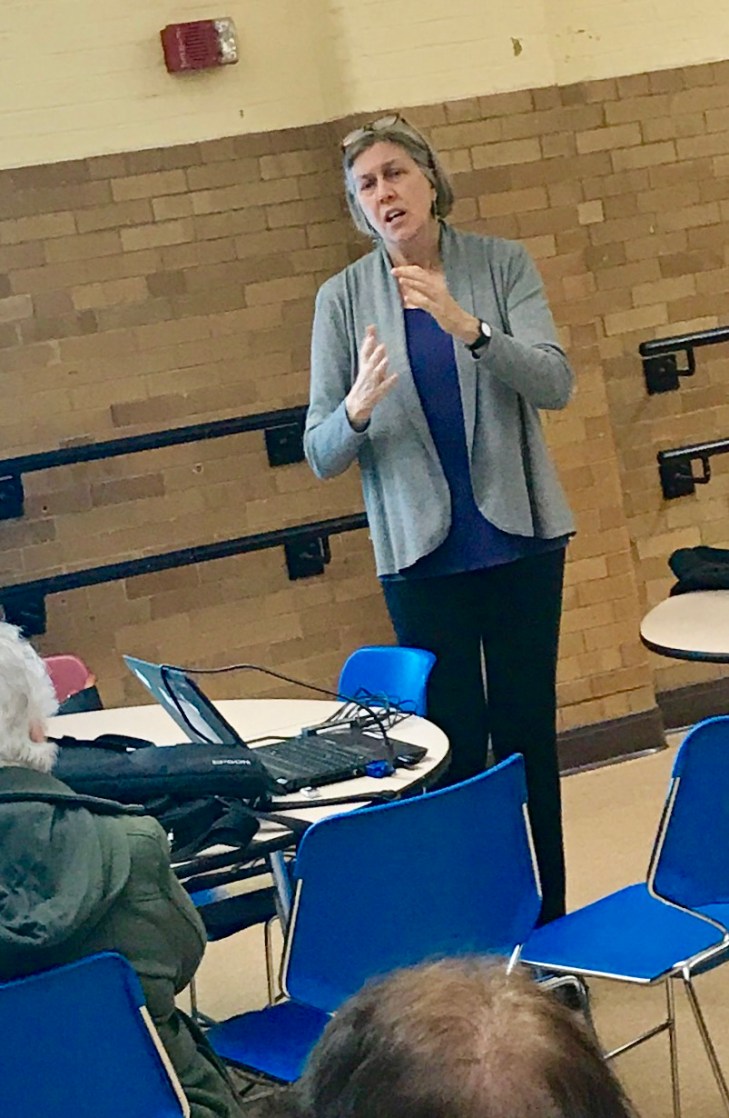
^ Christine Poff answers activists’ questions at last night’s Community Preservation forum in East Boston

—- —- —-

Last night a substantial cross-section of East Boston activists attended a forum hosted by the City’s Community Preservation Commission and its chief, Christine Poff. As I understood the conversation, there’s about $ 20 million — funds designated by the Community Preservation Act and its one percent city tax surcharge, as adopted by voters in the 2016 election — available for the purpose. Thus the question is, what does East Boston need, by way of “community preservation,’ that can be enabled by suchy funds as get targeted to this neighborhood ?

I will answer that question below. But first, you should read the language of the Community Preservation Act (“CPA”) that governs this entire discussion. The City’s website offers the following shorthand of it : https://www.boston.gov/community-preservation-act … and this is the entire text of the Act, which you might want to read : http://www.communitypreservation.org/content/text-legislation

The Act is part of MGL c. 44B and is thus a state matter. (Which is a specific reason why I, in my capacity as an outreach co-ordinator for the Governor, attended the meeting. The Act makes clear that “community preservation” is a very sweeping mission. It includes creation of affordable and moderate income housing as well as preservation of landmarks and structures of significant historic value. It calls for a real estate tax surcharge of as much as three (3) percent — an amount significant in high-value redale state communities.

The major limitation on how much sweeping can be done pursuant to the CPA is its funds. According to Poff, Boston’s nCPA has about $ 20 million in hand (in a fund expressly escrowed for the CPA mission). That isn’t much to a city whose annual budget tops $ 3 billion and whose real estate values have risen sky-high these past 40 years. Preservation just happens to be a function of that bull market in real estate. If values remained at 1977 levels, there’d be no new construction — there wans’t any then — and thus no threat to existing structures and land uses. There is, however, a daily impact upon existing communities. East Boston has of late found itself especially under the gun of development that has utterly rewritten the neighborhood’s waterfront, its piers and its vistas, its open spaces and peacefulness. Today the East Boston waterfront has succumbed to crappy, hulking residential fronts and overpriced underwater garages that clearly came to pass unaware of rising seas reality. Preservation has no place in what now stands on the Eastie waterfront.

Can there be any kind at all of meaningful preservation, now that Eastie’s waterfront has been so thoroughly defeated ? Maybe.

Eastie very much ants to remain an affordable neighborhood. It has served working class families since the late 19th century (including my Mother’s parents, who arrived in 1896) when the area’s status as a destination port for major passenger ship lines inundated it with immigrants from Ireland — JFK’s great grandfather Thomas Kennedy included — then Jews from all over, then Italians. It is home to working class families now as well, most of them from Latino countries but also the Maghreb in North Africa, Brazil, and Rumania. Somehow, Eastie’s working class families manage to endure enormously risen rents, prices that bar many young professionals who, too, would like to come to a neighborhood that offers less density (and lower rents) tan are available Downtown. I’m not sure how long they can adapt. The next level of price rise will surely be the curtain call as Eastie becomes entierly a neighborhood of technology workers, doctors, lawyers, finance workers, and top-level bureaucrats earning at least 4 150,000 a year.

Maybe that destiny need not happen. Community preservation certainly hopes so. To the CPA Board, which includes Jeffries Point activist Kannan Thiruvengadam, I offer the following suggestions :

( 1 ) very limited funds limit the Act’s effect to small victories : a pocket sized park — a dog park ? — here and there; maintenance money for the Greenway; tree plantings in the Gove Street neighborhood; funds for renovation of aging row houses, all over Jeffries Point, Eagle Hill, and the Maverick Square area.

( 2 ) a more ambitious step might be the purchase of a dilapidated, vacant building for renovation as workforce housing

( 3 ) a traffic study of the dangerous, over busy intersection of Bennington and Saratoga Streets hard b\y the Orient heights T stop. Recently Chris Marchi and I discussed this in a thread on the East Boston Open Discussion facebook page. Maybe it can happen.

( 4 ) creation of a plan for safeguarding local homes now seriously threatened by high tides upon rising seas. If we do n ot figure this out, and begin working on it damn soon, the entire generation will find many such homes unlivable.

Doubtless you have many other suggestions what the City’s scarce CPA dollars can work on. I welcome them all. The money is t.here — taxpayer money — and the oversight to make decisions is in place.

—- Mike Freedberg / Here and Sphere


What Science Tells Us… and Doesn’t

CharlesMurray2

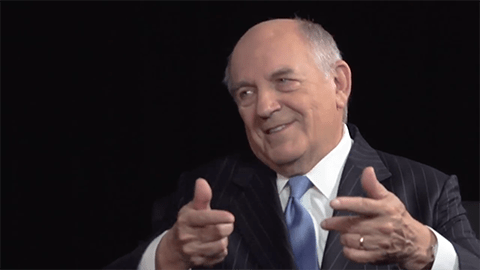
^ conversing with Bill Kristol, Charles Murray explored comprehensively the anomalies in today’s societal structures, but drew conclusions unnecessarily pessimistic. Free will exists, and so does social adaptation

—- —- —- —-

Much attention is being given these days to three academic thinkers : Steven Pinker, Jordan Peterson, and Charles Murray. All are social scientists and/or psychologists — students of the brain — much given to biological observations. From these biological observations, they draw conclusions about individual behavior and societal accommodations. All three thinkers point toward so-called traditional arrangements and imperatives and away from the revisionism that has affected both these past 50 years since the individualistic revolution of the 1960s.

To what extent do I support these thinkers’ recommendations ? The answer is that I don’t support them much at all. Where I do support the traditional social arrangements, I don’t need their authority; the arguments for traditional set-ups were all established long ago. More, I disagree that biology has anything to tell us about moral questions. Thus I am unconvinced that its observations dictate society’s duties. Observed phenomena are what they are, and nothing else. Data recorded do give the lie to speculation, but they tell us nothing about what is meant, if anything.

Biology certainly affects medicine. Medical discovery usually can’t take place without a biological record. The same is not true of morals. Even if possession of a y chromosome gives the possessor an advantage in certain physical capabilities — and a concomitant disadvantage in others — that finding tells us nothing about how to value the lives of each, the y chromosome person and the person with only x chromosomes. (I use the chromosome distinction only as an example. There are, for sure, other fundamental biological differences between people we describe as “male” and “female.”)

The relationship between biology and the mind  is a complex one as yet quite unsettled. Why some people identify as female even though possessing biologies that we list as “male,” and vice versa,  we have as yet no good answer for. Self-identifications seem embedded deep in  the brain, well below the cortex, in the brain stem or deeper, in the mimetic mind where music and rhythm arise. They are FELT even when no name can be put on the feeling. Nor is gender feeling the only personality outcome that defies biological explanation. The question then arises,:are identity feelings determined, or are they an exercise of free will ? Free will, as we use the term, has little, if anything to do with biology and not much more to do with social science. Free will, when it occurs, can arise unexpectedly — surprising the person willing it, even. All the anecdotal evidence suggests that identity feelings do not arise willingly; that they are felt to pre-exist; are FOUND OUT by the person finding, the way one stumbles by accident upon a secret that was already there, just not noticed. But if that is so, that identity feelings already existed even before noticed, where in one’s being were they ? To this question, biology has no answer, psychology only a guess.

The biology adept would like to assert that gender feelings are random and groundless; that biology rules, feelings have only subjective presence. On these grounds Peterson and Pinker both object to the political use of identity feelings. Are they right to say so ? That depends on what motives we attribute to their opinion. Myself, I agree, that identity feelings have no political bearing. Whatever civil rights our society accords, it accords to all, equally; the question of who one is does not arise, or should not. Only when people try to make identity an issue and to deny civil rights to certain identities does identity become an issue. Is this what Peterson and Pinker tell us ? I am not sure. I do agree with the two that identity should never become a legitimate basis for differentiating, politically, between people.

Back now to the issue of identity.

It is difficult for modern man, given to answers for everything, to accept, or to agree, that identity feelings are real despite there being no answer to where they are : in the body ? In the brain ? In one’s heart ? Augustine, long ago, wrote that sexual feelings arose in him, all the time, no matter how much he wanted them not to. His response was to will them dormant. Our age takes the opposite tack : admit them and let them be. Each outcome is equally deterministic. We can will these feelings to retreat, but we cannot will them to go away.

I don’t think our current trio of thinkers has gotten much farther than Augustine did. They may not even have gotten as far as he did. He said about evil, why does it exist if God is all powerful, that evil exists because people want to do it. They will it. I think Augustine is right; and his conclusion also dignifies humankind enormously by granting every person the capacity to choose the good. The good — or the bad — are not simply the reflex actions of a biological condition that we cannot do anything about. They are choices that all people can make. Thus Augustine’s “capability to will” becomes a basis for the social and idealistic equality that our Framers wrote into the Declaration of Independence and Constitution. Our modern thinkers, who assert that biology is destiny, and that different physical sex characteristics are a valid basis of social role assignment, deny the moral basis of political equality.

Charles Murray has advanced the most comprehensive — and insightful — analysis of current social conditions, which he considers broken down and unable to wean an optimally prepared next generation. He considers the two parent family essential and urges that children be born in wedlock, not outside; and that a boy who grows up without a father role model is compromised thereby. I find his view much too lazy. Of course the standard family usually works (but not always!); but so do other family forms. People growing up in single parent homes, or in homes with two fathers or two mothers, don’t just give up; they work around their structure, or they adapt it to make it work. Adults are still role models even if there is only one, or two of the same. And kids want to grow up to be important. Few grow up not caring. Murray mentions finance as a factor, but not in the way that it really is. To him, families at the bottom of the economic scale are denied access to success not by having few funds but by lack of motivation resulting from the overwhelming burdens upon them. So saying, he has it backward. Any divorce lawyer knows that more marriages break up over financial difficulties than for any other reason. lack of finance is a terrible restriction upon lives. Blame becomes the daily yell, the accusation, the poison that splits parents apart and leaves kids in turbulence — never an asset to the acts of will that enable individuals to rise.

Like all the present science-based thinkers, Murray is trapped by the determinism built into scientific observation. Or should I say, he seems deterministic where acts of free will can and do save many the day, and not deterministic enough where basic identity feelings are involved. But while I criticize Murray, I do not puzzle at his outcomes. Human life is a mystery that resists explanation. Augustine and Rabbi Hillel, who gave us the golden rule, and maybe Plato’s Socrates, have come the closest to understanding who we are and what we should do; but even they haven’t the final word. There isn’t one.


—- Mike Freedberg / Here and Sphere