FIXING THE T : STEP BY STEP

Baker

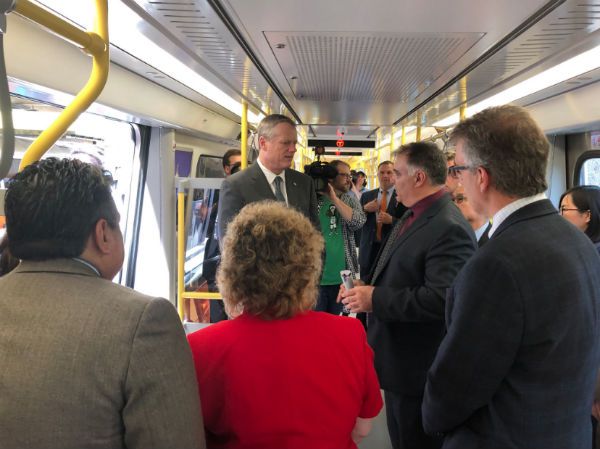
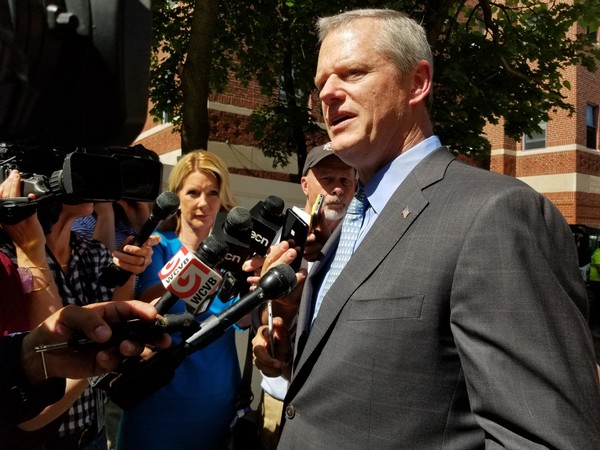
^ Governor Baker tours new Orange line cars

—- —- —- —-

That the MBTA is renewing and improving is no longer in doubt. Bit by bit the improvements can now be seen and used. Shock and awe it has not been: advances have arrived one by one, singly, not every day or even every week: but if you take a look now at what has happened in the MBTA world these past two years especially, you’ll see a lot of fairly awesome stuff:

( a ) Green Line extension has at last begun, fully funded, from Lechmere to West Medford.

( b ) the entire MBTA has now been digitalized. You can see on the digital sign board where yhour train is and how soon it is coming. T announcements arrive via digitalized advertisements placards.

( c  ) new cars are arriving for the Orange Line and Green Line. The Red Line’s new cars will follow soon.

( d ) A Silver Line connection, from Chelsea and East Boston to the Seaport, opened up three months ago.

( e ) connection of the Blue Line to the Red Line — no simple matter — is now the subject of an organized conversation about how best to do it.

( f ) track repair and signaling upgrades continue. No part of MBTA improvement has had a harder time. Almost every part of the running system needs repair and upgrading. Billions of dollars are involved. Governor Baker has opined that it might take a decade to complete this work. That is no reason not to do it.

( g ) new work contracts have been negotiated between the Carmens’s Union and MBTA management. There was much talk about privatization, but in the end the union gave some and management gave some, and today labor issues seem solved — for now.

( h ) the Fiscal Control Board that, by legislation enacted in 2015, controls MBTA financial oversight, has put in place new safeguards against sloppy budgeting. Reform of the pension operation overseeing employees’ retirement continues.

( i ) electric buses will be operative within five years, and also buses of varying sizes.

( j ) fare collection on the Commuter Rail has been reconfigured.

( k ) non-stop Commuter Rail between Worcester and Boston is now in place.

None of this has happened easily or dramatically. There’s not much news in step by step events, at least until enough steps have been stepped that the public can finally see 1000 steps all at once. Yet it is right here, in the arena of MBTA renewal, that Governor Baker’s dogged, day after day involvement in progress at its most minute level of devil-in-the-details, that the effectiveness of his no-drama governing style merits most applause. When repairing any vast public service system, step by step always beats bull -in-a-china-shop. If Governor Baker gets called “Mister Step By Step,” I for one fully approve.

Of course much credit must also go to our legislature for giving Baker the legal tools to kick-start his T reforms.

(Disclosure: it’s no secret that I am a supporter of Governor Baker, his methods and his politics. That said, there are reasons why I support it. He has a large fan base, that likes him no matter what, but I do not consider myself a fan. My support derives from judgment. There are many matters, of high policy, in which Governor baker has taken positions that win my heart as well as my head, policy preferences, especially in the arena of civil rights, that make me proud of him. I have said as much to his top people. Yet at bottom, my support for Governor Baker is a judgement call, not a fan’s cheer. I hope that you will grant me that measure of objectivity. As a journalist, I never forget that I owe my readers calling things as I see them, no matter what.)

MBTA renewal continues. Not until all the transit lines have new cars and fully operative track and signalling will we be able to take a time out. The Red Line to Blue Line connection won’t be decided on any time soon. A link between North and South Stations remains controversial, with no resolution. Which company will eventually operate the Commuter rail remains to be decided. Too many Charlie Card machines in T stations do not work properly or lack maintenance. Signalling problems continue to delay too many T schedules. The c ars continue to lack wi-fi, and the first attempt to install it failed to win approval by the communities the T and Commuter Rail service. Most above-ground T stop shelters are not winterized at all — even the vast Wonderland and Wellington T stations lack it. The South Coast rail connection remains unbuilt. It’s terribly difficult, by bus, to go from one location to another that is cross-town rather than to or from Downtown.

It’s likely that the MBTA will always need renewal and expansion. Financing will never lose its importance. The T can never again be left for another time, or have its finances impeded by unsustainable debt impositions. Yet for now, things look pretty good. Progress has been made and is on its immediate way.

— Mike Freedberg / Here and Sphere

THE RE-ELECTION CAMPAIGN OF JEFFREY SANCHEZ

FullSizeRender (1)


Representing the 15th Suffolk District since 2002, Jeffrey Sanchez seeks a ninth term in the Massachusetts House.

His is no ordinary incumbency. During the last House session he was named Chairman of the House’s Ways and Means committee, succeeding Brian Dempsey of Haverhill, who resigned his seat after many terms. The Chairman of Ways and Means directs the House’s annual state Budget proposal: a $ 41 billion behemoth allocating monies to literally dozens of agencies and departments. Many observers consider the Budget chief second in power only to the Speaker; and he or she who holds the position is prominently regarded as a future Speaker him or herself.

The idea of a city-resident Latino — Sanchez is of Porto Rican ancestry — becoming Speaker of the House has given Sanchez unique prominence in State and City politics. Nor is he a newcomer. His mom, the legendary Maria Sanchez, has been an influential activist in Mission Hill affairs since the 1970s. Even today, at Mission Housing Project events she draws as many people to her side as her famous son. Jeffrey Sanchez has all of that support as well, and his mother sees to it; and he has, by his rise to the top ranks of State House powers, acquired the support of all kinds of Mission Hill and Hyde Square (Jamaica Plain) activists. At least 200 of them attended his campaign kickoff in March at the Puddingstone Tavern.

You might suppose, in such case, that Sanchez would not have an opponent for re-election: but an opponent he has, and she is not insignificant. Nika Elugardo served on the staff of State Senator Sonia Chang-Diaz and thus has her own following of activists.

That said, there seems no comparison between the two, at least in fund raising. Sanchez’s most recent OCPF report shows he has $ 80,755.83; Elugardo has $ 16,866.37. The question thus arises : why is Sanchez being challenged by a candidate who has a measure of credibility, and what is her campaign about ? It would certainly seem that the voters of Sanchez’s city district (it includes one precinct of Brookline but is otherwise entirely a Boston district, including all of Mission Hill, the higher-income side of Jamiaca Plain, the power neighborhood known as “Moss Hill,” and three Jamaica Plain-ish precincts in Roslindale) would be mighty glad to have the House Budget chief as their State House voice.

Alas, the answer to my question is exactly what one might suppose : Elugardo asks voters to see Sanchez as part of an “establishment” that practices compromise where her voters want insurgency. We see this bifurcation elsewhere in this year’s primary season. Next door to Sanchez, Representative Liz Malia, a pragmatic reformer in the House even longer than Sanchez, faces Ture Richard Turnbull, who has for many years been the leading Massachusetts advocate for single-payer health insurance. A similar dichotomy pits City Councillor Ayanna Pressley — a very effective councilor at that — against Congressman Mike Capuano, who will be a committee chairman if Democrats take control of Congress this November. (Disclosure : I know and admire both Capuano and Pressley.)

There isn’t much in these challenges that we haven’t seen before. Age against youth, establishment and insurgent, long in office versus time for someone new — these are campaign themes you and I have heard from as long as we’ve been alive and sentient. Yet the journalist in me, as the voter in you, needs to ask, why should we replace an elected who is effective, and slated to become more so ? What can a replacement offer that the elected one cannot offer better ? In Sanchez’s case, especially, I see no convincing answer, no matter the enthusiasm of Elugardo, or her supporters’ very just aspirations, or her own argument that structural injustice is a serious problem. It is a serious problem; but how would defeating Sanchez alleviate it ? As I see it, promoting Sanchez further alleviates it more than defeating him ever could.

I’ve thought a lot about the significance of Jeffrey Sanchez as House Budget chief. My thinking is this : we’re on the verge of finishing the most productive legislative session I have seen in my adult lifetime. Prudent, forward looking reform has taken place in almost every policy domain, and a lot of that reform has been Sanchez’s doing. Governor Baker goes around the state awarding Skills Capital grants, ground breaking at workforce housing and affordable housing developments, announcing the renovation of university building and court houses, proclaiming hundreds of millions of dollars in new aid to education at all levels. The money he announces doesn’t come from a magic wand. It comes largely from the prudent, forward looking reform knotted together by city-guy Sanchez and his Budget committee. I think the voters of his District — many of whom I met at his recent backyard fundraiser at the home of Jaime Rodriguez, an old friend — rise high above structural injustice on the strength of having as their State House voice the man whose Budget work improves life all across Massachusetts.

One last assertion : we are very, very lucky in Massachusetts to have consensus government, well across partisan divisions, by which all manner of reform has been legislated this year by votes unanimous or almost. From automatic voter registration and criminal; justice reform to gun-regulations and the transgender public accommodations civil rights bill, and from a $ 1.8 billion dollar housing bond bill to a $ 2.2 billion dollar education bond bill, and the extension of the Green Line to new cars on the Orange Line, and via the grand bargain bill which instituted a $ 15/hour minimum age and paid family leave, we enjoy almost an embarrassment of effective practical reform. Idealists did not get all that they wanted; but almost every activist got something. Which is how actual good government works.

If incumbent legislators ever deserved re-election, this is the time to reward a job incredibly well done.

—- Mike Freedberg / Here and Sphere


CHALLENGES : THE KAVANAUGH NOMINATION

US-POLITICS-JUSTICE-TRUMP

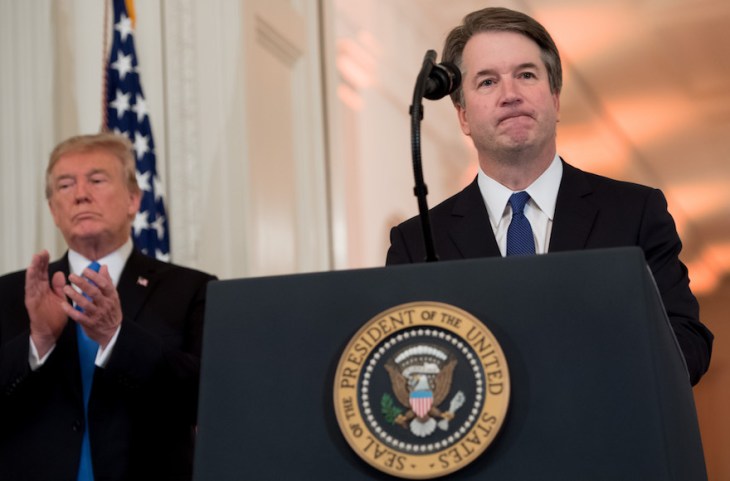
^ the nominee and the controversial President who nominated him

—- —- —-

Our nation is politically unready to handle a Supreme Court nomination, but that’s what we have. So what do we do about it ?

There WILL be hearings. There WILL be a vote. The likelihood is that Kavanaugh will be confirmed. There will also be political consequences, none of them helpful. Should the vote be put off ? I don’t see how that would do any less political damage. He has been nominated by a President whose performance is grievously suspect and whose very fitness for office looks well beyond the pale of acceptable. Mr. Trump has aroused the worst of our politics, a typhoon of anger and a backlash of outrage. In this climate even a fully Constitutional act — and a Supreme Court nomination is all of that — struggles for basic acceptance.

A nomination to the Supreme Court should not about politics. It wasn’t always this way. The only unavoidable political component is that presidents try to nominate someone who will judge Constitutional issues the way he or she would like. Other than  that,  politics should be left aside when confirmation is the question.

Unhappily, my view is at present not how nominations are treated. The Kavanaugh hearings will be long and loud, dominated by Senators grandstanding their partisan views of the Court, asking questions either to destroy the nominee or to pamper him. Few, if any, are the Senators who will actually try to assess Kavanugh’s suitability for confirmation; and even these Senators will only appear to assess, doing so because their constituents are about evenly. divided, and they, the Senators, hope not to be judged by. how they decide on the nomination.

Heroes there are none in this demeaning show of buncombe and blather.

I would like to offer you, my readers, an informed opinion of Judge Kavanugh’s suitability: but how many of you care ? How many of you want to assess him on the facts rather than his political effects ? Perhaps in a future column i will assess him. I’ve read several of his opinions in actual cases and read the facts of those cases besides. There is a story there. How many of you want to hear it ?

In Louis Brandeis’s time, 100 years ago, nominees rarely testified at the Senate. (John Marshall Harlan, Sr. was the first to do so, in 1877.) They did not campaign for the job. Their friends did that, and their opponents opposed. Qualifications and legal honor were the issues in Brandeis’s long confirmation battle. This battle was then a rarity. (Brandeis was Jewish, and while never said, that was the big big issue.)  Few nominees faced any kind of opposition. Nominations weren’t a big deal.  Nominees were confirmed as quickly as two days after nomination, most by unanimous vote.

All sorts of lawyers ended up on the High Court, from diverse work backgrounds. Not so today.

Much reform is needed if the High Court is to revert to at least approximating its original design: appointments for life in order to insulate the Justices from any kind of political input, much less retribution. I would suggest the following, knowing full well that my suggestions have scant chance of adoption in the current shape of Court nominations :

( 1 ) nominate people who have not spent their entire legal careers as judges. Choose electeds, corporate lawyers, union lawyers, public defenders, prosecutors, law school professors.

( 2 ) refrain from having nominees testify personally at hearings where they will be asked unanswerable questions, and questions improper to answer, whose purpose is to embarrass the nominee or worse

( 3 ) make it clear that the “advise and consent” clause of Article II, by which the Senate is given the power to confirm or reject Presidential nominees to office, includes the implied phrase “which consent shall not be unreasonably withheld,” so that the bad faith move made in 2016 by Senator McConnell — refusing to hold hearings on President Obama’s nominee — can never again happen.

( 4 ) establish a custom that, whatever the background of a nominee, the next nominee cannot be of the same. For example, Judge Kavanaugh is a Federal judge. Under my suggestion, the next nominee cannot be a Federal judge, or even not a judge at all. And let the next nominee after that be of a different background than the prior two.

( 5 ) look less to a nominee’s legal philosophy than to his or her record of innovation and ad hoc advocacy. I am skeptical of all legal philosophies, knowing, as Justice Holmes so well wrote, “the ;life of the law is not logic, it is experience.” The law is far better served by common sense than by ideological commitments. The Constitution was an experiment; nothing like it had ever been tried except at the municipal level. It should be treated as an experiment now : an attempt to provide rules for promoting the General Welfare. The Constitution’s precepts seemed to those who ratified it to work better than any alternatives. “Work better” does not mean work perfectly. We should not expect interpretations of the Constitution to rise to exactitude.

As I have written before, the most fateful decision made by the Framers was to have a written Constitution. Other nations have accepted an unwritten one. Unwritten constitutions are freer to be flexible, to meet exigencies. Written ones tend inevitably to a conservatism arising from being written more than from what the present disputes require. But a written Constitution is what we have. The last thing Justices should do is to add an extra layer of conservatism to the conservation arising from it being written.

Let these my suggestions and this my argument infuse the future of our actual Supreme Court nominations and purposes.

—- Mike Freedberg / Here and Sphere


MEETING THE OCEAN BEFORE IT MEETS US

Maritime Festival

In East Boston, my family’s home town, there’s a citizens’ action association, dedicated to all things ocean, that bears the name “The Harborkeepers.” The picture above announces one of the many Harborkeepers events that have changed entirely the conversation many are having about what climate change will do to the ocean and the shores that border it. Whatever people may have thought about the ocean 100 years ago, or fifty, or even twenty, today the objective is to get comfortable with  — knowledgeable about — the ocean as a friend who is also an opponent.

If that sounds like paradox, it is so intended. Much in life is paradoxical. T>he ocean beckons; it also destroys. Water is not shy. It goes where it has access to go. It doesn’t care about your feelings, your heirlooms, your garage, your mattresses. At the same time, the ocean exudes great beauty at so many levels and offers opportunity for co operation — as any sailor knows. The great storms of literature — from the ominous calms and mad bursts in Moby Dick and the near capsizing in  Joseph Conrad’s The Nigger of the Narcissus : or from the fatal horror in Sebastian Junger’s The Perfect Storm to the futile seductions in Homer’s Odyssey — all show communities of human beings overwhelmed by, or brought to the edge of fate by, the ocean unruly — human beings forced to humility, driven to co operate, taught their limitations, by the weakness of wood and cloth, the faith that takes us into the ocean’s carnivorous mouth in such flimsy devices, as if we were a team of Daniels against the lion or one hundred Jonahs inside the whale. To be sure, meeting the ocean involves the entire community. We saw it this winter and Spring as storm flooding inundated many low-lying homes and garages along Marginal Street.

That’s why The Harborkeepers directs its events at the entire community.

The ocean also requires an individual response. We can’t always rel;y on having community back up. Venture onto the ocean, and you are on your own. Just you and the sea, as in Ernest Hemingway’s great novel. Or when the sea ventures onto you, as it does in flood mode.

Each of us needs to prepare himself or herself on what to do — and what to know — about the sea that abuts us. You can’t learn to sail without learning about weather and the sea’s moods and behaviors. This, every kid growing up in a working port,. or near a working harbor, learns early, the way one learns a language : best and most naturally when young. That hasn’t been true, however,m of Boston’s sea-bounded neighborhoods. Ships brought immigrants here, but it did not bring them to sail. East Boston was not a place where anyone other than those who worked on ships or at marinas had anything to do with the Harbor except to dive into it from rotting piers. Most East Bostonians — including all in my family — fixed on Boston itself, across the harbor, and the jobs they could get over that side and beyond.

They could take that tack because in 1900, 1920, 19040, even 1970, the sea was no threat to anything. Today it is a threat. And so we learn first of all how to swim. Mastering that, we often proceed to learn how to sail.

There’s much more to sailing than you might think. You learn about boats, rudders, keels, sails, halyards, helms. You learn charts — of what’s out there and what;s underneath your boat. You learn ship to shore radio, LORAN, life jackets (of several types), horns, whistles and their uses; you learn what to do in a capsize or man overboard. You learn how to plot a course, and how to recognize buoys and channel markers — rules of the road, so to speak. You learn weather. You learn about various harbors and what sorts of facilities you’ll find there : supply marinas, restaurants, comfort stations, diesel fuel fill-ups.

All of t.his you learn individually. You may have crew aboard with you, but it’s not required. many people sail alone. You need to learn to do it, confidently. I’ve been in a small sailboat in a thunderstorm. It’s as frightening as you imagine. What should you do in such a situation ? You had better know BEFORE it happens. On the sea the weather can change on a dime, with little warning. Fog brings its own huge difficulties. Sounds bend in the fog. You may hear a ship’s horn thinking one direction when actually it has come from quite another.

The community can encourage you and advise you, but only you can learn the sea. It really is just it and you. The same is true when t.he sea comes at you in a flood. Today the sea invades East Boston only at storm time, but the year is coming — soon — when seas will live in your house. What will you do to turn nit aside ? Berms, raised foundations, sluice channels, even floating houses — Holland has them — demand one’s attention. This is where The Harborkeepers has offered concepts and urged conversations in which no idea is too outlandish to be discussed. We are going to have to be sailors, soon, even when we’ve not gone out to sea, because the sea has come to us; and having come to us, we the sailors it has sought will need to know all there is in a sailing course that the ordinary sport sailor learns. You’ll see what I mean pretty darn soon if you haven’t seen it already.

—- Mike Freedberg / Here and Sphere


OF CIVILITY

Voltaire

Who would have ever expected that civility in political participation would become a matter of debate ? Yet this is where we are in a nation where many political people are fast losing — have already lost — their composure.

It is easy to blame the President for what has happened. That would be a mistake. The current incivility began during President Obama’s years. It reached a fever pitch there, both from his opposition, which refused him even basic legitimacy, and from Congress, which refused to work with him on anything significant. The reforms that Obama and his party achieved were enacted with zero Republican support. Republicans not only shunned Obama’s policy moves, regardless of their utility, they did everything they could to repeal them once enacted. Then came the gravest move of all, Senate leader Mitch McConnell’s refusal to accord Obama’s Supreme Court nominee the “advice and consent” predicated in the Constitution.

Here is the language that McConnell spat upon:

“He shall have Power, by and with the Advice and Consent of the Senate, to make Treaties, provided two thirds of the Senators present concur; and he shall nominate, and by and with the Advice and Consent of the Senate, shall appoint Ambassadors, other public Ministers and Consuls, Judges of the supreme Court, and all other Officers of the United States, whose Appointments are not herein otherwise provided for, and which shall be established by Law…”

McConnell decided that the grant of consent power to the Senate gave the senate authority to refuse to even entertain a nomination. I doubt that is how any normal person would read that language. The list of appointments to which consent applies is a long one. If the Senate had the power, by the grant of consent, to deny consent to all of that list the Presidency could not operate. By what argument could McConnell assert that Article 2, Clause 2 vests in the Senate a power to prevent the Executive from operating ? Common sense reads the consent language as including an implied phrase ” which consent shall not be unreasonably withheld.” One sees this language in contracts and Leases drafted today. It’s there precisely to avoid the bad faith consequence that McConnell applied because of its absence in Article 2, Clause 2.

McConnell’s move broke the Constitution. It is unlikely that the “advise and consent” clause of it will ever recover. This was an act of gross incivility. None of the anger that it aroused went beyond the incivility of McConnell’s destructive act.

McConnell crossed a Constitutional Rubicon. (the phrase comes from Caesar’s bringing a field army into Roman territory, in contravention of the Republic’s firm policy, by crossing the Rubicon River, in northern Italy, that served as the Roman Republic’s northern boundary.) The anger of activists over McConnell’s act was fully justified.

Caesar’s act initiated a generation of civil war in Rome in which thousands of activists died or were judicially murdered, the Republic was destroyed, and a dictatorship ensued. (a benign dictatorship, to be sure, thanks to the political wisdom  and caution of Octavian Augustus, but a dictatorship nonetheless.) Might something of the same soon befall our nation ? We’re well on the way. We don’t have actual civil war — yet — but the anger and intimidations, threats, conspiracy hallucinations, radical utopianisms, and downright race, anti-immigrant, and gender bigotries brick-batting every square inch of social media — not to mention flash points in the brick and mortar world — are dragging the rest of us into an arena we justifiably don’t want to die or be tortured in.

The Red Hen restaurant flap; the vitriol spoken by Congresswoman Maxine waters — and thrown back at her even more criminally; the harassment of DHS executives in a Washington restaurant; the constant foulness voiced by unhinged followers of Mr. Trump; the almost daily barrage of mass shootings by disgruntled jerks; the criminal, frightening, warrant-less, unConstitutional actions of DHS and the ICE, occurring daily and in many, many locations — all of these and more have shoved civility aside and taken us to the brink. The tearing apart of migrant and asylum-seeking families at our borders, and resultant incarceration of kids and parents — much of it in for profit prisons and tent camps, and paid for by transport companies given no-bid, multi-million dollar contracts — has created an entire industry of persecution. Scant wonder that citizens are angry, are losing their civil habits.

I see no good outcome for this torrent of anger, this combat of shout versus shout. You can’t shout a person into agreeing with you, can’t intimidate her into discussing anything with you. “A man convinced against his will, is of the same opinion still.” Ben Franklin.

Assuming that the wise reform policies of mainstream Democrats and a few Republicans deserve to become law — and I do assume it, what is the best course for achieving such an outcome ? You know t.he drill : vote. Organize, persuade, urge ordinary citizens to vote common sense. Do not shout. Do not talk At people. Listen TO them. Maybe you will learn something ! Listen to everyone; find policy suggestions that most of those you talk with can buy into. We do it here in Massachusetts,. where our electeds, of many policy persuasions, negotiate with one another and enact compromise legislation that advances a just and workable state. If we can do it here, in State, we can do it nationally.

Of course the nation is not like a State. Our Federal set up is infinitely complicated. It encompasses 55 jurisdictions: states, territories, the District of Columbia, Congress. To govern it, compromise and consensus are required. The Constitution itself was a compromise. (Today many utopians decry the Constitution for countenancing slavery, as if the Civil War and its aftermath did not correct that acceptance; as if progress is somehow illegitimate because its predecessor accommodated injustices.) Almost every legislative reform we live with was a compromise, a result of many discrete factions agreeing on what they could agree about.That is how civic progress is achieved. As the great Athenian lawmaker Solon (from whose name we now call legislators “Solons”)  is reputed to have answered when he was asked, “Did you give the Athenians the best laws ? “No,” he responded, “I gave them the best laws they would accept.”

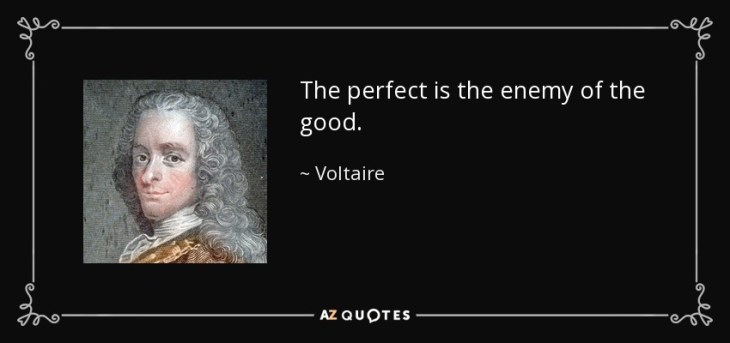
The radicalism of Mr. Trump AND the opposite radicalism of his angriest political opponents are themselves a kind of incivility. With good and solid reasons, Ted Kennedy said, “the perfect is the enemy of the good,” updating Voltaire’s aphorism Dans ses écrits, un sage Italien Dit que le mieux est l’ennemi du bien. Both Voltaire and Kennedy understood that perfection is lethal to human beings and that seeking it is inimical to progress. Voltaire had seen the persecutions and illiberalisms that religious perfectionists imposed on his country (and to avoid which he had to go ito exile in Ferney, Switzerland, outside Geneva.) Ted Kennedy, who achieved so much reform, knew, too, that no progress would have resulted had he refused to yield to opponents.

We live these days in an arena of clashing insistences. What are we to do about it ? All around us is noise and inflammation.

—- Mike Freedberg / Here and Sphere


MASSACHUSETTS SHOWS HOW GOVERNING IS DONE

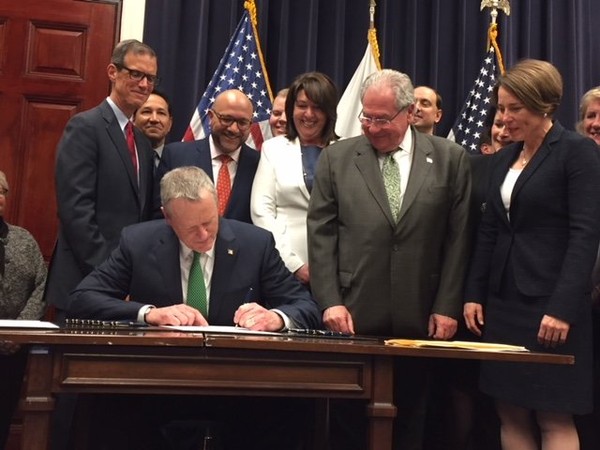
Baker signs housing bill

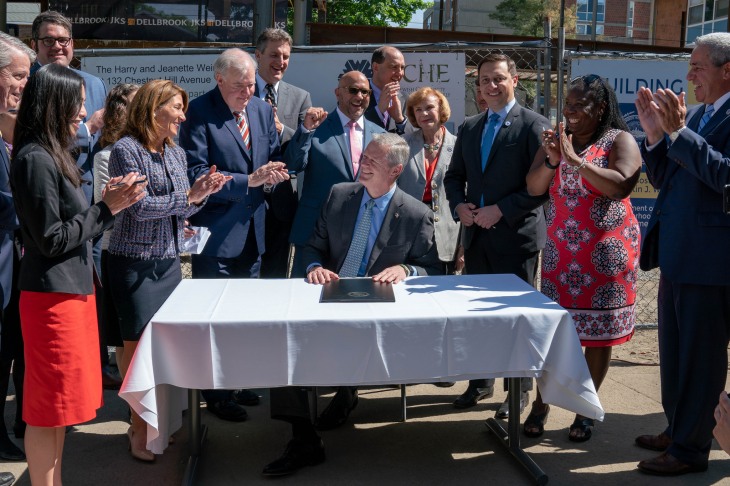
^ Governor Baker signs $ 1.8 billion dollar housing bond bill

—- —- —-

The year’s legislative session ends soon. What session it has been ! A list of the laws enacted completes just about everybody’s bucket list of priorities:

— $ 15/hour minimum wage, in steps, of course, but getting there by 2023. Along with this reform comes a reduction in the sales tax from 62.5 percent to five percent as well as elimination of time and a half pay for overtime.

— paid family leave

— the “Red Flag” law by which a person shown to be dangerous can be denied possession of weapons. (this has already been a feature of c. 209 A restraining orders)

— so-called “conversion therapy’ banned (conversion is a kind of angst and intimidation by which gay kids are supposedly shocked to become “straight”)

— addition of an “X” gender option to the state’s driver license. (still pending in the House)

— a $ 1.8 billion dollar bond bill to fund workforce and affordable housing construction : you can read the entire story here : https://www.mass.gov/news/governor-baker-signs-18-billion-affordable-housing-bill-to-increase-housing-production

— a $ 2.2 billion bond bill to fund climate adaptation :

$2.2 BILLION FOR CLIMATE ADAPTATION AND ENVIRONMENTAL PROTECTION (H 4599) —House 143-3, approved a bond bill allowing the state to borrow up to $2.2 billion for climate change adaptation, environmental and natural resource protection, and investment in recreational assets.

— a Clean Energy Bill, enacted by the Senate (note : Governor Baker has his own proposal, which I will post below):

CLEAN ENERGY (S 2545) — Senate 35-0, approved and sent to the House a clean energy bill that supporters say will prepare Massachusetts for the inevitable problems that will come with climate change.

Provisions include increasing the percentage of renewable energy that must be purchased by retail electric suppliers from an additional 1 percent annually to 3 percent annually; requiring the state to adopt statewide greenhouse gas emissions limits for the years 2030 and 2040; helping the state achieve its greenhouse gas emission by establishing compliance mechanisms for the transportation, residential, commercial and industrial building sectors; lifting the cap on solar net metering; authorizing additional hydropower and offshore wind; and implementing statewide energy storage goals.

— a major Criminal Justice Reform bill : https://www.masslive.com/politics/index.ssf/2018/04/gov_charlie_baker_signs_landma.html

Criminal Justice reform

Final enactment of the state’s FY 2019 budget remains: the legislature has its budget ( https://malegislature.gov/Budget/FY2019/FinalBudget ) and Governor Baker has his : http://budget.digital.mass.gov/bb/h1/fy19h1/ The two budgets aren’t the same, as one would expect, and reconciliation may take up all of this session’s remaining time. I shall discuss the budget in my next column.

Almost all of the above reforms were approved unanimously or by overwhelming, bipartisan numbers. Even the conversion therapy ban, which I expected would arouse controversy, was approved 137 to 14 by the House and will surely be enacted at least that overwhelmingly by the Senate. As for the “Grand bargain” bill that included the $ 15/hour minimum wage and sales tax reduction, it was voted 119 to 24 in the House and 30 to 8 in the Senate. Let’s note that this is no new development. Since Governor baker’s election, almost all major legislature has been enacted by nearly unanimous numbers. Consensus governance, it is.

Consensus government works. Reforms enacted by all or almost all concerned tend to last , which is what one wants reforms to do. A reform isn’t much good if it’s enacted narrowly over the objections of a large number who oppose it. It’s all too easy for reforms enacted thus to be overturned when the objectors come to power. We see the consequences of narrowly enacted reform in what’s been happening in Washington since the Obama years. It is imperative that reforms win the approval of more than a bare majority. In Massachusetts we have that. It’s highly unlikely that the reforms enacted during this legislative session — or the three before it — will be overturned. People who live in Massachusetts can plan their lives accordingly without worry that tomorrow everything will change.

I mentioned above that Governor Baker has his own clean energy initiative going on. He has plenty of other initiatives in place, for example these : workforce development in “gateway” cities; workforce housing all across the state, from Amherst to Lynn; SkillsCapital initiatives at all levels of education, awarded to communities all over the state; incentives for our biomedical and biotechnology industry; upgrades to the state’s Department of Conservation and Recreation. Then there’s this:

Massachusetts is proud to be the 2nd state to join ’s network, and our bill will help to ensure that our seniors who have raised families + contributed in so many ways here are able to live out their years in the communities that they know best.

Baker in Lynn

^ Governor Baker at the completion of Gateway North Apartments in Lynn. Mayor Tom McGee on the left.

And finally, this : extension of the Green Line, long promised, finally begun. The ground-breaking photos you can see here : DgkD8woW4A

Finally, there’s this : the Governor’s clean energy and electricity rate reform bill : https://www.mass.gov/news/baker-polito-administration-files-legislation-committing-over-14-billion-to-climate-change

If you the reader are saying to yourself, “wow, he makes the Governor look awfully good,” my answer is “no. It’s not i who are doing this, it’s the legislature. By enacting the legislation it has, and by overwhelming margins, the legislature has made it easy for Governor Baker to put his signature to these bills and to “look good,” because he knows that the vast majority of voters like the bills he is signing and therefore like him. Baker is, of course, a politician. He depends upon voters to re-elect him. It is common sense that he would sign legislation that a strong majority of voters like. And isn’t that what governance by electeds is about ?

There are some activists who are impatient with , or dissatisfied by, consensus reform. I get that, and so do our electeds. Neither they nor i have any problem with activists pushing for even further reform. Someday those reforms may attract majority support and amend to meet objections. that’s what democratic government is about. Yet for now, the consensus that we in Massachusetts enjoy is worth celebrating.

—- Mike Freedberg / Here and Sphere


WHAT TO DO ABOUT THE “I.C.E.”

ICE

^ is this a picture we want to see more of ? I say “no”

—- —- —-

Whether the Immigration and Customs Enforcement (“ICE”) division of Homeland Security should remain, or be abolished, is now up for discussion. Several candidates for Congress have asked for it to be defunded. Congressman Marc Pocan of Wisconsin is filing legislation to abolish it.

Clearly the actions of ICE operatives, under the vicious, bigoted, and scatter-shot directives of our current President, have aroused enormous opposition. In my mind, this opposition is fully justified. ICE people are harassing immigrants, arresting many, incarcerating some. They’re stopping people driving on highways up-country. They’re intimidating people on Greyhound buses. They’re arresting perfectly legal residents, and word is that they plan to seek the revocation of some who are naturalized citizens. Then there;s the tearing apart of migrant families seeking asylum from deadly enemies in their countries of origin. There is, in these actions more typical of dictatorships than of a democracy, more than enough here to support every level of opposition a voter can express.

I fully share this opposition to what ICE people are doing. What, then, do I propose we do by way of legislation ?

Immigration and Customs Enforcement was established by Sections d and E of the 2002 Homeland Security Act. Some of us at the time objected to this legislation on freedom grounds; Senator Rand Paul (R-KY) has continued to object to much of it. The Homeland Security Act remains the sharpest limitation upon ordinary freedoms this country has enacted since World War II. There is much in it, besides what it has done to immigration, that intrudes upon personal privacy. Surveillance of individuals is made possible — albeit with some, but not much, measure of due process — and of our communications. None of this prevented Russian hackers from diverting and tainting our elections, nor has it stopped Congress people from defending Russian hacking. The Homeland Security Act — as could easily have been forseen — has now become a political bat with which to beat up on one’s opponents. If any legislation is to be abolished, it should be the Homeland Security Act.

As for its immigration and customs enforcement sections, my recommendations would be these :

( 1 ) require ICE personnel to seek a “just cause” warrant from an immigration judge prior to any field action, said warrant to specify the actions intended and the reasons

( 2 ) no enforcement action by ICE’s customs personnel can take place except within five (5) miles of a border. No ICE actions can involve entering buses, trains, or aircraft. No ICE actions can occur in or outside a courtroom or government office.

( 3 ) persons with legal residence, of whatever kind, are wholly exempt from ICE action.

( 4 ) customs personnel have no power to detain entrants for more than 48 hours, and such detainees must be given a written explanation of the express reasons for such detainer. Said writing must also include a statement that the detainee has the right to seek legal counsel and to make up to three phone calls for that purpose.

( 5 ) under no circumstances can family members traveling together be separated.

( 6 ) detainees for up to 48 hours must be provided a bed, basic food and drink, and quiet.

( 7 ) penalties for persons violating any of these sanctions shall include fine and possible loss of job. Such violations may be civil in nature, but aggravated violations, or violations by a person already under sanction may be prosecuted criminally. All ICE personnel must be bonded.

The above list seems basic; likely you may think of others. I do not support abolishing ICE altogether except in the context of repealing the entire Homeland Security Act. We must recognize that the only justification of enabling the Homeland Security Act was the feeling that our nation was at war. Maybe it was at war in 2002 — even that assumption can be justly disputed — but our nation cannot declare itself permanently at war with bands of pirates, which is what ISIS and its straggler successors amount to. We went to war with pirates once : 1804k, when our navy sailed to the Libyan coast and destroyed the flock of pirates then hurting international trade. We did not declare the entire nation at war then, and I see no need to do so now. The FBI and CIA are quite capable of identifying almost all ISIS types and stopping them before they activate. In any case, by far the bigger terrorist danger to public peace arises from home grown mass shooters.

Why should I have to take  a passport with me to drive into Canada ? Or vice versa ? For 200 years Canada and our nation have existed side by side peacefully. I used to drive to Montreal, crossing a border as I did, and having it be no difficulty ata ll. The so called border passes through the middle of cities. Why should it be weaponized ? i say let’s extricate ourselves from such thinking.

The southern border is more problematic, because all kinds of desperate people enter from Mexico. I do support a vetting process for entry from the south. Yet almost everyone who enters from our south comes to live a peaceful life, even to prosper: and most do. The Mayors of El Paso and Brownsville in Texas both say that the border they straddle is no problem at all; indeed, El Paso is one of the safest cities in our nation.

It is high time to end the state of war mentality that has given rise to the current ICE persona. ICE must be given drastically new, legally observant, judicious regulations to live by. If it continues on its present path, however, abolition won’t just be the outcry of a few. It will be the common wisdom.

—- Mike Freedberg / Here and Sphere


THE UNIVERSAL AMERICA : A COMMITMENT

kidnapped

^ those who come t,o us seeking our national ideals and promise are as much American as anyone already here.

—- —- —-

The ideals that  created the American nation are not temporary or local but universal and lasting. If this were not so, people from all over the world would not come to us to be part of us, nor would their coming be a constant coming over decades, centuries, as they have been and are.

We are the Promised Land. There have been other such promised lands, the one written about in Exodus most famously but hardly only that. Throughout recorded history, people have sought better lives in newly founded places. It was common, for example, in the early Middle Ages, for peasants, merchants, and vagabonds of all kinds to leave lands of baronial oppression seeking new cities. Robert Hughes, i n his tome Barcelona, cites the 10th century constitution of Cardona, then a newly founded hill town 100 miles west of the big city, as it invites everyone who wants to come, to come and be part of the new city. And what made Cardona made 100s of similar settlements all over Europe. Thus the welcome offered by America had precedent. What was unique about us was not the welcome but the limitless vista. America would be a city on a hill, as John Winthrop described it in a s1630 speech — a new Cardona –but not for long only a city: an ent8ire continent beckoned, a newly discovered continent at that. The vista of America was endless, its welcome boundless.

It took courage to come here. Many arrived with nothing. Death by disease took many, wars with Indians killed more. Slavers brought millions of captives to the South to toil in chains. Others landed in Montreal and walked the 250 miles through wild beast forests to work for pittances in the Lowell textile mills. Millions arrived from southern and eastern Europe, or from Asia, to find themselves persecuted, legally or otherwise. After the Korean and Viet Nam wars , hundreds of thousands of refugees came. Other hundreds of thousands arrived from Europe after World War II. More recently, millions have arrived here from Central and South America, or from Haiti, or from Iraq. Yet always they come. Not to other nations so much, but to America. We should rejoice that they come to us and not to elsewhere.

Every immigrant community that has come to America has built it, enriched it, helped it prosper, and confirmed its ideals, which as we all now know are so eloquently expressed in Emma Lazarus’;s poem engraved on the Statue of Liberty’s pedestal. Yet there is more: almost all those who have immigrated here have done so because our foundational documents contain every human being’s basic rights: all people are created equal, all are entitled to life, liberty and the pursuit of happiness, and, inscribed in the preamble of the Constitution, a governmental covenan56t that “provides for the General Welfare.” Civil rights for all : is that so hard an ideal to grasp ? Yet its radicalism has made enemies of some, who because immigrants, like all of us, are not perfect, have decided that immigrants are a bad thing.

American ideals probably can never be fully achieved. People simply aren’t perfect enough to master their condition, situation, daily life, destiny. Yet to look at where we fall short of our ideals and proclaim that falling short proof t.hat our ideals are a bad joke, or a lie, or a bad thing, is to assure that failure will rule rather than striving to do better.

Myself, I prefer to commit to the striving. I commit to welcoming all immigrants who want to strive with us. Failure may happen, but it must never be final. America itself can never be final. The common saying that “America’s best days lie ahead” is how we declare our triumph over pessimism: a pessimism which America ideals  contradict and chide. Those who fear immigrants fear American ideals. Plain and simple.

— Mike Freedberg / Here andm Sphere


CONSENSUS GOVERNMENT WORKS

BAKER

Much was made, in the media yesterday, of Governor Baker’s supporting Senator Warren’s bill to protect states’ marijuana legalization and procedures thereunder. Ten other governors joined the letter that Baker participated in, but t.he headline didn’t indicate that the support was not merely Baker’s. The reason is obvious : Baker and Warren both seek re-election this November but belong to different political parties. The media believe that you, the reader, find this agreement across party lines to be news. Perhaps it IS news, given the partisan polarization that the media assures us is the current norm and which message cynical politicians seek to advantage to themselves; but what if the Baker and Warren agreement on this matter is the norm, and polarization isn’t ? What then ?

I would assert that in Massachusetts, at least, the norm is agreement on major issues by leaders who belong to different political parties; and that disagreement is the exception.  There are sufficient examples of such exceptions to trouble many complacency we may feel; the matter of full civil rights for transgender people divides more or less on partisan lines. Yet even on “transgender rights,” the partisan disposition is not absolute. Enough Republicans join with almost all Democrats in support that even “trans rights” adhere to consensus. Most every issue that Massachusetts voters think about enjoys similar consensus. If that were not so, we would not see our legislature enacting most bills unanimously or almost. Which is not to say that opposition does not find its way into legislative discussion. Opposition would certainly arise in the House, were Speaker DeLeo not determined to allow a floor vote only on bills that enjoy overwhelming support. The House includes so,me two dozen “progressives” who profess an agenda on which there i sno consensus at. all, in many cases no majority even. The House also includes about two dozen Republicans who oppose almost every bill that DeLeo judiciously declines and even many that he does allow to a floor vote. Yet when those votes are actually taken, few of either House group vote Nay. The Senate plays disputation differently. Progressives get a floor vote on much of their agenda, and it usually commands a majority, only to succumb to the House’s priorities. Thus consensus is maintained.

So far, t.he voters of Massachusetts seem to like consensus. Those laws t.hat it achieves acquire a kind of absolute legitimacy thereby, which assures them respect broad enough to insulate them from challenge; and the voters thus feel that their say in the matter has been listened to and taken into account. Thus the support that Baker is giving to Senator Warren’s bill to reverse the Attorney General’s decision to have the Department of justice enforce Federal marijuana laws notwithstanding state legalizations.

Some of us would say “country over party,” which works in several contexts; but that’s not the tack here. The agreement between Baker and Warren plays out on a different field, a classic American one : the powers that Amendment Ten of the Constitution reserves to the states. (I understand that by bringing up this topic I am digressing from my main theme, but hear me out.) Exactly which powers the Amendment means, it does not say. It’s not clear, either, what powers the Constitution grants to the Federal, government. Many such powers appear implied by the grants made expressly, and always we are realizing implied powers that we had not anticipated.  At the Ratification convent,ions of 1787-88 there was nothing like consensus about this issue, and the divisions expressed there continue to this day an d are often the rubric by which this state or that one have abused people’s basic civil rights despite express Constitutional protections. For Massachusetts, whose voters ave almost from the beginning looked to Federal power t.o promote and defend  the most idealistic guarantees of civil rights, not to mention the most sweeping Federal regulations of commerce, the matter of state powers has always seemed a dodge — an excuse for particularist state governments to abuse Federally guaranteed rights. Massachusetts voters’ right to legalize marijuana sale and to enjoy the fruits thereof invokes the states’ rights cry; but it also defends commercial law. It is doubly particularist, and those who — like this writer — support expansive Federal power over commerce as well as civil rights guarantees should understand that by supporting Baker and Warren, we are making an exception to our usual policy rule. “Country over party” does not apply here, neither leg of it, the partisan or the national.

So back we come to the practice of consensus. The divisions that have always pressured American politics about state authority versus Federal power can stop much reform, and have often done so. It is no minor achievement that Baker supports Warren’s bill. It is an act of consensus crucial both on its own footing and as an example to electeds going forward to address issues far more liable to division : think immigration, in which arena states have scant authority and the people even less, to effect reforms badly needed if the promise of our nation, as the best hope and dream of immigrants from everywhere, are to be achieved by those who need the law’s help NOW.

—- Mike Freedberg / Here and Sphere

THE MUGGLEBEE FILES : The 3D Chess of US-Russia relations

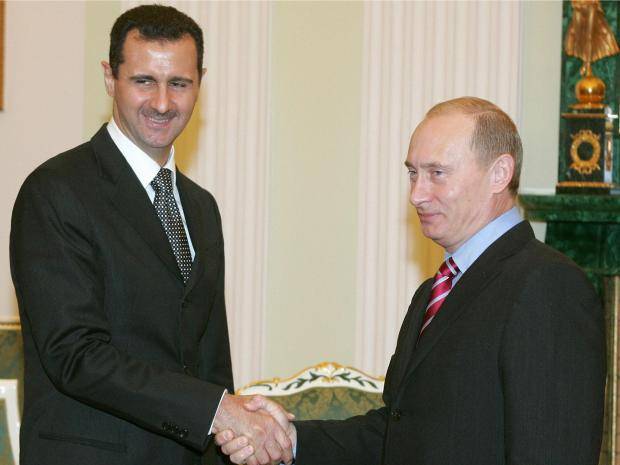
bashar-al-assad-vladimir-putin

Assad (L) : a convenient villain ? Putin (R) : a Trumpian hero ? Seems like it

—- —- —- —-

The recent strike on Syrian targets has raised many questions. The answers to these and other questions are tough, because they require a broad perspective, beyond the simple reported use of chemical weapons on innocent people. The Geneva violation aside, global interests involved may point to a more diabolical play unfolding that is hidden behind the atrocities of the Assad Regime. A play that involves both Russia and the US.

The election of Trump is thought to have been influenced by Russia and led many to believe he has been compromised in the process. Trump’s refusal to say a single bad word about Putin or Russia, ever, has perplexed everyone — until recently he did finally say something: right before the launch of this bizarrely-timed missile attack on another purported chemical weapons factory north of Damascus. Again, Assad is blamed by the US…but Russia denies. This is the play, it seems; one party accuses (in this case the US accuses Assad) while another denies the act even took place (Russia, of course).

Before the play, Trump actually called out Russia and Iran. He told them clearly to “get ready”. Ready for what? The explosion of a chemical factory?

Trump touted his “genius” of never announcing what he’s gonna do before he does it, but this time he did the exact thing he claims he wouldn’t do. Psychologically, that’s a well-known trick- when someone says “I’m not gonna do this” and then they do it, weak-minded people reflexively believe there must be some other brilliant meaning to what he did, other than the simple explanation, which is : he’s just doing what he said he wouldn’t.

Trump is under increasing pressure from the Special Counsel over corruption. His “personal attorney” Michael Cohen was raided, and suddenly… this strike appears.

As soon as Trump announced the US was leaving Syria, Assad purportedly used chemical weapons (again) and quickly the determination was made to strike. Not at Assad himself, mind you, but his chemical weapons. Why not get him AND his weapons, you might ask? Well, to do that would leave a vacuum of power. But to leave him in power, and supported by Russia, only ensures he will do the same, again…and most-likely when Russia needs the US military to do another strike. And perhaps that’s the play.

I encourage anyone interested in this to do an experiment: pull up a map of Europe and the Middle East.  Assess the region. Look at the countries involved. Now consider all their interests. Then imagine its your job to figure it all out — an impossible puzzle inside a nightmare. Regarding Syria and its monster leader, his continuing existence offers a consistent narrative allowing strategic military intervention every time he “attacks his own people”.

This move could very well be a tactic designed to influence the American people. Influence them how? By getting them to support military strikes by their US president, carried out by the US military, on the US tax-payer dime. But if the US is seeking to leave Syria, as Trump stated, how does this benefit the US? The answer is it doesn’t. It benefits whoever is still there with a vested interest in the Syrian landscape. That would be Russia.

Let’s look at how it benefits Russia. It controls the Assad regime and occupies much of Syria militarily. Assad helps Putin fights ISIS, but Russia helps Assad fight the rebel factions seeking to overturn him. (Russia isn’t the only vested interest there, either. That is a key fact not to be overlooked.)

Saudi Arabia and Israel help the US fight ISIS, Iran seeks nuclear power and is opposed by the US and Israel while Russia supports them. The US/Israel/Saudi coalition keeps Russia, Iran, and China from commandeering the Middle East. Many do not even know of China’s presence in Syria. Yet China gets cheap oil from Iraq, now that Exxon has been pushed out and ISIS came to be.

The next Sunday, UN Ambassador Nicky Haley announced sanctions on Russian businesses that do any business with Assad, in conjunction with the strikes. Sounds like something Russia might not like, right? They wouldn’t, if in fact Trump hadn’t turned around and undid the sanctions as soon as Haley announced them. What? Yeah. This makes something remarkably clear: the US president is easing the way for Russia, not punishing them. The unanswered question is why.

But how did the strikes benefit Russia? It’s hard to know specifically, but perhaps helping Russia hedge toward its stated goal to control of Syrian oil and gas markets. Syria’s market is big, the most important strategic region in the Middle East now, but it requires massive reconstruction investment.  It was reported months ago Russia wants to corner the entire gas and oil market in Syria, which is not something the US can allow. Yet, the US President seems to be allowing it- he hasn’t implemented new sanctions abroad and here he actually reversed them.

The infrastructure investment that Russia needs, to accomplish its goal, is roughly a $40bil deal — probably more, as we know from our money spent in Iraq. Syria is a mess. Its warring factions make any real financial and military investment, at this time, tedious and il-advised, as it is too unstable and the civil war too intractable. In a chess sense, getting the US to strike certain sectors under the inflammatory claim of chemical weapons use is odious, because it puts both the responsibility and the costs on the US instead of Russia. It is a classic misdirection move. In this way, the Syrian conflict might be being systematically shaped not toward a US agenda, but a Russian one, instead.

Chess is about making moves that are several steps ahead of your opponent, using positioning and distraction to eventually capture the opponent’s king. In this 3D chess game, let’s look at the other pieces in the region and perhaps gain a broader view of what’s actually happened and is in the process of happening.

ISIS arose in Iraq and funds itself through oil. When we exited Iraq, ISIS overran the region and eventually began moving into Syria. The Syrian landscape is a key strategic region because it links the Mediterranean and the Persian Gulf in terms of oil shipping routes. The Med Sea links oil to Europe in the north and the US in the west; the Persian Gulf leads up the South China Sea to China moving north-east. The global routes for oil, looked at broadly, describe the play on the chess board that is Europe, Asia, and the Middle East. Because Russia is in the energy biz, almost exclusively, it makes sense their designs surround every avenue it can. It was John McCain who said “Russia is just a gas station.”

Russia supplies Europe and China, Britain, France, Turkey, and North Korea with the vast sources discovered in Siberia…the only barriers to its becoming a serious world supplier are US and UN sanctions. Russia’s efforts to reclaim Ukraine follow this purpose ; its presence in Syria too.

US sanctions have limited much of Russia’s oil export but not stopped it. Exxon has invested a billion dollars in Siberia refinery infrastructure thus far unable to pump due to sanctions restrictions. BP faces a similar problem. Russia’s state run oil, Rosneft, on the other hand, is doing very well. Exxon and BP are two of the biggest companies on the planet, but if Russia succeeds in its strategic plans, Rosneft may end up the biggest and reduce the power of the aforementioned giants. Since war is mostly about oil, Russia may be engaged in a secret war for global dominance of the oil and gas market. This is occurring as many developed nations are moving toward more renewable sources.

Evidence this may be the case can be found in the ways Russia is treating both Exxon and BP lately — a shocking change from 50-50 deals to something much more one-sided. Emboldened Russia is flexing on many countries which in the past it could not, and one reason it may feel emboldened is because the US president does not seem inclined to oppose them in any way, whatsoever.

Countries must hedge their energy demands against the politics of surrounding supply routes and the countries that supply them, in order not to be dependent on any one supplier. In a chess sense, they have to watch the whole board. Turkey is Syria and Iraq’s neighbor, so it hedges the oil that comes from below and the oil above (Russia). Because of this, Turkey must ally with the West (US) while at the same time the East (Russia), and assist in the Middle East in managing Iraq, Iran, and Syria, not to mention Saudi Arabia and other Arab states. The fact that Russia is in Syria, and poised to take that market, means Russia may be angling to control the Middle East corridor to the Mediterranean and the eastern corridor (South China Sea), this cornering not just the Syrian market but the entire geo-political market. That’s 3D chess.

The politics of the Middle East nations are complicated, and in some ways insurmountable: ISIS is partially opposed in Syria by Kurd factions, which are also in Northern Iraq as well as in Turkey. The Kurds in Turkey, however, are active separatists — they want their own piece of Turkey; in Syria and Iraq, they fight the Islamic State. (ISIS, it seems, is everybody’s enemy but has no actual country. It’s identity exists somewhere in the Ottoman Empire and the dustbin of history. The Caliphate’s existence creates a difficult position for Turkey- how do they support Kurds in Syria against the Caliphate but oppose them, their own citizens, in Turkey? Not easily.)

Moving north into Europe, the UK, France, and Germany have ethnic problems from the warring Syria; refugees fleeing Syria go north, because the US president has made their ability to flee to the US impossible, which puts incredible pressure on Europe. Part of that pressure created the Brexit. At the same time, these nations have energy needs and must meet them by working with the oil-producing nations that supply them…which includes Russia. For example, Germany has a major gas line going under the Baltic linking them to Russia; tensions could threaten that. This makes them increasingly hesitant to feud with Russia. (Yet, the recent poisoning of a Russian ex-spy turned British citizen on British soil sparked Theresa May to condemn Russia’s disregard of the UK homeland. The substance was Novichok, a chemical poison created by Russia. What message was that meant to convey? A bold one, it seems.)

At the same time, Trump announced the US would pull out of Syria. What followed, though, was the surprise announcement of another chemical attack by Assad in Syria, which demanded the US and its allies respond. May was immediately on board, as was France, despite the suddenness which seemed to disallow Parliament’s approval. This once again highlighted another complexity: the US opposes the Assad regime but it also opposes ISIS. So the US decided it needed to leave Assad alone because he opposes ISIS. This strategy was countered by Russia, however, by Russia showing up to oppose ISIS but with a twist- they embrace Assad. This move is important because it locks up US control of Assad by giving the regime a powerful ally. One that can protect them like a queen. The problem that Russia supports the Assad regime puts the US in a tough spot. The US needs Russia and Assad to help defeat ISIS, but what seems to be emerging from this…is Russia and Assad are taking control of Syria and leaving the US out. The US president’s actions lately and previously prove this is literally the case.

When the US attacks Assad’s chemical weapons, but not Assad himself, even as it openly states Assad must go…the contradiction makes it possible that chemical weapons are an ongoing excuse to employ US force. There is no other explanation for the continued use of such weapons in defiance of the UN and US redlines. The ability to read between the contradiction is the essence of this chess match- and is beginning to reveal an invisible partnership occurring. A partnership not between the US and Russia, but Russia and the US president.

This partnership is drawing US armed force into the region for specific targetings that Russia benefits from. It is entirely possible the US president is being directed as such, in a visceral way. The use of chemical weapons is easy to sell the American people on- women and children suffering horrible effects of chemical weapons use, outlawed by Geneva. Doing Russia’s bidding is not an easy sell. But if the US president calls out Russia (and Iran)…that might work. This distances the Russian president, when in actuality he may be very close. This is chess, remember.

Such use of weapons should literally draw the condemnation of the world, and it does…but what it doesn’t draw is actual consequences. This means it’s a play, one someone knows they can get away with. Assad remains unpunished, possibly fortified, and free to do it again. Now, every time Assad “uses chemical weapons”…the US must take some action. So far, its been the same action, every time, just different locations and targets that never include the leader responsible.  That should tell us something loud and clear.

Syria’s Assad is a Rook protected, it appears, by Russia’s King. Russia’s Bishops and Knights surround him. And the US president is a pawn that will do anything to be King’d, it seems. He will race to the other side, leaving his most key pieces vulnerable, because Putin is promising he will help him become King’d. What he doesn’t seem to get is America doesn’t have a King, and never will. He thinks he’s got this by check, when it may actually be check-mate…for Russia.

— Christopher Mugglebee / The Mugglebee Files

Christopher Mugglebee is an actor, boxing trainer, and a martial arts expert. He now writes about politics and world affairs.