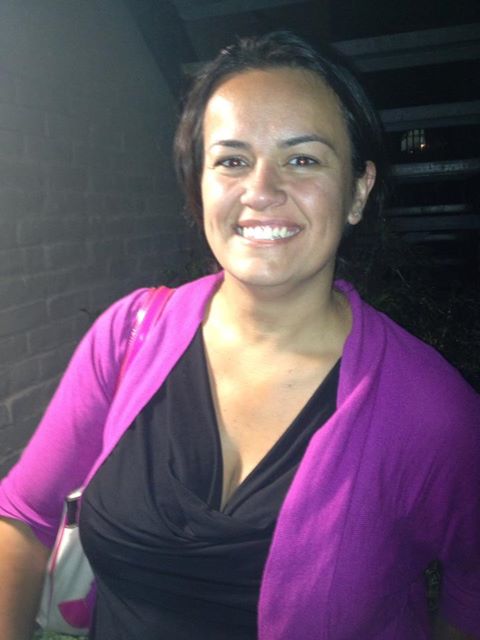
BOSTON CITY COUNCIL PROFILE : ANNISSA ESSAIBI-GEORGE

Image

As many of you reading this already know, we put Annissa Essaibi George on Here and Sphere’s suggested” list for the Primary. Of her we said the following :

a Boston Teacher’s Union (BTU) activist, Essaibi-George has the radiance, class, and articulation for which Boston Public school teachers are justly respected. We met her and liked her instantly, and mot just because she’s from Dorchester, with strong support in East Boston as well (where she teaches at East Boston High School). She runs a small business, and has time, somehow, to also be a neighborhood activist. We think no one will outwork her on the Council, and definitely her voice for the BTU is needed, even if the BTU itself sometimes misses the political bulls-eye.”

Everything we said of Essaibi-George then, we found to be just as true as we had observed of her. We met her in the home neighborhood, that part of Dorchester centered on St., Margaret’s Church. It’s where the late House Speaker John McCormack lived, and it’s where Marty Walsh was born and still lives. Essaibi-George was born and grew up here too — and keeps her campaign headquarters nearby as well. (And yes, it was open with volunteers busy when we met her.)

Despite the exotic name — her Father came from Tunisia; George is her married name — Essaibi-George is a total Dorchester kid. She has the accent and she knows the people. When we met her at the Sugar Box on “Dot Ave” she was just finishing an intense discussion with District Three Councillor Frank Baker, who also grew up close to St. Margaret’s and still lives there.

We and Baker said our hello’s, and he left for other business, and we asked Essaibi George (AEG below) the questions we always ask of Council candidates. The first question that Here and Sphere (HnS) asks is, “what unique qualities do you bring to the Council if elected ?”

This answer we already knew : as a Boston Teachers Union memeber and activist, she will be a voice for teachers : who are, after all, the focal point of Boston’s most costly and biggest single city department.

HnS : What school reforms do you see as needed ?

AEG : “A lot of Catholic schools end in the eighth grade. We need to ramp up what we are doing in our high schools so bthat parents feel better about sending kids to them. Not every kid gets the exam schools. Each of our high schools needs to be partnered with a union, a big business, or a university. To give the kids hands-on training connected to learning. Bio-tech firms need to be in this mix). More than once a year. Let our kids see what it’s like to work. Universities: let sophomores at BU (Boston University) come to the high schools and mentor our kids. Our kids need to know what it’s like to go to college. They need to see what it’s like to do the work (that’s expected of them) in college.”

HnS : The BRA — replace it or reform it ?

AEG : “Reform it.. Don’t get rid of it. Community opinion (should be) heavily weighted.”

HnS : Doesn’t that simply enable NIMBY ?

AEG : NIMBY comes from a neighborhood not being included. There has been undue dumping of low quality housing in some neighborhoods. And too many methadone clinics. These are often for-profit, and the more people they can run through their system, the more profit. And the neighborhood ends up having to deal with it.”

HnS : As for neighborhood development, what about liquor licenses ?

AEG : “Every neighborhood has different characteristics. Again, if the neighbors feel that a liquor license is needed or useful, then the City should be able to grant it. And if it isn’t needed, then not.”

HnS : Do you agree with what Marty Walsh said a couple months back, that there os a heroin epidemic in Boston ?

AEG : “There is a heroin epidemic and a mrthadone epidemic. We need to hold the methadone clinics resposnsible for the quality of their care. Care and supervision needed.”

That discussion that we mentioned her having with Councillor Baker was, so she told us, about when the Council hearing would be held to discuss the 25.5% BPPA arbitration award — Baker did not yet know when it would be held. The subject being mentioned, we of course had to ask — indeed, she insisted we do so :

HnS : “All right then, what IS your opinion of the BPPA award ? Can we assume it is the same as everybody else’s ?

AEG : “I support the award ! We’ve negotiated, and we should make the decision before it gets to arbitration. After 24 negotiating sessions we should be able to settle ! Otherwise why have negotiations ?”

On this resolution she and we disagree. But we were impressed to find her giving so forthrightly a contrary opinion to our own. She has a point : how can a labor negotiation not reach settlement after 24 bargaining sessions ? The question wants to answer itself. Besides, we actually prefer to see diversity of opinion on the Boston City Council. If all four at-Large Councillors agree on matters, why have four of them at all ?
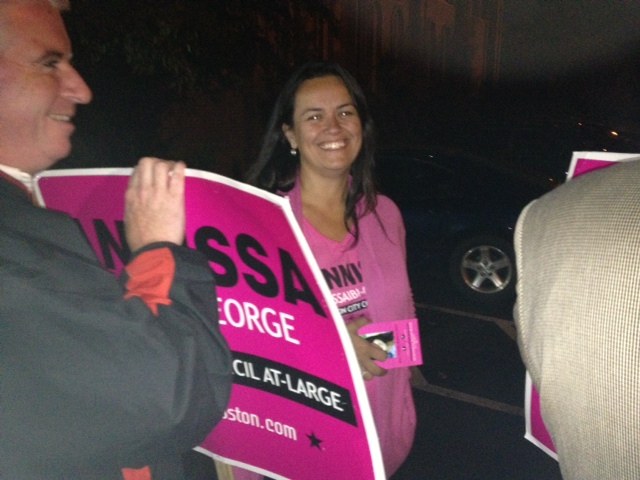
Image

^ the candidate in West Roxbury, meeting voters at ward 20 Precincts 10 and 14, on Primary night

Essaibi-George finished seventh in the Primary. We’ll be looking to see her in the areas she is now focusing on, including, of course, West Roxbury and Jamiaca Plan. She has the active support of Catherine O’Neill, who was on our “suggested” list as well but finished ninth and thus missed “the top eight cut.” O’Neill comes from the opposite end of Dorchester and, as a television hostess and published playwright, has a different following from Essaibi-George’s but one that complements it. Did we mention that the Firemen of local 718 also support her ? They do.

—- Michael Freedberg / Here and Sphere

NOTE : Our summer intern, Dave Morrison, contributed important research and reporting to this profile.

BOSTON MAYOR FINAL : MARTY WALSH REACHES OUT

Image

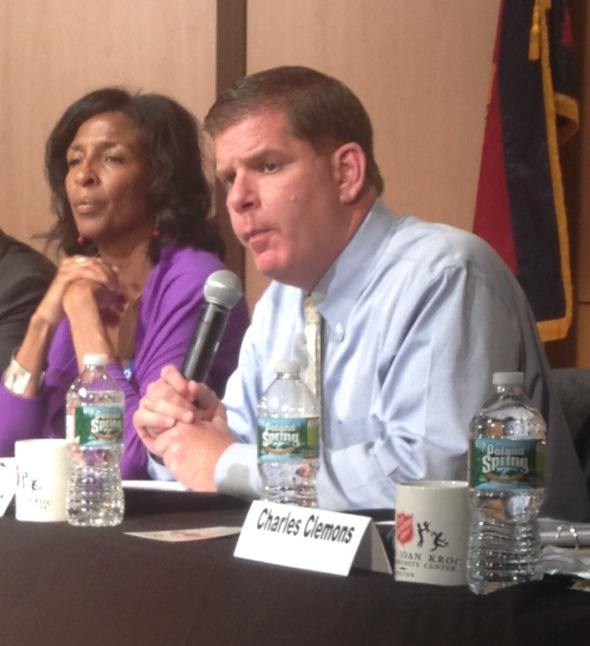
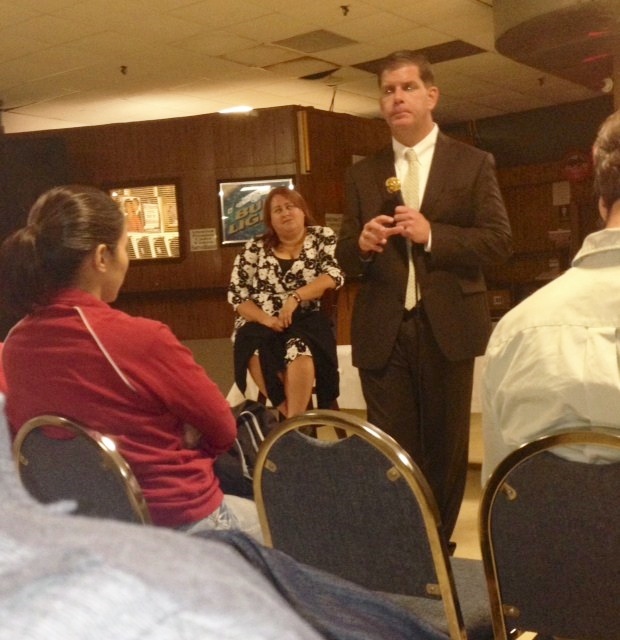
^ Speaking plainly and taking the heat : Marty Walsh at Talbot Avenue “Monday”

—- —- —-

Marty Walsh, one of the two finalists to become Boston’s next mayor, is making a major push to win the city’s communities of color. He is meeting voters in Dudley Square, along Blue Hill avenue, and in Mattapan, at bus stops, along shopping districts, in restaurants. If he wants to win in November, it’s something he must do and thus is spending a lot of these last six weeks of the campaign doing it. Last night he upped his push by holding a “Monday With Marty” at the old and storied Carver hall — now Russell Auditorium — on Talbot Avenue.

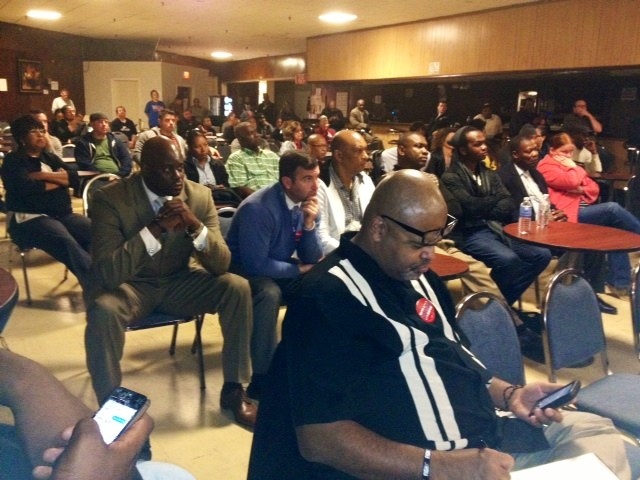
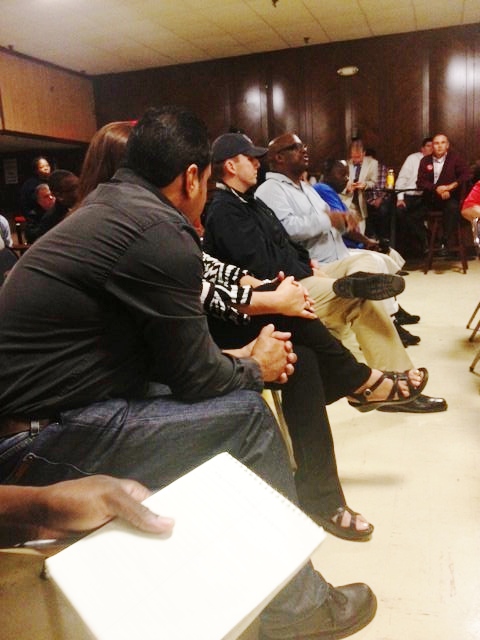
About 80 people, most of them from the neighborhood, showed up to “have a conversation” with Walsh. Many were female — a good sign for a candidate whose campaign has had a “burly white union guy” image. But a “union guy” he is; his campaign theme has been jobs and more jobs; and at Russell Auditorium he talked about jobs first : “Kids will stay in school if we give them a reason to stay in school,” Walsh said, about the high drop-out rate in the Talbot Avenue area and how it often leads to jail. “It’s an important message we send to the neighborhood. You go to jail, all the hopes of being a police officer, fire-fighter, teacher go out the window.”

Walsh was the Building Trades Council business manager, and his campaign has always stressed construction (and its jobs). Often this for Walsh translates to talk about constructing new schools, to replace schools built, as he always mentions, between 1870 and 1926. Thus at the Russell, after delivering the message, he promised, “I will establish an office of new school construction,” he said. “A billion-dollar plan. We will build those schools as community centers, used 18 hours a day.”

And of course he then talked about his 150 million dollar proposal to sell City hall and develop all of City hall plaza for commercial use — “adding all that money to the City tax rolls,” he pointed out. No one in the room missed the point : developing City Hall Plaza means construction jobs. Lots of them.

Walsh also stepped directly onto his opponent John Connolly’s school reform turf. Citing his work as a board member of a successful charter school, Walsh insisted : “I can prove that I am the candidate who will change the schools, not just talk about it.

Image

^ frustrated, but listening : the crowd at Walsh’s Talbot Avenue “conversation.”

It was a strong and articulate stump speech as Walsh has shown he knows how. He stressed is Dorchester roots and the skin color diversity of the district he represents, which, as he noted, “begins just down the street from here.” Still, the audience, albeit polite, proved, once the discussion portion of the event began, that it was not at all pleased with having to choose between Walsh and Connolly. To be quite specific, the Russell audience was sick and tired of having “Irish” mayors, and it said so, in words almost that blunt. In question after question, people let Walsh have it ; the lack of diversity on the police force, police disrespecting them when they call 911; guns everywhere in the community, but not in the white neighborhoods; the utter failure of Madison Park High School. One man — wearing a “Boston raider” t shirt, a man who easily, were he white, could have been a burly Marty Walsh Union guy — angrily pointed out that he never sees people of color in downtown construction jobs nor minority contractors. He challenged Walsh on what he was going to do about it, and about the lack of high-ranking policemen of color.

The scene reminded me a lot of what Robert Kennedy faced, almost 50 years ago, when, as United States Attorney General, he took himself to Black Community meetings to listen to — be insulted by — the frustrations and anger of people of color about what was going on in the South — and in the North too. It made me pretty upset to find that the Russell crowd was making the same points, almost in the same heated expressions, as I had hoped we had put paid to back in RFK’s day. Obviously we have not put paid to the existence of skin color discrimination and divisions.

Image

^ palpable : the confrontation of community and candidate

Walsh listened to it all, respectfully, no sign of anger on his face; almost certainly he agreed with everything the people were saying. He answered every question as best he could. He said much that needed to be said. And if his eloquence did not rise to that of RFK, that’s no criticism, for how many politicians these days do speak at RFK’s level of moral fervor ? Still, Walsh’s even tone and plain language, if it did not inspire the audience, engendered respect.

Will respect be enough to bring to Walsh a majority of votes from Boston’s most economically isolated communities of color ? John Connolly has long been active in Boston’s neighborhoods of-color and has expanded his presence therein all through the campaign. His patrician presence has long — since the days of Boston Brahmin reformers — found more favor among Boston ‘s people of color than Walsh’s rough accents, which, to many Boston people of color mean the old school segregation racism. That memory is unfair to Walsh; and his dogged outreach to Boston people of color is changing minds. But he isn’t, as was RFK, the brother of a President. As for John Connolly, he’s the son of a former Secretary of state and a District Court System ‘s chief judge. If to Boston’s people of color, Walsh exemplifies building trades jobs and a hug and handshake of heart to heart solidarity — a feeling that Walsh proves every day — Connolly exemplifies entry, for people of color, to the board rooms and “tables of power” where the highest aspirations are decided.

Walsh’s outreach is a superb portent for Boston’s political future. And that is how Walsh put it at the Russell : “it’s not about me being Mayor. it’s about the future of Boston.” There he spoke truth, as he almost always does.

My feeling is that Walsh will have to win the votes of Boston’s people of color almost one family at a time and that he must do it if he’s to get into the win game. We’re talking 25 % of the total final vote. He has less than five weeks to make it work.

—- Michael Freedberg / Here and Sphere

UPDATE October 2, 2013 at 1.00 AM : earlier this afternoon Marty visited the Bartlett Garage art works and met many of the makers. This is one of Roxbury’;s best-liked secret places, and it says a lot about the canny advice he is now getting — from someone who knows — about where to go and who to see in “the ‘Bury” and along Blue Hill avenue. Tonight he’ll be at the MAMLEO Forum at 61 Columbia Road. The outreach continues at full force.

“SECESH” FOR THE 21ST CENTURY ?


Image

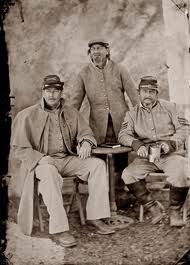
^ “Secesh” 1860s style : Confederate troops fighting for slavery

The word “secesh” hasn’t been heard much in America since the 1860s, but we read and speak it more and more these days as a small band of rabid anti-government congress-people push the Federal government to a shut-down and a Federal debt default.

In 1860-65 “secesh” referred to the southern states that seceded from the Union, and to their troops. It was northern, Unionist talk, and it still is so, and for very similar purposes.

Then, the issue was slavery. Today it is a whole lot of stuff : Obamacare, Federal debt, immigration reform, minimum wage legislation, food stamps, voting rights, marriage equality, gun control, even the Obama presidency itself : all of which 21st century “Secesh” despises.

Image

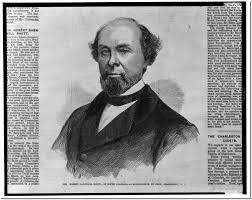
^ Robert Barnwell Rhett : the 1860 Secesh “fire eater” — like today’s Secesh voices, he was a media man (newspaper editor)

In 1860, “Secesh” left the Union rather than accept restrictions on slavery. But by LEAVING the Union, 1860 Secesh actually strengthened it — unified it — and made Secesh’s defeat almost certain.

Today’s Secesh is smarter. Instead of leaving the Union and thus making it stronger, Secesh is staying in the Union and destroying it from within. Secesh today is ABLE to do so because, unlike the 1860 Secesh, it is being copiously funded by corporate goliaths through huge-money PACs  and “think tanks”and through ownership of many media outlets, on which the funds-givers program talk show demagogy with a broadcasting reach that 1860s Secesh couldn’t even dream of. Because of this vast broadcast reach, today’s Secesh has supporters in far more states than the 1860 Secesh had any chance of.

Image

^ Secesh 2013 : Charles Koch, the money behind ALEC and much of the shut-down media

In 1860 Secesh in Congress didn’t have the filibuster or the majority caucus or a “Hastert Rule” (in the House) by which its minority view could be forced upon the entire Union. Today’s Secesh has all of those procedural artillery pieces and plenty of media ammunition with which to fight the nation from within.

Image

^ Bryan Fischer ; Secesh 2013’s version of R B Rhett

President Obama and the majority Democrats could give in, but they have chosen not to. At some point a stand must be taken. Obamacare is the law of the land, and good that it is. Gun control measures must come., Immigration reform will come. Minimum wage legislation should come. Voting rights must be assured to every citizen and expanded, not suppressed. Marriage equality kust come to the 36 or so states in which it still remains unsecured. Federal debt should be seen for what it it is : the world’s economic glue, the safest investment, one which almost every financial institution depends upon, and a no-brainer given today’s near-zero interest rates costing the Federal Budget less than 2 % of its total expenditure.

The President and his party are to be congratulated for refusing to let America’s future be extorted by its enemies.

This is America’s future. A nation welcoming, diverse culturally, more economically fair, secure fir those who live with great insecurity, confident of its currency, cleansed of guns and ammo. If Secesh wishes to stop the future — OUR future — let it try., It will fail. Ignominiously.

—- Michael Freedberg / Here and Sphere

GOTH — AND SOME MIKE MAREEN : OLIVER HUNTEMANN @ MACHINE 09.26.13

Image

^ Oliver Huntemann : a monster movie’s Mike Mareen ?

—- —- —-

From Hamburg, Germany came DJ Oliver Huntemann on Thursday night to Machine for what, to the best of my knowledge, was his first Boston performance. His two hour set was much heralded by local connoisseurs, but few actually showed up. Even at peak hour no more than 100 fans graced the dance floor, and by 1.30 AM hardly any were still on point. Given that local maestro Jeff LeClair played a short but strong opening set, it isn’t unlikely that he is whom they came to dance with. DJ Melee also played a useful set of grungy grumble house music.

Huntemann gave it his best shot : his own tracks, segued and blended, dark and foreboding and, occasionally, coolly Moroder-istic. His sound was a sound effect : streaks and cello-like strums atop stroll and stride beats and moan-ful rumbles. His textures felt thick, his tempo turgid, his tones a mix of growl and groan. The mood was horror movie; the backdrop, monstrous; the totality, almost Goth — of the overblown, German variety in which fake Shakespearean elocution serves a grotesquely comic rubber-face. It’s been done before, though doubtless few of Hunhtemann’s Boston fans recognized it; German hi-energy disco of the mid-1980s had the same Goth moodiness — think Mike Mareen’s 1985 “Dancing in the Dark” — serving up the disco room as a spaceship moving through a midnight void. Then, it was fun, even giddy, and tempoed faster. Huntemann’s version sounded damaged, dull, defeated.

He used two red Traktor vinyl 12s and pc program and edited his sound sparingly. Many of his own tracks displayed their wares and lived up to their imagistic titles : the Goth-y “Melbourne”; a most Mike Mareen-ish “Decks and the City” ; the airs of “Aire” ; a bit of traipse and Polynesia beat in “Tasmanian Tiger” ; and the self-explanatory Cocoon’ and “Dark Passenger.” Given the ominous tone of his set, Huntemann’s “Hope,” in which the great Robert Owens voices soulfully, was not on the dance card. That was too bad. In that track Huntemann compromises his black vision just enough to win house music fans to his side.

At machine there was not winning but defeat. On and on went the monster mash, the ghostly groans, the B-movie brooding, the painful beat. Off and off went the dancers. Huntemann made no changes to his program;. He played what he plays, what he makes. imaginative it was; masterfully sculpted, brutally painted, a sound quite unusual in today’s track making and certainly more thematic than the sketchy rips of electro skrilling. Huntemann’s almost murderous moods may even portend, as experimental music often does — (Though for those who have heard the German “industrial” music, of 30 years ago, that stands behind what he does, his music may sound as much a reclamation as portentous) — but of such portents Boston dance music fans were having little and none. It would be shrewder, henceforth, to book Huntemann at a festival of experimental new music than at a mainstream dance club.

— Deedee Freedberg / Feelin’ the Music

Image

BOSTON MAYOR FINAL : MARTY WALSH ON THE HOOK

https://malegislature.gov/Bills/188/House/H2467

Bill 2467

^ The State House on Beacon Bill : where H. 2467, “By Mr. Walsh of Boston, a petition…” looms mightily over the Mayor election

—- —- —-

Just this morning I opined about the impact that the arbitrator’s large pay raise award to the BPPA might have on the mayor’s race. Little did I know ! Only a few hours after I wrote, Marty Walsh declared his opposition to the size of the award — a perfectly reasonable opinion — only to have John Connolly call a 4.30 PM press conference on the matter.  At which…

Connolly struck a body blow : that Marty Walsh, as a legislator, had sponsored and filed a bill, House 2467, by whose provisions arbitrator awards, of the exact kind now at issue, would be binding even on City Councils. And thus that Walsh’s stated opposition to the award was, in effect, opposition to himself.

The law on municipal employee arbitrations now is that arbitrator’s awards to such employees are subject to approval by the City Councils of those municipalities. If the Council doesn’t approve, back to the arbitrator goes the pay dispute. Marty Walsh’s bill would take that power away from City Councils. An arbitrator’s award would be final.

Walsh tried to explain that in fact his legislation would make an arbitrator’s award binding upon Councils only to the extent that city finances could bear it. But as Connolly pointed out, Walsh’s legislation does not contain that proviso. Though the bill’s language directs the arbitrator to factor several such concerns into his award — and says nothing about HOW the arbitrator does such “factoring” — once his award is made, that’s it.

I was sitting with a friend of mine who’s a Marty Walsh supporter — he even has two lawn signs for Walsh — when the Connolly press conference broke. My friend turned to me and said, “well that’s that. I’m not for him !” I suspect those words were said quite often in Boston late this afternoon.

It’s a very tight spot for Walsh to be in. His own legislation — H 2467 starts off saying “By Mr. Walsh of Boston, a petition…that provision be made for binding arbitration for fire fighters and police officers” — casts in stone an arbitration award that has the whole city up in arms over its size.

He has some serious, serious explaining to do — not the spin syrup that he put out today — and it had better come quickly.

Because in two days or so the City Council hears the BPPA award details and votes on it. And John Connolly will be part of that hearing.

— Michael Freedberg / Here and Sphere

Afterthought :  Connolly’s revelation about House Bill 2467 casts a dark light on a Walsh campaign that has looked, to me, to be heading in a Romney-like direction. Just as Mitt Romney won passage of Romneycare, then proceeded to turn his back on his achievement, as a presidential candidate, so Walsh, whom Labor support lifted into a first place Primary finish, has lately taken to sounding like a chamber of commerce, Club for Growth-type business-recruiting Texas governor. It’s been curious to watch this gradual transformation; one wondered how or even if Walsh could pull it off. It seemed possible, Now it looks hyperbolic..

His campaign is also a case study in why State legislators in the Boston delegation don’t often run for mayor and, when they do, don’t get elected. With H. 2467, Walsh is using the power of the state to override the power of the City. Well and good for the labor unions whose champion he is; not so good for his appealing, now, to the entire City.

Walsh needs to rethink his campaign to;p to bottom, and fast. He has much to offer that John Connolly is temperamentally unsuited to match. His passion is infectious, His respect for everyone palpable, exemplary, But Walsh has to be a superior helmsman as well as a rock solid shipmate. Right now he has lost the helm. Connolly has it.

NOTE : I updated this story at 9.16 AM on Sunday 9/29/13.

MEEK AT THE MOVIES : Rush – 3.5 STARS

Image
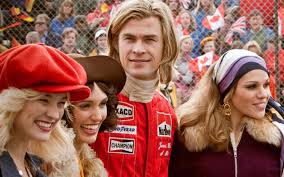
^ “a good driver but a legendary fuck” ; Daniel Bruhl as Niki lauda in Ron Howard’s RUSH

—- —- —-

Ron Howard has set his directorial career all over the map. Early on he made a spate of serviceable comedies (“Night Shift” and “Splash”) and took dips into the fantastical (“Cocoon” and “Willow”) before entering a very serious stage that saw “Backdraft,” “The Paper” and “Ransom.” During that stretch Howard also delivered his crowning achievement, “Apollo 13” (it’s a far more competent and complete work than “A Beautiful Mind,” which garnered a slew of Oscars) as well as the ill-conceived reality TV satire, “edtv.” Along the way, too, Howard unsatisfactorily attempted a cinematic adaptation of Dr. Seuss’s “The Grinch who Stole Christmas” and later ventured into Dan Brown territory, directing the lackluster “Da Vinci Code” films. More recently, the man who had once been Opie of Mayberry appeared more than ready for the directorial graveyard after laying the clucking Vince Vaughn and Kevin James dud, “The Dilemma.” But like the hero of his 2005 boxing drama “Cinderella Man,” Howard has come off the ropes with “Rush.” To sit through the real-life Formula 1 speedway drama, one might think they were viewing the work of an emerging auteur just hitting stride with a first big studio budget behind them.

It’s easily one of Howard’s two or three best films, and the subject matter, while held in check by history and fact, zips along supercharged by the immaculate production, detailed craftsmanship and dead on performances. The men of subject, James Hunt (Chris Hemsworth, better known as Thor) and Niki Lauda (Daniel Brühl), are Formula 1 deities of the early 70s back when household names like Mario Andretti and James Stewart were just getting off their training wheels. Both men were born sons of big European money and both were spurned by their families when they opted to go into something so lowbrow as auto-racing—but that’s where the similarities begin and end. Hunt, a hedonistic Brit off the track and an unbridled force guided by instinct and gut on it, has a need for speed and a flirtation with death. His appetite and personality present bigger than life and fill the screen over the roar of the engines. To put it all in perspective, one fellow racer advises Lauda, who is about to go on a date with the racetrack manager’s ex-wife (because she had an affair in the back of an ambulance with Hunt as her husband stood feet away unknowing), of the act he’s following and adds, “He’s a good driver, but a legendary fuck.”

Lauda, a tacit German who speaks too bluntly for his own good, earned his way up as technician, retooling cars and making them faster by retrofitting them. He and Hunt initially tangle in the lower Formula 3 ranks and re-ignite their rivalry on the bigger stage when Lauda is driving for Ferrari and Hunt is wasting away a foppish British Lord’s largesse and having champagne in the pits. For three years the two vie to be best driver in the world. Lauda, the calculated practitioner, achieves the seat twice but at all times, Hunt is right there ready to take it from him, until the 1976 season, when Hunt leads a coalition against Lauda — who wanted to have a race in the rain on a tricky course aborted, and Lauda, on a tricky hairpin, ends up in a wreck and trapped in a fire that burns him at over 800 degrees for more than a minute.
“Rush” smartly does not let the races become epic events. They’re terse. They make their point. In their own way, they’re mini wonders of film making, brilliantly staged, shot and choreographed. The montage, like the drivers, is efficient and minimal (no extra weight or pomp, just muscle and skill) and the stellar sound editing puts you right there on the track and nearly makes you wish for a pair of ear plugs as the cars rev up and vroom around the track. I’m not sure if I’ve ever walked out of a film and said this should win an Oscar for sound editing, but this is surely one.

The drivers are given soul by the women in their lives and by how they value each other. Hunt goes through women like grease rags, though he does marry the super model Suzy Miller (Olivia Wilde), who in a fit of frustration leaves him for Richard Burton, and Lauda marries a woman (Alexandra Maria Lara) whom he meets at a party he can’t fit in at (because he’s socially inept and would rather be reworking his car in a garage). It’s one of the film’s best scenes when her car breaks down in the Italian countryside and she tries to get a car to pull over for a ride by showing some leg, but the car that eventually does pull over, pulls over for Lauda because it’s full of three racing enthusiasts who consider it an honor to let Lauda drive their car. To that point she had no idea who he was, and after that, it’s love at first swerve.

While “Rush” is a brilliant sparkle, and perhaps relief to Howard, it’s really Hemsworth and Brühl and the chemistry between the two actors that make the film go. With another set of players and a different driver behind the wheel, this might have been a flabby bio-pic without any punch and pull. But something magical has rolled out of the hangar; all cylinders fire in unison. Given the road map, there was little room for error. Howard and the boys punch it home with gusto.
— Tom Meek / Meek at the Movies

BOSTON MAYOR FINAL : THE POLICE AWARD…AND THE BTU

Image

^ Payday for the Police — the arbitrator says so

—- —- —-

My first reaction to the award, by an arbitrator, of a four-year pay raise of 25.4%, has already been published by Here and Sphere’s big-name media rivals : it saddles the incoming mayor with a big headache.

True enough. But it also impacts the campaign going on now, something that none of our media neighbors has addressed at all. Here’s why, and how:

1. It poses a big problem for Marty Walsh — and also an opportunity: IF he grabs it. First, the problem : Marty is already perceived as “the union guy.” He can NOT go lightly on the police award. Nor can he go tough, for no one will believe him. He can avoid the issue altogether and say it’s a City Council issue — which it is; but that hardly shows leadership.

Yet Marty knows how to show leadership — in a big way. He did it with his City Hall sale proposal. Big leadership here would be to address Police department reform, top to bottom, new Commissioner included, as he has already done at Mayor Forums. If not now, when ?

Image

^ Marty Walsh : handed a lemon, needs to make lemonade

Image

^ John Connolly : opportunities aplenty in the police award… and the Boston Teachers Union

2. For John Connolly the issue is simpler but not risk-free. People know that he doesn’t favor this award. He will likely say so, and that the Council must reject it. But that won’t be enough. He should use the matter to talk about Police Department reform generally, including diversity in the higher ranks and what sort of a Police Commissioner he is looking for.  Take the long-term view, for sure. it will comport with Connolly’s follow-the-consequences approach to school reform.

If both Walsh and Connolly can turn the police award lemon into police reform lemonade, the cooking looks less favorable to Walsh when we turn to the Boston Teachers Union (BTU):

Image

^ The BTU’s Richard Stutman : his (and his team’s) decision could decide the future of Boston school reform — and the election

Walsh simply can NOT, politically, come to terms with the BTU. Having “tied his hands,” as the Boston Globe put it, to labor, Walsh has no perception room at all to accommodate the City’s major public employee Union. He almost MUST adopt the program of school reform that business leaders want. After all, how is he to gain any traction at all in Wards 3, 4, and 5 — where most of the City’s business leaders live, if they live in the City at all, and where he was beaten 2 to 1, 3 to 1, even 4 to 1, by Connolly on Primary Day — if he does not go all-in with school reform ?

Not surprisingly, Walsh has begun to talk more and more about recruiting businesses — going to other cities and states to do so — to come to Boston. This is language we usually associate with Governors of Texas and South Carolina. It’s Chamber of Commerce talk. It’s certainly a good idea for a guy perceived as a labor voice — as Walsh says, if there’s not business, there’s no jobs. But it’s an agenda that implies a school reform in line with what technology-savvy businesses want to see happen. They’ve made it plain that locating in Boston means having a pool of school graduates who can at least do entry-level jobs — something that Walsh has talked about in detail at Mayor Forums.

Walsh’s union base isn’t the City’s unions — except for the Firemen of local 718. his core support — his door-knocking army — is the building trades, who work for private businesses. Good jobs for their children is what they want, any way that Walsh can get them. Reform the schools as “philanthropists, entrepreneurs, and non-profits,’ in the language of a BTU objection, puts it ? If that’s what it takes, yes. It gives Walsh a pathway out of Downtown-vote poverty.

Meanwhile, John Connolly has made enough of an impression upon Boston’s business community that he has loads of political room to work out school reform with the BTU. It would be the only union in his orbit. Keep in mind that school reform isn’t this election’s number one issue because corporate education reformers made it so. It is number one because Connolly made it his theme.

For this very reason, I suggested in an earlier column that the BTU should have endorsed Connolly as one of its two primary picks, saying something like “we differ with Connolly and how to reform our schools, but we endorse him simply for having made schools the election ‘s top issue.” Now, it appears, that discussion is actually taking place. And for good reason. Connolly was a public school teacher; his children attend public schools; and he has the trust of the business community and of Boston public school parents. If either candidate can credibly reach — SHOULD reach — a working accommodation with the BTU, it is he.

Will Walsh take the police award lemon and whip up a winning lemonade ? Will Connolly and the BTU reach an election-winning accord ? We will soon find out.

—- Michael Freedberg / Here and Sphere

MEEK AT THE MOVIES —- Don Jon (3 stars)

Image

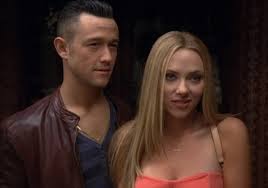
^ the lady killer and his ‘eleven” — Joseph Gordon-Leavitt courts Scarlett Johansen in “Don Jon”

—- —- —-

So you’re a lady killer and you’ve got abs and a workout routine that challenge The Situation (not to mention a bit of his Jersey gym rat accent too), so why live the life of a chronic masturbator when you can have any babe in the house? A good question and pretty much the rub of Joseph Gordon-Levitt’s plucky rom-com, where he not only tackles the role of the buff Jersey boy of the title but also makes his feature debut as both writer and director.

The film’s intrepid protagonist is so tagged Don Jon (a play on his first name, Jon coupled with that of the notorious lover, Don Juan) by his boyz because he always scores, though in private his ideal sex partner is ten minutes of internet porn and a tissue. Even after landing a nine (on a ten scale), it’s not untypical for Jon to slip out of bed as the conquest du jour snoozes and fire up the laptop for a quick porno boosted topping off.

Sex addict, porn addict? “Don Jon” is not so concerned with that as with Jon’s journey from meandering man-boy into manhood. That transition gets a strong directional pull one night; while out prowling the clubs, Jon lays eyes on the comely Barbara (Scarlett Johansen giving her best and most sex bomb performance to date). She’s an arguable eleven (that ten scale again!) who’s interested in Jon, but won’t let him bed her without a proper and long courtship, and she adroitly knows how to keep him on the hook without letting him in for a night cap. Barbara’s also a life planner and isn’t so thrilled by Jon’s dead end job in an electronics store or his lack of education; so, to even get in the game, Jon’s got to sign up for night classes and take Barbara to meet his parents. These ultimately prove to be loaded and fateful propositions.

Much in the film carries the tang of stereotype and cliché (think “Jersey Shore”), but as it washes over you and takes hold, you realize there’s much more going on than a couple of greasers looking for hit-and-runs. It’s about letting go, finding yourself and connecting; a sly subversive charm that Gordon-Levitt has (through skill or beginner’s luck) infused into the script. Barbara’s gum smacking challenges and demands piquantly put Jon on edge; and, as director, writer and actor, Gordon-Levitt isn’t afraid to deprecate himself or let the other players take center. Jon’s outshone by nearly every other character in the film. Barbara’s a strong cup of tea with her blunt bimbo-esque garble and clingy sweater dresses. Then there’s an overly tanned and toned Tony Dana and Glenne Headly serving up devilish fun (and archetypal puns) as Jon’s working class parents, while Julianne Moore adds a soft, human touch as a troubled older woman in one of Jon’s night classes. Their relationship moves in surprising and affecting ways that educes the reluctant heart in the brash braggadocio.

As Gordon-Levitt builds the film with emotional layers that take root with earnestness, there’s always a jab of good humor in nearly every scene, even if it’s a quick cutaway to Jon’s mounting mass of wadded-up tissue balls in the ubiquitous wired mesh trash can next to the laptop. The compendium of comedy also gets boosted by Jeremy Luke and Rob Brown as Jon’s posse and Greek chorus; Brie Larson adds tartness as Jon’s adolescent sister; she’s a constant reminder of teen angst and boredom as she sits at the dinner table, tacit and unengaged even during bursts of raised voice hysteria, which is common place at Jon’s parents’ house.

In its sweet quirkiness “Don Jon” plays out like a Woody Allen comedy from the other side of the tracks with sharp sophomoric wit stepping in for highbrow satire. It’s an impressive outing for Gordon-Levitt as a nascent filmmaker even if the film doesn’t have a satisfactory “happy ending.”

— Tom Meek / meek at the Movies

BOSTON MAYOR FINAL : WHAT THE TWO NEED TO DO, AND WHY

Image

^ John Connolly — Marty Walsh : two irish names but men who could hardly be more different

—- — —-

Who will win on November 5th and become Boston’s next mayor ? The punditry has already begun. Most of what we’ve read talks about “communities color” and how on Tuesday Boston voted once again for two Irish white guys who now need to find a way to win said communities’ votes. True; but very simplistic. There are a lot more votes that Walsh or Connolly need to win. 64 % of those who voted on Tuesday voted for somebody else. Many November voters did not vote at all. Probably as much as 80 % of those who will vote on November 5th did not vote for the two white irish guys.

What must Walsh and Connolly do about it ? And how do I assess the obstacles they face ? Here goes:

1.Marty Walsh on Tuesday was pretty much a locally dominant winner; John Connolly on Tuesday was fairly much a broadly based vote-getter. Walsh’s vote was passionate, Connolly’s cool. Cool votes count as much as hot ones.

Despite his first place finish, Walsh’s challenge is immense. Though he swept cleanly the precincts of his seaside base — from South Boston to Savin Hill to Florian hall — he turned out 45 % to as much as 71 % of the voters in those precincts, by dint of a vast field organization of door knockers. That card is now played. He can increase his base vote by some, but not by a lot. Yes, he won as much as 77 % of the vote in his “base.” But 77 % of 80% of all voters in his base, say, isn’t that much more than 77 % of 71%.

As for outside his base, Walsh barely registered in some very key places. Take a look :

( a ) Ward 5 (Back bay, Beacon Hill, Fenway ) ——— Walsh 224 Connolly 1426
South End & Downtown (Ward 3 Pcts 6,7,8
and ward 4 Pcts 1-6, Wd 8 Pcts 1-3, ward 9 Pcts 1-2)………………………………………………………                               Walsh 545 Connolly 1909

TOTAL DOWNTOWN AREA ………….          Walsh 769 Connolly 3335

In the Primary, these precincts turned out an average of about 22 % to 25 % of their registered vote. In November these precincts always turn out in much bigger numbers. Even an increase from 25 % to just 40% — there will likely be more — would raise Connolly’s advantage over Walsh from 2564 votes to over 4000 votes. at 50% turnout the margin would increase to 5128 votes.

( b ) Ward 20 (West Roxbury and much of Roslindale)
………………………………………………………………… Walsh 1763 Connolly 4074

This doesn’t on the face of it look so bad for Walsh in Connolly’s home neighborhood. But looks deceive. Connolly faced a strong other candidate, Dan Conley, living in Ward 20 too and taking about 2500 votes (I am estimating, the City of Boston Ward and Precinct unofficial results for some reason leave Conley out). In addition, Ward 20 turned out 49% of its huge number of voters. In November, Ward 20 can turn out at least 70% — 17,000 to 18,000 voters — and Dan Conley will not be on the ballot. At 17,000 votes, a Walsh 3500 Connolly 13,500 result is entirely feasible. Even a more likely Walsh 5000 Connolly 12,000 result would give Connolly a larger margin than the entire vote turnout in Walsh’s home Ward 16.

Add a conservative Connolly margin of 5000 in the downtown areas, and he now has a bigger margin — 12,000 — over Walsh than the likely entire turnout from Wards 16 and 7, Walsh’s two strongest Wards.

( c ) East Boston, Brighton, Ward 19 (Centre Street, Jamaica Plain; plus a small part of Roslindale)

Even with the support of State Rep. Liz Malia, Walsh fared not so hot in Jamaica Plain. In East Boston, Connolly had the endorsement of State Rep. Carlo Basile. Basile delivered. In Brighton, to which neither he nor Connolly had any local claim, Connolly was the clear winner :

Ward 1 ………………………………………………….. Walsh 762 Connolly 1214

Curiously, in this once banner “Italian” Ward, Rob Consalvo did not dominate Tuesday. His vote total barely matched Connolly’s. Turnout, too, was shockingly small : about 28 % . In November, all this will change. Historically, East Boston has consciously “delivered” the bigger part of 6000 to 7000 votes to a preferred, usually Irish, contender. It was famously so in 1959, when Ward 1’s vote made the difference in John Collins’s upset win over the much favored John E. Powers. In 2013 it is unlikely that Ward 1’s top politicals can “deliver” the Ward to anybody; yet with a much higher turnout — that much the ward’s politicals can do — and Rob Consalvo out, plus a clear preference for Connolly, as it stands today he will carry “Eastie” by about 1400 votes : say 4200 to 2800.

Ward 21 …………………………………………………………. Walsh 362 Connolly 631
Ward 22 …………………………………………………………. Walsh 818 Connolly 832
TOTAL ………………………………………………………………..      . 1180                  1463

Brighton’s turnout was tiny. In Primaries it always is. In November, the turnout might double and still be small. Connolly’s advantage isn’t much, but it is an advantage and takes away from Walsh a possible chance to cut Connolly’s huge vote margins in the Wards I have already assessed.

Ward 19 ………………………………………………………. Walsh 542 Connolly 1007

Many Ward 19 votes went to other candidates on Tuesday. Still, unless they break decisively to Walsh, and adding a modestly higher turnout — to maybe 55 % — than Tuesday’s estimable 42 %, Connolly still stands to win the Ward by a good 1500 votes. Not a lot, but at this point Connolly doesn’t need a lot more.

All of the above leaves it — with one exception; see below — up to Boston’s “communities of color,” concentrated in Wards 8, 9, 10, 11, 12, 14, part of 13 and 15, 17, and much of 18. It’s a lot of the City’s voters, maybe 25 % — greater, taken together, than Ward 20. On Tuesday, Walsh and Connolly won almost an equal share of what little vote in these communities did not go to Charlotte Golar Richie, John Barros, and Felix Arroyo. If on November 5th communities color divide their vote equally, Connolly almost certainly wins. What are the chances that Walsh can turn a palpable majority of voters of color in his direction ? As of today, I cannot tell. My friends think that a decision here will not be made until after one or two of the upcoming three debates. I think they are right.

But let us say that even after the debates, Boston’s voters of color poll equally for Walsh and Connolly. Does Walsh still have a chance ? Yes he does.

I’ve left one big region out of the discussion : the part of Ward 18 that Mayor Menino lives in. it is said that Menino cannot stand John Connolly, and Connolly’s loss to Walsh in Hyde Park and Readville bears out what is said :

Ward 18 Pcts 9, 10, 16, 17, 18, 19, 20, 22, 23)
————————————————————————– Walsh 647 Connolly 542

In Menino’s home precinct (20), Walsh beat Connolly 97 to 34. Of course the overwhelming majority of votes in the precinct went to local hero Rob Consalvo. He won about 2500 votes in the whole region. It is assumed, probably correctly, that Consalvo will support Marty Walsh. If I assign Consalvo’s 2500 local votes three to one to Walsh, and increase the turnout from 45 % to 60 %, Walsh wins Menino’s home area by about 1800 votes.

With this 1800 vote victory, a 10 point margin among communities of color, some increase of vote in his home area (South Boston especially), and a strong debate showing leading to a decent majority among voters who did not vote at all on Tuesday, Marty Walsh can win the day. But it will not be easy.

Marty is respected by all who know him, has a civil rights record second to no one, and has the utter loyalty of labor (other than the Teachers Union). He needs to run an almost perfect campaign. He needs to tell us about his 16-year record at the state House. He needs to show that he speaks the language of business, and its plans, as authoritatively as he talks that of labor.

Walsh needs badly to expand his reach at least into areas where he wasn’t blown out : Tom Menino’s half of Ward 18; Jamaica Plain; Brighton (Ward 22); the North End; and Ward 10 (Mission Hill precincts). He would be well advised to borrow from Dan Conley’s excellent, neighborhood-oriented recommendations list of administrative reforms. He needs to get Felix Arroyo and Rob Consalvo aboard.

John Connolly’s strategy should be “steady as you go.” Continue to do exactly what he has been doing, but also present a convincing plan for administrative reform — Dan Conley’s neighborhood by neighborhood list, but also reform of the Police and Fire Departments. Connolly needs to get some sleep before the debates and come out passionate and and in command as he already has shown he can do.

Can Walsh do it ? Yes he can. But John Connolly is no punching bag. He can do it too. He speaks as eloquently as Walsh does, seems to understand the culture better, and draws voters of all ages and both genders much more readily than Marty Walsh has so far shown.

It is going to be a terrific six weeks, isn’t it ?

—- Michael Freedberg / Here and Sphere

ReciPee’d OFF!!

Relationship Advice

sincerelyheylady's avatarSincerely Hey Lady

Hey Lady:

My fiancee Matt and I are recently engaged, he is about to graduate soon from Harvard, and I will follow next year. We just moved into our first apartment just of campus. I come from a very low income household and put myself through college with grants, loans, and hard work. Matt on the other hand comes from money. He is definitely used to the finer things in life, and he was raised to have a certain mentality. He is a great man don’t get me wrong, but then there’s his MOTHER; I don’t even know where to begin on this subject. His mother was introduced to me after a year of dating. As a freshman I did not see all the red flags of a serious “Mamma’s Boy”. Early into my Sophomore year I began to see some things that made me wonder, but now it’s become a nightmare…

View original post 1,430 more words