BOSTON MAYOR : YEAR OF 1000 LEMONS

Image

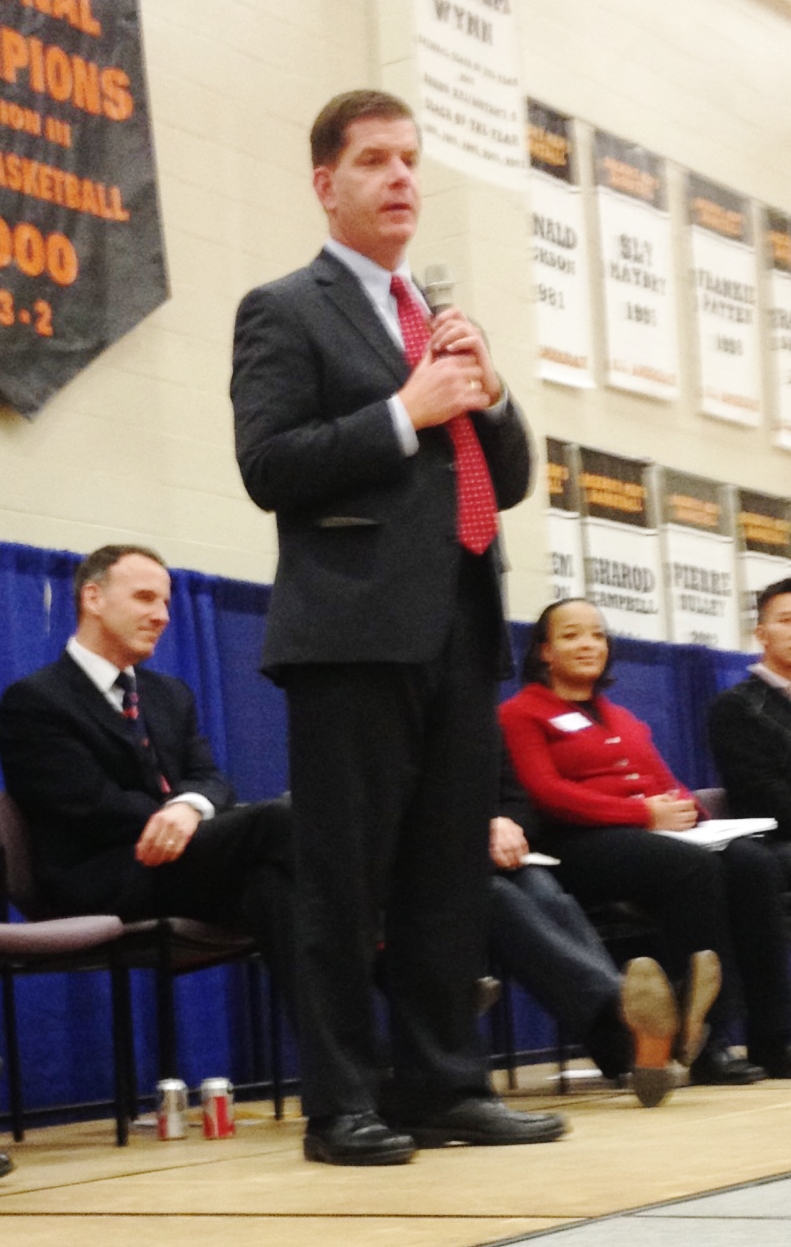
^ A 1000 lemons are zooming toward the man who will have to tend the Boston lemon grove….

—- —- —-

Those of us who preferred John Connolly as Mayor may wonder whether our preference was a blessing or a curse. Because the mayor we did get, Marty Walsh, faces an avalanche of problems verging on intractable. Well might John Connolly be grateful to have dodged the 1000 lemons descending upon Walsh’s first year in office, any one of which could derail his agenda and all of which might leave him muttering “why me ?”

Consider : ( 1 ) Boston Public Schools face change in every aspect, from teacher evaluation to curriculum development; from facilities upgrades to a new union contract; from competition for school funds to a revised school assignment plan that, hopefully, prioritizes close-to-home; and the bugaboo of charter schools, loved by supporters (and Walsh has been one), demonized by the Ravitch-ians ( 2 ) a Police Department that miserably failed to administer the City’s taxis, which entirely lacks diversity at the captain level, that has in many cases lost the trust of neighbors in the most violent zip codes, that just won a budget-busting pay raise heavy with money from public works details ( 3 ) a Fire department ready to rumble its own forthcoming contract negotiation; which now lacks both top administrators; is utterly resistant to firehouse and work rule reform even from a Mayor independent — which Walsh is totally not ( 4 ) city finances standing $ 50 million in the red even before the Police pay raise award and which can only redden more deeply as the funding needs of school reform, future union contracts, and public works present their bills — not to mention tax breaks that project developers will demand, and likely be granted, as the price of moving Boston’s Building boom forward (and thus providing continued work to Walsh’s core support, the building trades workers).

Consider also these : ( 1 ) major school reform that will be demanded — not requested — by employers who will either get job applicants who can meet entry-level requirements, at least, or will move to cities whose graduates do meet those requirements ( 2 ) expanding the City’s hubway bike system without aggravating car traffic flow ( 3 ) figuring a plan for Sullivan Square / Charlestown Neck that makes useful space of it, rather than a traffic-clogged jumble of trash, old brick, and rusty rails; and that takes into account the likelihood of a Steve Wynn casino in Everett, directly across the Mystic River ( 4 ) making the city’s parks safer to use, grounds-keeping them, and opening them — Franklin Park in particular — to tournament sport ( 5 ) devising a platform that makes middle-class housing profitable to build and affordable to buy — and deciding where to base it, in the face of neighborhood NIMBY-ism ( 6 ) configuring the BRA to increase neighborhood input (as most voters want) without enabling NIMBY-ism ( 7 ) choosing new hires without succumbing entirely to favoritism (although at a lower level, favors have value to the collaborator that Walsh has built his following by being; and, lastly ( 8 ) hiring a substantial presence of people from Boston’s Communities of Color (“COC”), and seeing many into the building trades : because without strong COC support Walsh wouldn’t have come close to winning and without which he won’t be re-elected.

Then comes the City Council Presidency flap now roiling some commentators and overly mind-busy “progressives.” The last thing that Marty Walsh needs, given the lemon grove of problems zooming at his head, is a Council President who can credibly run against him in 2017. Walsh will almost certainly face a strong opponent anyway. How can it help city governance to box Walsh further than he is already boxed ?

I wrote two days ago that Walsh may have made a big mistake by holding so many public hearings on the eleven issues that his transition team prioritized; that he might have been better served to put a lid on it all until a few months into his actual term of office. But perhaps his public hearings have more value than not. They give issues constituencies opportunity to speak, insist, petition; to feel that this new Mayor sincerely wants to listen. I think he does.

Listening — which he does well — is true to who Walsh has been, as union leader and legislator : a collaborator who works by bringing various interests together for a common purpose. The weakness in his method is that it depends on the willingness of those interests to collaborate with the collaborator. We will find out soon enough if that happens, and with how many lemons.

One asset that Walsh does possess is a wide circle of “wise old heads’ who trust and respect him and whose reputations in the City;s various communities Walsh now commands. He will not lack for good advice or for spokesmen and spokeswomen to argue bis case to the various interests arguing their cases to him. Other than these folks, however, his team looks young and quite all of a kind. He need to diversify his core staff, and soon.

Most of all, he badly need to hire top people now working for the various entrenched interests that now confront him AWAY from those jobs and INTO his administration.

The success of his lemon grove lemonade depends on it.

—- Michael Freedberg / Here and Sphere

LISA MOELLMAN, GUEST CONTRIBUTOR : RESPONSE TO “PUBLIC SCHOOLS BEAT PRIVATE SCHOOLS” ARTICLE IN BOSTON SUNDAY GLOBE

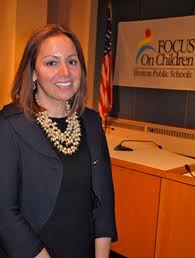
Lisa Moellman

^ Guest Contributor Lisa Moellman

Editor’s note :

We received this via inbox at our personal facebook page. It was sent, said Ms. Moellman, in response to an article that appeared in Sunday’s Boston Globe, by Christopher and Sarah Lubenski, to the effect that by some measures Public Schools perform better than private ones. As her response addressed the article in question most persuasively and, as well, highlighted a major urban public school set-up as rebuttal, we have decided to publish it as a guest contribution, after which we have posted an essay of our own.

This is Lisa Moellman’s letter :

“I sent an email to Prof. Lubenski sharing my response to the Globe piece highlighting his and his wife’s conclusions about why they found public schools outperforming private ones on a math measure nationally. Here it is:

“I just read the key conclusions of your study highlighted in the Boston Globe piece today (site based autonomy and school competition bode poorly for math achievement). http://www.bostonglobe.com/ideas/2013/12/15/public-schools-beat-private-schools/hWLzdKv1x7wwupcjk5zonI/story.html

“I taught in one of the best PUBLIC school districts in North America (approx. 100,000 students)–Edmonton Public Schools–which in fact maintains a portfolio of schools in which EVERY school has site based autonomies, student weighted funding and the ENTIRE district is an open district of choice for families. It is a public district of autonomy and competition–extremely high performing. This flies in the face of your rationale about auntonomies and competition at the core of the differences you found between public and private…take a look at this summary about Edmonton Pubic and take a deeper dive into understanding the developmental histroy of this district–it’s a beacon for districts across Canada and the U.S., as well as some in the EU.

http://www.hawaiibusiness.com/Hawaii-Business/May-2010/Best-School-System-in-North-America/

“Further, a 2010 McKinsey report notes that public districts moving from poor to good need to centralize professional development, curricula, etc. but that once districts are at a good level, if they want to become great districts, they must decentralize and provide leadership and teachers with site based autonomies.

http://www.mckinsey.com/client_service/social_sector/latest_thinking/worlds_most_improved_schools

“In my experience and reading, your conclusions are not justified by your research findings. It’s troubling because this article was just tweeted by a key advisor to Mayor Elect Walsh in Boston on #Bosmayor. Scaling back our movement toward pilot and in district charter autonomies as Boston Public Schools attempts to move from ‘good to GREAT’ would be a misstep and deeply troubling as we strive to close the Achievement Gap.”

—- Lisa Moellman / Guest Contributor

—- —- —-

Editor’s Note : first, the Lubenskis’ article talks of private schools in general. No distinction or classification is made. This stacks the deck. Because private schools operate almost entirely in competition with one another, the fact of competition becomes the standard, for many such schools, rather than the rigor of the curriculum.  It is unfair to pit ALL private schools, of whatever sort and however set up, against public schools, which must adhere to a common, legislative standard. The argument is not whether public schools do better than ALL private schools but whether they do better than the schools most parents would be comparing to public schools. Most parents would not pay money to send their kids to a poorly performing private school.

Second, by choosing mathematics, the Lubenskis have already made a structural choice as well as a curriculum decision. They do not seem to realize that we school our children to two very distinct obligations : citizenship and the workplace. Mathematics do not get taught at home as often as reading, history, and civics because these are citizenship disciplines, while mathematics is almost entirely a workplace knowledge, at least in our society (to the Greeks, mathematics was as idea-based as te other liberal arts and formed the basis of much of their awareness of the real world).

Much of the otiose discussion going on these days about education arises from the failure to distinguish the prerequisites of citizenship and workplace. For citizenship, we teach reading, writing, argument, the arts, and music; and ethical, societal, moral, and legal knowledege (including history) that does not change — or, at best, slowly evolves — because human nature does not change; whereas for the workplace, everything changes constantly. This has implications for formal education that almost no one talks about. One is that teachers of citizenship knowledge should have long experience of the world — tribal societies used councils of elders to instill such knowledge in their young and to test their mastery of it. Whereas, with workplace knowledge, long experience often impedes instruction. In our rapidly innovating world, the best teacher of workplace knowledge is, likely as not,  to be very young — the younger the better. A career in workplace teaching contradicts the experience of the innovation economy, in which collaborative competition renders career knowledge relentlessly obsolete.

When thinking workplace knowledge, we must never forget that we are educating children for tomorrow. Not for today, not for yesterday.

Much workplace knowledge is most effectively imparted on the job, by apprenticeship. This is what our society used to do, but because apprenticeship was often a form of child labor and indentured servitude, it was given up as immoral or illegal. today it should be brought back, in a new form, as internships.

Unfortunately the huge institutional power of academe has all but monopolized our society’s teaching functions, so that subjects that should be learned by doing (as John Dewey knew 110 years ago), in apprenticeships or internships, are now “taught” in  formal schools by “teachers.” Why should future lawyers go to a law school ? The law, for example, is quintessentially a practiced art. It is best learned by “reading law’ or “clerking’ for a lawyer.

We also ask our schools — public especially — to do too much that isn’t education at all. Teachers are not set up to be day care providers, baby sitters, psychologists, nursers. Parents can NOT simply dump their children at the school door and say, “here, take them, I need a day of quiet.” As long as we allow our schools to be thus imposed upon, schools will be hard pressed to do what schools do. the only way that this “here, take my kids, I need quiet’ system works is with boarding schools. (It’s not such a radical idea. Our first Massachusetts antecedents, back in the 1600s,  often sent their kids at age 12 away to live with a family not their own. It was thought — correctly — that the child would be less likely to fight discipline at someone else’s house than in his or her own. Having been sent to boarding school myself, at age 13, I can attest the truth of this custom.)

At the primary, middle, and high school levels, however, it is fair to ascribe almost all citizenship and work skills education to formal schooling. This we do. But just because we do this, we cannot lose sight of the gulf that separates the two curriculum paths. Citizenship requires learning of one kind, the workplace of a completely different kind.

Of course we could always decide to teach mathematics as a conceptual art, as did the Greeks. The relationship between number and computation as concept, and number and computation in empirical experience, was the first pathway by which Greek civilization developed its sense of what is as opposed to things imagined merely. And it is from Greek speculative research that our civilization’s axioms have developed.

But that is a discussion for another day.

For now, suffice me to assert this education proposition : 1. first is the child — all children, at first.. 2. second is the curriculum : what we agree to teach him or her. 3. third is a teacher we hire to teach it to him or her. 4. fourth is the evaluation of how well the instruction is being done, both by teacher and student. 5. fifth is the site ; where will we teach the student ? (In Athens it was the Lyceum, a building and grounds set aside for that purpose.)

These are important. Everything else in the education discussion is gossip, self-seeking, or house cleaning.

—- Michael Freedberg / Here and Sphere

BOSTON SCHOOLS : THE SOUND OF ONE HAND CLAPPING

photo (19)

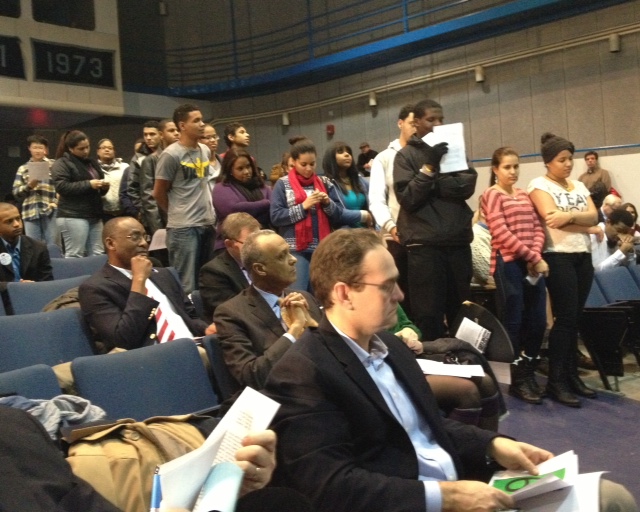
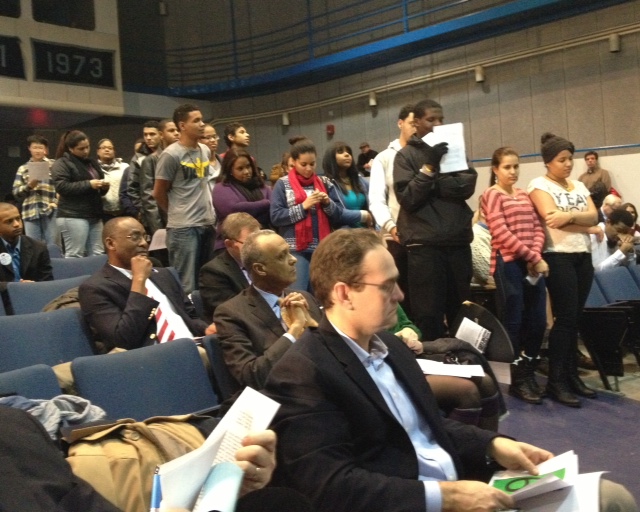
^ Boston public school students lined up to testify and support the issues on order at Mayor-elect Walsh’s education Hearing

—- —- —-

Last night Mayor-elect Walsh’s Transition team held its Education Public Hearing, at English High school in Jamaica Plain. For two hours, from 5.30 Pm to 7.30, three of Walsh’s Transition Team menbers, including his Education Team chairman, John Barros, heard testimony from at least fifty witnesses. Students, school parents, teachers, advocates all spoke.

Less people attended than came to the previous night’s education rally held by Boston Truth. There were at least a hundred vacant seats at English high’s auditorium. listening to the testimony, it was easy to tell why. With hardly any exceptions — more on these later — every witness said basically the same thing : more funding for public schools, downplay charter schools. It was the sound of one hand clapping.

photo (19)

^ plenty of vacant seats : the elephant wasn’t in the room

There isn’t much to learn from a soundless sound and hardly much more from hearing the same message repeated again and again, with only the age, gender, or skin color of the speakers differing (and these aren’t policy matters, although identity issues were raised by some of the witnesses).

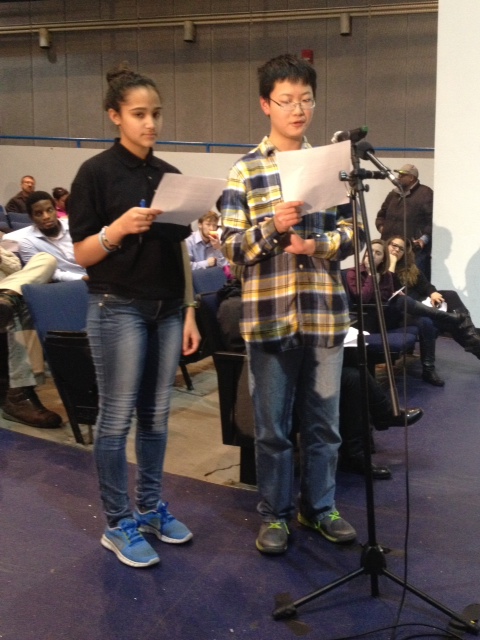
photo (17)^ Boston Latin student (and Student Advisory Council President) testifying against charter schools and thus, basically, that there shouldn’t be any additional Boston Latin schools. “Making history,” wrote one activist about my post of this photo 🙂

It was especially odd — unsettling, too — to hear the students who testified. How does a 17-year old Boston Latin student — smart, yes; Chairman of the Studernt advisory Group; but — acquire an interest in curbing the number or funding of charter schools ? Did he learn his view in debate at school ? Was he coached to his position ? Quite possibly, because he read his testimony from a prepared statement. I found his testimony manipulative. Contradictory, too ; after all, Boston Latin, the City’s totally competitive exam-entry school, is the ultimate “charter” school. Was he really telling us, not that charter schools are bad, but that Boston Latin doesn’t like having its exceptionalism duplicated ?

photo (21)

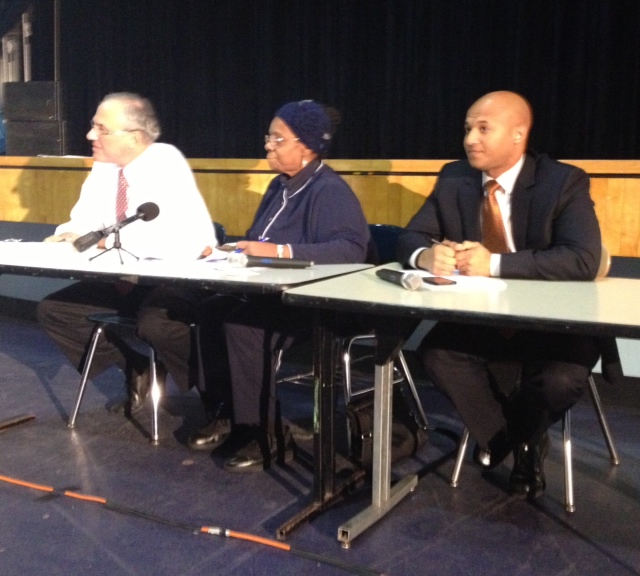
^ respectful : Education Transition team members George Perry, Jen Robinson, and John Barros (Team Chairman)

The Transition Team members, George Perry, Jen Robinson, and John Barros, listened respectfully to all. Barros, at least, knows all these issues masterfully. At numerous Mayoral Forums during his candidacy for the office he heard, and responded to, all manner of school reform agendas. Last night surely tried his patience. At times I saw a bored look in his eyes. Did he really need to hear the applause given the various witnesses — the louder, the more in agreement — by the Hearing’s audience, heavy with Boston Teachers Union members (including its President, Richard Stutman, and its organizer, Jessica Tang, who testified) and Boston Truth activists, in order to get the evening’s message ?

photo (16)

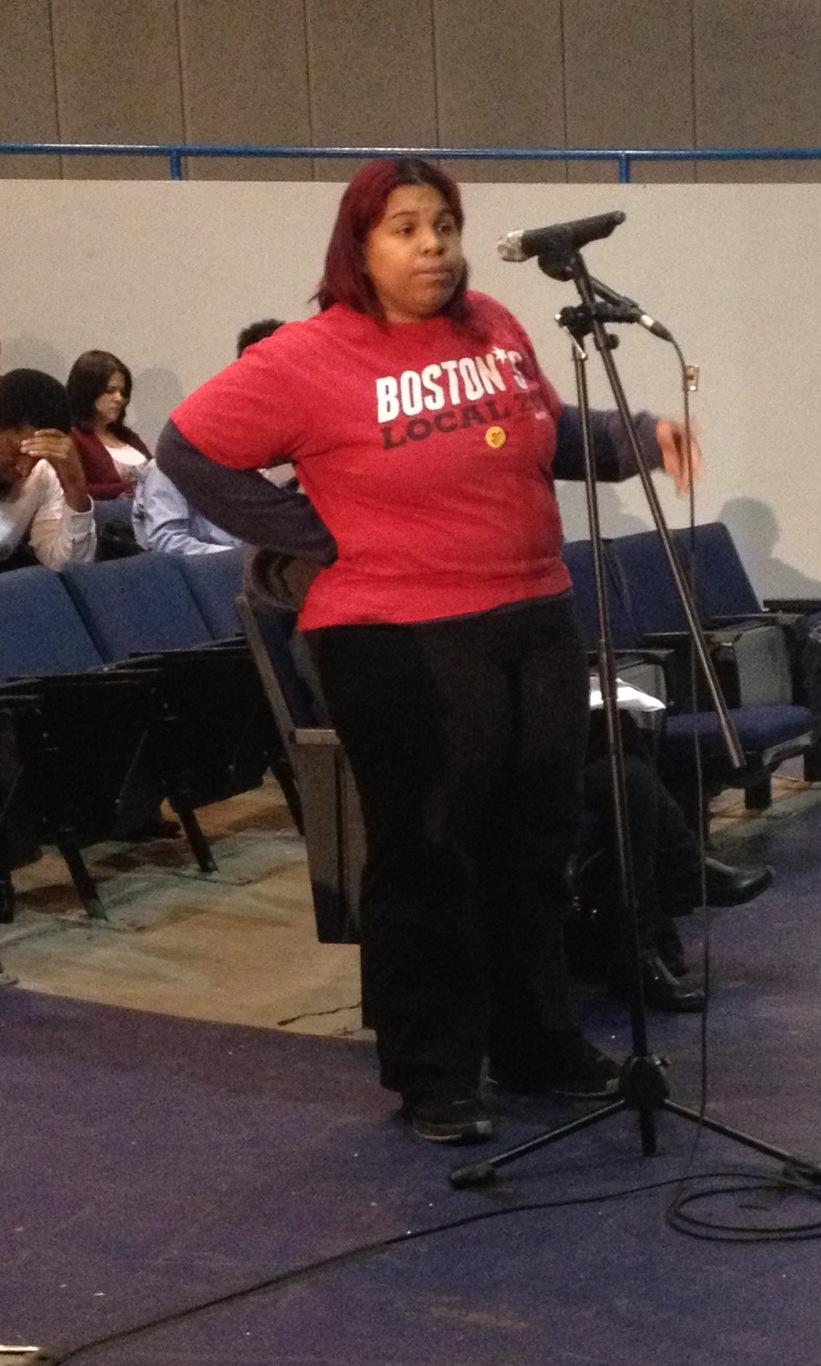
^ “I’m a Boston public school parent,” she said, and told of her difficulties getting her child properly assigned to a school convenient to her home. I wondered : Hadn’t she asked Councillor Connolly to help with that — as did so many Boston school parents ? Then I noticed her LOCAL 26 T shirt…

Fortunately for those who might have expected the incoming Mayor’s Education Team to hear a diversity of views rather than a one-hand clap, a few witnesses did offer opinions credibly their own. Jason Williams, an executive with of Stand for Children, hoped that Mayor-elect Walsh would continue his commitment to charter schools, noting that as a legislator, Walsh worked to increase their number. Applause ? None. Another witness, who said that he was a Boston Harbor captain, suggested that BPS should offer 6th grade students a course with sailing experience. Applause ? A few. Karen Kast, organizer of Boston Truth, challenged Mayor-elect Walsh to keep his campaign promises. Aplause ? plenty.

Most interestingly, Mary Pierce, who heads a special eduaction advocacy group, voiced her personal experience of frustrations dealing with Boston School Department administration. This was risky territory : reform of Boston Schools administration was a centerpiece of John Connolly’s education agenda. A door was opened — a bit; but the moment passed.

Sometimes the elephant is in the room; sometimes he is not in the room. John Connolly was the elephant not in the room. Other than Jason Williams, there likely wasn’t a single person testifying (or applauding) who on November 5th stood with Connolly’s 48.5 % of the vote.

Education became a key issue in the campaign entirely because John Connolly made it so. Most of the other candidates would gladly have left it aside — Walsh too — to be dealt with at the State House. Connolly made sure that Boston schools would be front and center — the decider — on election day. The major effort now being assembled by the Boston Teachers union and its allies, to push the schools reform agenda in its direction, would likely not be taking place had John Connolly not forced school reform sharply, radically forward.

This history makes many people wonder why the Mayor-elect even bothered to have an Education Hearing last night. As I was preparing to write this column, I found on my facebook page the following comment (excerpts follow) by friend Lisa Moellman :

“At 5:30 on a school night, just before Christmas — thry are stacked so that BTU representation/agenda dominates. picking up and feeding kids, holiday commitments prevent so many parents from participati9ng. Why would Walsh hold these important forums…at a difficult hour….? Why not the first weeks of January when actual diversity of participation could happen ?”

Why, indeed ? Myself, I think it’s public relations — Walsh’s showing the voters (and the media) that “he will listen to the people.” Nothing more, nothing less. Education is an issue that Walsh wants to put aside as much as possible ; to hand over to whichever poor sucker accepts becoming his new School superintendent, so that Marty can get on with his first priority : keeping the Boston Building boom alive and expanding, so that his building trades workers — including the many new hires that he will insist upon — can keep on earning hefty pay checks.

As for public schools and charter schools, compared to the issue debate that took place the prior evening at Boston Truth’s gathering, and much more so at every Mayoral Forum during the campaign, last night was a complete waste of auditorium heating oil.

—- Michael Freedberg / Here and Sphere

UPDATE at 3.11 PM 12/11/13 : am informed that during the 20 minutes prior to my arrival at the Hearing at 5.50 PM, other opinions, including from representatives of charter schools, were given. These sure didn’t last long. Still, it’s good to know that the Hearing wasn’t completely one thing. — MF

BOSTON PUBLIC SCHOOLS : WHAT NEXT FOR REFORM ?

Image

^ Boston school reformer Mary Tamer : Marty Walsh needs to reappoint her

—- —- —

Lawrence Harmon’s column in today’s Globe tweaked me to write once more about the prospects for school upgrade in Boston. My last column on this topic appeared well before the Mayor election. Much has happened since, and not just the selection of a new Mayor. School reform occupies center stage nationwide, as parents, students, and the job market push for — insist upon — huge changes in how we educate children, how rigorously, and to what purpose.

Harmon focuses on the City’s teacher evaluations, which he finds very suspiciously upbeat. 93 percent of teachers, he writes, land “in the exemplary and proficient categories on a new teacher-evaluation system.” He also notes that almost every BPS principal rated high. “Yet,” he goes on, “about two thirds of the city’s schools rank in the bottom 20 percent statewide based on student test data.”

He asks, “what is going on here ?” A few sentences later comes an answer : “It suggests that good teachers are unable to compensate for poverty, social ills, non-native English status, and other difficulties associated with urban schools.”

The suggestion rings true. Harmon says that it should not matter, that just as the Boston Police do not settle for the high rate of crime in certain neighborhoods but attack it head-on, so should the schools. No doubt that Harmon is right. But teachers aren’t a police force. Boston’s police patrol 24/7 ; teachers teach only seven hours a day, five days a week. Boston school children live by far the most of their day with someone other than their teachers.

I agree that the new teacher evaluations disservice everyone, the teachers included. No one working on any job does it perfectly. All of us can improve; all should try to do so. To have value, an evaluation system should do what my Phillips Andover American History teacher did ; “no one in this course will get an A,” he said, “because none of you can master the subject that well.” The best that anyone could do, he told us, was a B. My American history teacher was pressing the point that what he would be teaching us really, really mattered. Being the best teacher that one can be matters even more.

Harmon also quotes school committee member Mary Tamer at length, on the evaluation issue — especially of Boston Public school administrators. Her rigor and critique should be cherished by a system dedicated to improving itself.

That said, as I see it the big problem in urban public schools is not the competence of teachers or principals. The problem lies elsewhere, most often at home. If children are sent to school without a healthy breakfast; if they come from homes in dysfunction or commotion; if they cannot negotiate the English language; if they are prey to peer pressures, from bad decisions to worse; if at home no one ever reads to them, challenges them intellectually, engages their curiosity — if any or all of these home situations devils every part of a child’s life outside school, what is his life IN school likely to be ? Peer pressure becomes even more intense at school.

The home lives that I listed in the previous sentence come to school on the backs of all too many kids. Your kid may have the solidest home life in the neighborhood ,and it is not going to be enough, confronted as it will be in school itself by kids from problemed homes. A very few, remarkable kids can work through such peer pressure. A few can triumph even over their own home badness. But how many ? And there isn’t much that a teacher can do about it. Most Boston public school teachers I have known can rescue many kids from the badness; what about the others ? It cannot be all on the teachers.

School reform begins at home. If the parents or guardians aren’t fully committed to see that their kids triumph intellectually, morally, physically, and emotionally, and if they cannot rely on their neighbors to do the same with their own kids, urban public schools are going to continue to under-perform even with miracle men as teachers.

It is this time that we evaluate the parents and guardians. And time too that we expect no better of Boston public school kids than public school parents put into it.

Frankly if I were a Boston public school parent, I would grow grim about the certainty that my kid(s) will find it almost impossible to get that cutting-edge technology job — or even an entry level tech-competent position — because I am failing, my neighbor is failing, and thus the public schools are failing, too, because my neighbors and I aren’t demanding that school concentrate on testing, teaching, cajoling, piquing every child in class to work to the next level, to experiment, to imagine, and to really, really THINK. None of which my school can succeed at because too much class time is spent getting hepped-up kids to calm down, into some sort of order, into concentration.

No wonder that diligent parents choose charter schools if they can make the cut. But that too is not the answer. The only answer is the community-wide, full-metal jacket — much more than the competence of teachers and principals evaluated without compromise — that I have outlined. Anything less well work only partly, leaving some parents unsatisfied and some children unready for tomorrow’s mercilessly experimental jobs.

One final question : do you have any evidence that the new Mayor will spur a school reform as vast as the effort i have outlined ? I sure don’t. The voters of Boston already passed judgment on how much school reform they wanted. Mary Tamer supported John Connolly, as did I, for much the same reason: school reform cannot be piecemeal. Yet piecemeal it looks now to be. There will be some changes. More teachers and principals will be people of color. The school day will lengthen. Trade and technology curricula will expand, in partnership with universities, labor unions, and businesses. Some children will definitely benefit, somewhat. I doubt it will be anything like enough; yet I am willing to be proved wrong.

Harmon suggests in his column that Mayor Walsh should reappoint Tamer, whose term is at end. “Walsh…needs to hear strong, independent voices,” writes Harmon, “as he tackles the job of improving schools.” I agree.

—- Michael Freedberg / Here and Sphere