SCHOOLS REFORM : THE “ACT TO FURTHER NARROW THE ACHIEVEMENT GAP” — WHAT WE LIKE AND WHAT WE DON’T

Image

^ stalling the huge reform, maybe for good reason — one hopes ; St Senator Sonia Chang-Diaz

—- —- —-

Much energy from the usual suspects in schools reform matters has decried the exquisitely named “Act to Further Narrow the Achievement Gap” that now sits “stalled” in the legislature’s Education Committee. To find out why, and to assess the opponents’ arguments, one need first to actually read the proposed bill.

Please do so before going on to read my words. Here’s the link : http://www.bostonfoundation.org/uploadedFiles/Sub_Site/web_specials/Race_to_the_Top/An%20Act%20to%20Further%20Close%20the%20Achievement%20Gap%20(1.17.2013).pdf

You will have noted that the proposed new school law is twelve (12) pages long and has twelve (12) sections. Each has its points; some merit more discussion than others. As for the Bill in its entirety, you will have noted its language to be procedural. This is a law for administrators; not a law for teachers.

Were it a law for teachers, it would give some guideline, at least, for what teachers are to teach, and how, and in what spirit. This, the law does not do. It’s a law for superintendents, evaluators, testers, commissioners of education. All of which limits the law’s reform reach and thus details the devils.

The more a law clings to details, the more opposition it will draw. Each detail of an administrative directive inconveniences those who administer. From mastery of the process, they return to being beginners, having to re-learn all over again what it is they are supposed to do. Of course they don’t like it.

It would have been far wiser for the reform bill to set general goals and empower generally. Then the persons affected could work out for themselves how to devil the details; and all such work-out discussions would have given the affected persons personal input into making it work. This new law denies them that. It’s a directive — a tsarist ukase. Little wonder that the established interests are complaining and that key staff are opposing.

That said, the law commits to some very useful tasks :

It grants a superintendent strong power to make the administrative, staffing, and curriculum changes that he or she sees fit, the objective being to improve the performance of so-called “underperforming schools.”

It allows for additional charter schools, above the 140 charters already allowed by MGL c. 71 : but, unwisely, only in districts that fall within under-performance results specified in section 4 of the bill.

It identifies what school performance falls short of stated standards and thereby gives the superintendent a flash point at which to intervene comprehensively.

Let me note right away that everything the reform bill grants to superintendents, John McDonough is already doing as interim superintendent of the Boston Public Schools. This part of the reform law would be difficult for even the most change-averse teachers union to object to.

Much more controversial is Section 4’s creation of an under-performing school district exception to the 140 charter school limit in the current MGL cl. 71, section 89. In the context of the law’s drastic superintendent takeover of under-performing schools, this charter school exception feels like punishment : not only are the personnel of an underperforming school district to face an entire, superintendent make-over of everything they do, including keeping their jobs, but, with the charter school creation possibility, they are put in the position of losing students notwithstanding how they might improve performance under direct superintendent management.

It would be far wiser for the proposed school law to choose one or the other — superintendent takeover, or charter school creation — but not both. Superintendent takeover threatens the jobs of poor teachers; charter school establishment threatens all the affected District’s teachers.

The consequences of this provision in the proposed law leads it almost inevitably to its most objectionable provision : Section 2(g), in which superintendents are given the power, when confronting an under-performing school or district, to alter the compensation, hours, and working conditions of school staff. I don’t think it wise to threaten the pay of the very people whose enthusiastic support the law needs if it’s to work. as for hours of work, everybody agrees the school day should be extended; but i there any reasonable objection to the teachers’ insistence that they be paid for working longer hours ? I think not.

I’m also not a fan of that provision in Section 9 which, in case the Commonwealth is approaching its “net spending cap,” gives preference to charter school providers who operate in more than one municipality. Why so ? No charter school should be like a bank’s branch office, understaffed maybe and offering fewer services. I trust the proposers will explain ?

To sum up : the reform bill contains many valuable provisions, assuming that a bill almost purely administrative is advisable, and that micro-managing the administrative requirements is realistic. The charter school exception, however desirable, makes its entrance on the wrong foot and in the wrong way. it should be the subject of separate legislation and should NOT be tied to under-performance issues and administration. Heck ; if charter schools are good — and I strongly support them — why should only children in under-performing districts have extra access to them ? Has no one learned anything from the Special education experience ? parents, seeing that special need children could claim an individualized curriculum, did everything in their power to get their children designated as special needs so that they too could get an individualized curriculum plan. I can easily see, under this proposed law, parents seeking to have their kids’ school designated as under-performing so that their kids would have a better chance of winning a charter school placement lottery.

This is what happen when you try, by laws, to do too much. You end up with laws that work opposite to the intention, or which can’t get enacted at all because they coalesce many kinds of opposition.

Pare down the bill, make it less administrative, put its page after page of do-this detail — especially the per pupil tuition reimbursement formula ; my goodness me ! — into a regulation, and give the statute some room to flex and develop. Then offer it for enactment. Until then, I think not.

—- Mike Freedberg / Here and Sphere

MAGOV14 — FORUMS, CHARLIE BAKER, & MONEY BOMBS

Image

^ huge SEIU candidates Forum last Saturday that Charlie Baker by-passed despite “repeated invitations sent,’ the SEIU program painfully  made known.

—- —- —

Hard on the heels of last Saturday’s hugely attended SEIU Forum on the “low wage worker crisis” comes a Governor Candidate Forum at Faneuil hall this Friday. It begins at noon. The subjects this time are Energy, the Environment, and the Innovation Economy.

You would think that GOP leader Charlie Baker would want to be on stage at Faneuil hall. Its topics are his bread and butter. 28 citizen organizations are sponsoring the Forum. How can a serious candidate for Governor decline to participate ? As Baker also declined the SEIU Forum ? I ask the question rhetorically, because Baker has indeed declined both.

This is what one would expect of the rejectionist GOP, the Tea Party that looks upon Massachusetts’s broad and diverse citizenry as an enemy.

Baker isn’t Tea Party at all. Just the opposite. So what gives ? His apologists say that he is visiting people and neighborhoods everywhere; fine and good; but that is what Scott Brown did for his entire three years as our Senator, and it didn’t get him re-elected.

As I see it, by not participating in an issues Forum set up by citizen organizations that expend much time and money to make them happen, you send a message entirely negative, a disrespect for citizens who care, as well as for the issues that they care about. We’re not talking gun nuts here, or rabid anti-taxers. We’re talking citizen reform — core of what the Massachusetts GOP has always been best at.

Skipping out of such events is the wrong thing to do. It makes me question the seriousness of Charlie Baker’s candidacy.

That Baker has the GOP convention on tap this Saturday is no excuse. His nomination is assured, and it could only enhance his candidacy to speak sharply on the issues at very public Forums widespread reported in the media.

Had Baker a huge money advantage, a case could be made that he is the people’s choice already and needn’t participate in Forums where his candidacy might find itself challenged. I think this a wrong argument, because why shouldn’t his candidacy be challenged ? if Baker cannot respond to challenges — many of them — on a face to face basis, he shouldn’t be running. In any case, he does not hold a vast money lead. The six candidates — the five Democrats and Charlie Baker — reported the following donations, expenses, and ending balance for the month of February :

Charlie Baker

beginning 562,808.84
receipts 209,425.05
expenses 184,735.99
ending bal 587,497.90

Steve Grossman

beginning 1,048,299.70
receipts 91,091.67
expenses 129,780.51
ending bal 1,003,619.86

Martha Coakley

beginning 494,328.43
receipts 184,245.04
expenses 175,951.68
ending bal 502,619.79

Juliette kayyem

beginning 160,119.47
receipts 65,038.58
expenses 108.454.20
ending bal 116,701.85

Don Berwick

beginning 174,376.01
receipts 116,670.06
expenses 139,326.80
ending bal 151,819.27

Joe Avellone

beginning 142,166.73
receipts 14,718.37
expenses 35,512.55
ending bal 121,372.55

Charlie Baker raised more money than anyone in February, but not by much more than Don Berwick, and his money on hand pales in comparison to what Steve Grossman — the clear Democratic caucus winner — commands. Baker barely has more money than Martha Coakley, whose fundraising in February picked up significantly.

Baker’s donations also arise from the usual sources ; CEO’s, high powered lawyers and developers, and residents of old-line GOP towns like Boxford, Hamilton, and communities in the Mid-Cape (Cod). In his February list I couldn’t find even one donor from Baker’s home town of Swampscott. It’s possible that I missed one; but there sure weren’t many. It’s possible, too, that big name Governor GOP donors already maxed out ($ 500 per year per person) in January; I hope so, because I saw very few such on Baker’s February list.

Meanwhile, donors to the five Democrats span pretty much the entirety of diverse Massachusetts, including even CEOs. Massachusetts works best when we pair an innovative GOP Governor with an institutional boss, Democratic House Speaker. But to get that pairing, Baker will have to step it up and be BOLD. He has been a leader on many issues this time around — look at his support for the Minimum wage hike, contrary to GOP orthodoxy — but as i see it, he needs to be bold on everything. And bolder.

—- Mike Freedberg / Here and Sphere

UPDATE : The Boston Globe today opines that Charlie baker will get more than enough delegates to keep his Tea Party rival off the Primary ballot. this has been my view for at least the last ten days. It makes me all the more bewildered why Baker has avoided attending and speaking at major Citizen Forums. Is he afraid that if he does, the anti-everything GOP that he has spent the last three years buying off will rise up and snarl ?

5TH SUFFOLK SPECIAL ELECTION : EVANDRO CARVALHO

Image

^ Team Carvalho. Evandro is second from left in back row.

—- —- —-

Of the four candidates seeking votes on April 1st, a mere 16 days from now, Evandro Carvalho may be the most traditional. He is of Cape Verdean lineage and, in a field with three candidates who are not Cape Verdean, hopes that his lineage will push him to the top. This is ethnic politics as it used to be.

It’s a feasible, even sensible, plan, because the 5th Suffolk District includes almost all of Boston’s Cape Verdean voters. They vote. In last year’s Mayor Primary, John F. Barros — Cape Verdean and a resident of the District –captured 2,071 votes within the 5th Suffolk’s precincts. He finished first of the then twelve Mayor hopefuls, almost 600 votes ahead of number two, Charlotte Golar-Richie, and 1300 ahead of Felix G. Arroyo, who finished third.

I interviewed Carvalho by telephone and then next day visited him at his Bowdoin Street headquarters. There, hard at work with laptops, voter lists, and canvassing packets were his field staff and his parents. Carvalho was on his way to door-knock, with his campaign aide alongside, and so I couldn’t supplement the phone interview — in which Carvalho told me of his work as an Assistant Suffolk county District Attorney — working for District Attorney Dan Conley — posted to the Roxbury District Court. There he prosecuted gun crimes — certainly one of the 5th District’s major concerns. As his hand out card adds, “there he saw first hand the cycles of poverty and violence that put our young men and women in the system” —  he means the criminal justice system. It’s what all the 5th District’s candidates talk about, and it is real. The 5th’s Bowdoin-Geneva neighborhood is one of Boston’s most violent.

Carvalho could make a fair case for electing him based on his prosecutorial experience alone, but he spends more time talking to me about education. “I am for universal pre-kindergarten,” he affirms, but is not “sure what to do about the charter cap. We have to keep funding the Boston Public Schools, and we need more of vocational career schools.” Schools funding is an issue that galvanized last year’s Mayor election and will certainly commit a large chunk of the 5th District Representative’s work on Beacon Hill.

He also supports raising the minimum wage to $ 11.00 an hour and wants to see a jobs and development initiative in the District — he’s glad to welcome such an initiative to Dudley Square, which lies just outside the 5th Suffolk, if as some reports have it, the initiative actually happens. But just as important are “more construction jobs within our community, and we just have to make it easier for people within the community to get access to loans, perhaps in partnership with the City.” The loans he has in mind are business loans, a major need throughout the 5th Suffolk, most of whose commercial streets feature only Mom and Pop store fronts of no great prosperity.

This is an issue which he certainly will be able to discuss — probably already has — with John Barros, who now serves as Mayor Walsh’s Chief of Business Development. Carvalho never comes out and says so, but one of his strongest appeals is to the Cape Verdean solidarity that centers on Barros, a local hero.

Carvalho doesn’t know yet which House Committees he’d like to serve on. He’s completely focused on getting elected. Can he ? The votes are there to make it happen, if they vote on April 1st. One advantage Carvalho definitely has : his votes are going to be his even if, as expected, expelled Representative Carlos Henriquez runs again in September once he’s out of jail. Henriquez commands a following that feels he got a raw deal. But Henriquez is not Cape Verdean. The votes that Carvalho gets will be his no matter what. He seems likely not to be just a temporary office holder.

This might just seal the deal for Carvalho, who as a prosecutor is the opposite of the man he seeks to replace

. —- Mike Freedberg / Here and Sphere

Image

MAGOV14 : FIVE VISIONS FIVE AT SEIU CANDIDATES FORUM


photo (45)

^ the Forum Five (photo courtesy of Chris Condon of SEIU local 509)

Since I last saw the Democratic Five at a candidates’ Forum — about six weeks ago — all have sharpened their profiles considerably. On stage at the SEIU (Service Employees International Union) candidates Forum today, there was lots of specifics, even some debate, and only a touch or two of the vague.

Specific, the five needed to be today. The SEIU’s members do the campaign grunt work and they have an agenda that they insist upon — and which they’ve proven, time and time again, they have the muscle to see enacted. Every one of the five badly wanted the SEIU endorsement. They want its game-on. They need it, and they made their need plain to the gathered attendees — at least 500 strong, a massive showing on a Saturday morning.

In return, SEIU members know which candidates have a chance to win the race and which ones probably don’t. So how did the five do ?

Image

First, Steve Grossman.

Grossman reminded the gathering — maybe too many times — that they had endorsed him before, and he had always kept his promises and “stood with” them on strike lines and issues fights. He gave voice to more specific agenda items than any of his rivals — policy points are his great strength. But he missed the point of one question — about restoring rights to ex convicts : the right the questioner wanted to hear about was voting right restoration — and, addressing the minimum wage, he said that “I will veto any minimum wage bill that includes an unemployment insurance give-back !” As this give-back is Speaker Robert DeLeo’s price for supporting the minimum wage hike, Grossman opened up the door to a running fight with the Speaker — who, like his predecessor during the entirety of Deval Patrick’s two Governor terms has proven that the Speaker always wins such fights. And that any Governor who fights him comes away weakened. Grossman either is just blowing smoke here, or he has ceded the entire minimum wage issue to Charlie Baker, the almost certain GOP nominee, who has said — no ifs ands or buts — that he accepts Speaker DeLeo’s give-back and can thus get the $ 11.00 per hour minimum wage hike enacted. (Baker has also made the issue of expanding the earned income tax credit his own, and it was interesting to see that at least two of the candidates, Coakley and Avellone, mentioned expanding earned income credits. Two months ago, no Democrat at Forums mentioned it at all.)

Image

Second, Martha Coakley.

Coakley campaigns with a light touch and an eyes-up grin that often feels snarky. She took a middle route at the Forum : not endorsing driver’s licenses for undocumented people, refusing to grant bargaining rights point-blank to public defender lawyers, sliding away from Don Berwick’s single payer health insurance call. Coakley played careful lawyer : she made clear that she agrees with SEIU’s wage hike and immigrant rights agenda, but maybe not on as all-in a basis as SEIU would like to see. Coakley spoke personally about mental health issues, and with real life stories about income equality; and before the Forum began she posed for many pictures with SEIU’ers who smiled like crazy to be photographed with her. She even said “we have to improve the economy for everybody.”

Image

Third, Juliette Kayyem.

Kayyem continues to converse at times, in a Forum setting where conversation wanders off message. But she has become much, much more forensic in her approach; at SEIU she made big, clear points addressing criminal justice reform; she rejected Don Berwick’s single payer call, saying “even if it can be done, it can’t happen until 2018. we need a Governor for right now.” Obviously, Kayyem has realized that sweetness and glamour — which she owns in this race — must bring toughness and advocacy aboard. Yet the generalities continue. She said “Massachusetts has done well but we can do better.” Better how ? She posed an actual plan: “three points…Save, share, and grow. save money in criminal justice spending. share it by setting up a ‘green bank.’ Grow by investing in education and comprehensive immigration reform.”

Kayyem stressed her immigrant roots; that she’s a mother and wife; and — taking full advantage of being two decades younger than her rivals — that she is “the young generation ready to govern.”

Image

Fourth, Don Berwick.

Berwick has no peer when discussion turns to health care. If he were running for Massachusetts Commissioner of Health and Welfare, he’d win by acclamation. He decries our state’s health care failings — its waste, high cost, inequities — as rigorously as Baker is likely to do. Berwick also speaks to income inequity and the “low wage crisis,” as SEIU’s Forum hosts put it, as passionately as anyone, maybe more. But Berwick overshoots the progressive mark. His solution to the health care system’s failings is single payer — a worthy idea, but it isn’t going to happen soon, and as Kayyem said back at him, “we are electing a Governor for now.” Berwick also seeks a graduated income tax (though he didn’t call it that), an idea that Massachusetts voters quite a while ago rejected in two separate referendums and which would hardly entice to our State the businesses which every Forum candidate, Berwick included, say that Massachusetts needs.

Image

Lastly, Joe Avellone.

Avellone speaks authoritatively about the state’s drug abuse crisis, about recovery and re-entry, and about CORI reform. nd like all the Forum candidates, he supports raising the minimum wage and protection of low-wage workers’ bargaining tights, including extending them to hospital workers who don’t know have that right. Still, Avellone barely seems a possible Governor rather than what he has been, a town selectman. At no place in the Forum did he address the big picture, the massive responsibility sphere that we entrust to the state’s Governor. The Big Dogs of the Legislature would eat Avellone for lunch. So might the State House lobbyists. Avellone made some friends at the Forum; I doubt he won many members’ endorsement.

It was too bad that Charlie Baker wasn’t at the Forum. He had a delegate rally of his own to attend, in Saugus; and the GOP convention takes place next weekend. Still, an opportunity was missed. Baker could have addressed the health care issue authoritatively; the minimum wage and earned income credit; criminal justice reform; homelessness; schools reform; and jobs and innovation — even bargaining rights. It would have been an opportunity to expand his personal reach where a reformist candidate needs be : directly into the most important front of the labor movement, the fight against low-wage situations and all the burdens that low wage work puts on workers and taxpayers alike.

—- Mike Freedberg / Here and Sphere

#16TH SUFFOLK DISTRCT : WE INTERVIEW TODD TAYLOR

Image

On March 4th the Democratic Primary voters of the 16th Suffolk State Representative District chose Revere’s Roselee Vincent to be their nominee. Observers commenting on her primary victory seem to assume that it’s election. It isn’t. On April 1st, Vincent faces Chelsea businessman Todd Taylor, the Republican candidate.

Taylor — who grew up in Arizona and has lived in Chelsea since 2000, and owns a staffing company at which he started many years ago as a waiter, working his way up — hopes to disprove the common perception of a Vincent victory. “We’ve been door knocking for two months now,” he told me at the Kow Loon restaurant in Saugus last night. “Lots of doors.”

“Have you door-knocked all the super voter doors,” I ask him ?

“By election day we will have done so, yes.” Taylor smiles a confident smile, a full shoulder smile.

Taylor’s literature spells out the same old “policies that spur job creation…reducing burdensome regulations” mantra that I see from every GOP legislative candidate these days; but when questioned on the issues, he sounds like an actual candidate.

“We’ve gotta get people working again,” he says. And concentrate on quality education for our kids. We have to lift the charter cap.”

I remind him that teachers unions an d public school advocates oppose lifting the cap, that they’re concerned about losing funding from their budgets, that they feel that charter schools are trying to replace them. Taylor rejects these arguments.

“Charter schools are a supplement, not a replacement,” he says passionately. As for the argument that charter schools don’t serve special education kids of English language learners (so called “ELL”‘s), he says, “Look. My kids attend the East Boston Br0oks school. it serves the ELL community well and special education kids too. Example : we have two Ethopian adopted kids at the school who have made made fantastic progress acquiring English. Brooks does the job !”

Is this a State wide issue, I ask Taylor, or is there a need in his Chelsea – Revere – Saugus district ? He concedes “not so much here as in the state’s underserved communities.” He gives Chelsea city manager Jay Ash “great credit turning Chelsea schools around. But state wide we need to anticipate problems, not play catch up. Charter schools force other schools to improve. It’s that simple.”

Taylor talks of arguments between “conservatives and liberals”; so I felt a need to ask him : for Governor, does he support Charlie Baker or Mark Fisher ? “I’m a Char;lie Baker supporter,” he says — firmly. “Charlie Baker is what we need.”

But Baker is running quite a progressive campaign, I remind Taylor — noticing, too, that Paul Craney of Mass Fiscal Alliance (MFA) is in the room, and that MFA opposes the minimum wage raise that Baker strongly supports.

Says Taylor t0 me, “by ‘conservative,’ I mean smaller and more effective government. Effective, efficient.”

Fair enough. So I ask Taylor another question that often outs GOP conservatives : “your district is filled with immigrants of all statuses. Moroccans, Brazilians, Hispanics. What do you feel about that and them ?”

Taylor’s answer surprises me. “Diversity is us’ he says. “My business employs 1000 people of all cultures, languages. Our nation is waves of immigration. We need to welcome people here. Both parties are responsible for the immigration problem, it’s not the immigrants’ fault.”

Taylor says that he’s “not a professional politician” and decries the system of people staying in politics all their lives; but his answers to my questions sound properly political to me. Thus I ask him, “OK, you sound like you hear your district’s voice” — he smiles that shoulder smile — “so tell me ; how are you, a Chelsea guy, going to beat Roselee Vincent, who was chief of staff to State Representative Kathi Reinstein (whose resignation occasioned this vacancy) and who has the entire Revere political establishment behind her ?”

“That’s exactly the problem,” says Taylor. “If we keep electing the same people, we’ll keep getting the same results. I have plenty of Revere support. You’ll see.”

I’m looking at Taylor’s staff — young and think-tank conservative, quite off to the side of a Massachusetts electorate, eighty percent of which supports raising the minimum wage and few of whom (including most GOP voters) want anything to do with the Party platform that Taylor’s campaign staffer just voted for.

There is disconnect between what he tells me and what the make-up of his support group suggests.

Taylor can’t miss the look of skepticism on my face. “I am going to surprise you,’ he grins. “I’m going to surprise a lot of people on April 1st.”

I believe that he means to do just that.

—- Mike Freedberg / Here and Sphere

BOSTON SCHOOLS, PART 2 : SEEKING A COMPREHENSIVE EDUCATION POLICY

Image

^ we first suggested it, now others are joining us : John McDonough as Boston’s new school superintendent

—- —- —-

Note : what you are about to read is my re-write of a column that I posted to Here and Sphere a few days ago. This is why I’m doing it:

1. In the days since I first wrote, the Boston Globe published a full page editorial addressing the complexity of school reforms now taking shape as state legislation; and Globe columnist Larry Harmon added his opinion that current Boston interim superintendent John McDonough should be given the permanent position. (Two months ago, I posted the same opinion. I was glad to see others taking up my suggestion.)

2.The Globe editorial arose in response to a strong push by public schools advocates that the state’s current limit on charter school numbers not be lifted. As I wrote in my original article,

“It pains me to read news recently that the chief reason why Massachusetts got busy creating charter schools was that 250,000,000 Federal dollars were at stake. I had thought that the creation of charters — schools privately run but publicly funded — was a matter of policy, not purchase. But now we read that bills in the legislature to expand the number of charter schools allowed is stalling, not because the policy has changed but because the Federal dollars aren’t there any more.”

Charter schools cannot be seen as replacing standard public schools. They were never intended as such and aren’t used as such now. Teachers unions and their allies want to push the notion of replacement because they somehow feel that education reform threatens their jobs. Their fears have some basis. In many states there’s been much legislation cutting back on public employees’ bargaining rights; and some corporate interests, backed by right-wing think tanks, want to use charter schools as a wedge to eliminate public, taxpayer-funded schools for all children. That agenda has some presence even in Massachusetts. Some business interests want aggressively to control the education of their potential future employees and are determined to get as complete control of the process, from K to graduation, as they can — and if not, to move operations elsewhere.

My inclination is to let such corporations go, if they choose to. Massachusetts’s pre eminence in higher education, research, and finance assure that we will always have plenty of enterprises who want to stay here, move here, set up shop here and continue here. This, of course, assumes that our education of all children continues to be the most rigorous and productive in the nation. To that end, I suggest the following :

1. charter schools should be encouraged and their numbers increased on a one or two at a time basis, by application to the State Commissioner of Education. Funding for charters must come from a combination of user fees, local aid, and taxes assessed state-wide for the purpose.

2. charter schools should continue to act as experimental places, innovating curriculum, teaching method, teacher hires, and student homework loads. Charters might even in some cases be boarding schools ; why not ? Charters cannot become routinized in anything or they cease to be what they were created to do.

3. budgets for standard public schools must be separately assured and planned without thought of what alternative schools may cost. Rivalry for funds cannot be permitted.

4. what succeeds at charter schools — the so called “best practices” test — should be applied in standard schools where and as feasible, and no standard school should see its routines written in stone, ever. Teachers in unions cannot be permitted to cling to work rules — including short school days — that impede pedagogic improvement. In this regard, John McDonough has shown the way by imposing a teacher recycling system that has already produced pedagogic improvement in the schools where he has put it in place.

5. School principals must be free to choose every member of their teaching staff — and of their school support staff too.

6. all schools must educate for two goals : employment and citizenship. The reasonable needs of reasonable employers must be met; the employers want capable hires, and the children want solid employment. Citizenship is the role that children will play as adults in community; to that end, schools must teach cooperative study and play, emotional education, social knowledge — including the role and risks in sex play — and basic civics including the role and process of democratic politics and government.

7. Testing is the only way that we can find out where education is or isn’t succeeding and how well or not. Tests should be semi-annual — no more frequent. Tests should include essay writing, reading comprehension, spelling, mastery of concepts both spacial and philosophical; mathematics and computation; American and world history; basic sciences; civics; and social knowledge including manners and dealing with emotions.

8. Tests need not be given as rigidly as the MCAS. Each school course can conduct its own course tests which can then be fed into the MCAS process and added into the total test score.

9. Teachers should be given the lead role in compiling such tests.

10. As many schools as possible — charter schools too — should be dual-language. Students whose first language is not English need it, and students whose first language IS English need to learn another language. It’s vital if we are to encourage cultural diversity and free American kids from cultural isolation.

So there you have it. What follows is the rest of my original article, slightly revised:

Mayor Walsh has added 39.6 million dollars to this year’s Boston Public Schools budget. Most of it will go to fund teachers’ pay raises. There will some millions left over. So, what does the phrase “taking resources away” mean now ? Probably just that the increased dollars won’t be coming from Washington. they’ll be raised locally. And that means that some other local aid funded need will have to make do with less.

Such is indeed the talk. In the Governor election going on in Massachusetts right now, all the talk is of local aid : increasing it; releasing 100 million dollars of it already collected but held; increasing it again. Candidates running for the State legislature or Senate all talk of local aid needs. The Department of Children & Families is in crisis; State transportation repairs and service upgrades cry out for attention; drivers’ licences for undocumented immigrants must be done. All these get mentioned ; but the big talk is, local aid, local aid, more local aid. You hear it whether the speaker is a Democrat or a Republican. Local aid now; the other matters can wait.

Charter schools were meant to be an alternative to standard public schools, not simply public schools with a new name. If charter schools do not do the job they were intended to do — significantly improve student achievement — they shouldn’t be funded, whether the Federal money is at hand or not. And if charter schools do do what they were intended as, they should be funded regardless of money from Washington.

Legislation to increase the number of charters being stalled now, those that do exist are kind of on their own, to prove their worth. Charter parents will have to speak out; to organize. Democrats for Education Reform, the local chapter of a nationwide group deployed to power up the alternative schools constituency, will have to get talking.

Did I mention curricula ? The battle is raging already to reject the national education establishment’s “common core” as being too difficult for children to master and too narrowly tested. Myself, having read through the “common core proposal, I find it a trope, a slice of common sense. Every society with schools at all has had a common core curriculum; it’s how that society prepares its children for the jobs it offers. this was as true of Rome in year 300 A.D. as of western Europe in year 1090 A.D. and 1500 A.D., and it was the basis of the New England School Law of 1634. Children must learn a common basic curriculum in order to do the jobs that will need to hire them; and to be good citizens. Is it difficult ? It always was. Life, too, is difficult. Tears come to one’s eyes as well as joy.

Kids can manage. They really can.

As for teacher pay and standard school budgets, in Boston these look paid for — this year. After that, a lot depends on who the next School Superintendent will be. The “search committee” is already on it, but for me, the best choice is John McDonough, the current “interim superintendent,’ who says he doesn’t want to be considered for the permanent job : but whom all sides respect and who can therefore best steer “standard Boston public schools,” troubled schools as well, into the next phase, alongside charters as they are and all manner of experimental school set-ups that innovators may successfully propose — as they surely will, and should.

—- Mike Freedberg / Here and Sphere

VAUDEVILLE SHOW AT THE SUFFOLK COURT HOUSE

Image

^ the Lady’s not for trashing : Patty Campatelli on the big stage — with Mayor Walsh

—- —- —-

It’s vaudeville time at the Edward W. Brooke Court house down-town, hard by TD North Garden, up the street from pugs and mugs bars, close on Haymarket Square.

Yep, vaudeville time. There’s the current Register, said to be a party animal given to fisticuffs and cuss words. She’s now on “paid leave” while certain scandalous allegations made against her are duly investigated by inquisitors official.

There’s not one but two (2) former City Council candidates — one of them who served as such, with distinction — seeking to replace her. There’s also an East Boston businessman in the running. My question to all is, “why ?”

WHY does ANYONE want to be Register of Probate ? Why is the job an elected one at all ?

The Register of Probate keeps the records of Probate Court cases : estates, guardianships, divorces, custody matters, and some restraining orders. Because estates especially are public records and must necessarily be so, the keeper of these records gets to be elected by the public. Or so goes the collective wisdom of those who enact our State’s laws. And why not elect each county’s Register of Probate ? We elect the State Auditor, for goodness sake. We elect Registers of Deeds. We elect Library commissioners.

One wonders why we don’t go ahead and elect the Boston Harbor Master, or the Commissioner of Transportation, or the Franklin Park Overseers. But the trend is moving in the opposite direction : toward appointing ministerial officials. Heck, we no longer elect even Boston’s School Committee — and for very good and sufficient reason. Our experience of the School Committee in its last decade was of a body beset by racist demagoguery, by insider politics with respect to administrative jobs, by a custodian’s union immune to reform and accused — perhaps unfairly — of acts verging on the illegal. The elected school committee spent more time politicking than managing; and the school department’s managers spent more time politicking, too. Today, the Mayor appoints Boston’s school committee. It perhaps hasn’t enough power : but it does advise, and often wisely. Those who serve on it do so as citizen activists, which is what elected school committees are supposed to do as they govern the system that prepares the entire society’s next generation.

A Register of Probate has no such vital task. The Register’s work is purely ministerial. The only connections the office have public policy are that its expenses are paid by the public, and its administration must enable those who seek Probate services to do so efficiently and well informed.

Upon these tasks are placed, in Suffolk County, a six figure salary and a six year term. a Register, once elected, is almost impossible to defeat. The work is not strenuous. Assistant registers do the grunt stuff. A name well known to the voting public, and not tainted by scandal, gives a candidate entree to that never-to-be-lost six figure income and the tasty pension that accrues to it.

Thus the vaudeville. Let’s look at the players :

Image

^ out of retirement : Felix D. Arroyo with newly elected Charlestown St Representative Dan Ryan

Your show time includes Felix D. Arroyo, returning from pleasant retirement in Uruguay, to the political klieg lights with a familiar beard and an act that he performed very skillfully long before he was ever a City Councillor : administrator of a bureaucracy. People forget that he served as such in the Mayor administration of Ray Flynn.

photo (43)

^ dancing and prancing : Marty Keogh is rushing to the stage now

The marquee also lights up the name Marty Keogh, long a City Hall aide and, last year, a City Council candidate at large. Keogh has an especially lively act on offer.

Every vaudeville act needs a newcomer, a kind of opening act, and in East Boston business-person John Sepulveda, this show has its man. Give him room to show his stuff and then applaud or throw rotten tomatoes, in the best vaudeville tradition.

And finally there’s Patty Campatelli, the buxom gal who won the Register’s job in 2012, when it happened to be open; and who has since then entertained many, infuriated others, and delighted me. I kind of like her act. Spunky, charismatic, buxom strong. But then she hasn’t yet punched my face or called me a vagina.

Yes, it’s show time at the Probate Comedy Hour, and not far from where once the Old Howard theater — formerly an emporium of serious theatricals — displayed strippers and dialect comics to Harvard students and those who couldn’t get enough of bare boobs, scatological wise cracks, and ethnic cartoonery. I miss the Old Howard, and so, probably, do you. Time to welcome it back.

Arroyo, Campatelli, Keogh, Sepulveda. One to be Register of Probate, the others to be — why not ? — Boston Harbor Master, Franklin Park Commissioner, Head Keeper of Licensed Bicycles. I insist.

All that’s missing, so far, is for Ted Lewis to strut on stage, cane in hand, and orate “Is everybody happy ?”

—- Mike Freedberg / Here and Sphere

BOSTON SCHOOLS : IS FUNDING EVERYTHING, SCHOOL POLICY NOTHING ?

photo (36)

^ stalling on charter schools, ostensibly because the Federal $$$ aren’t coming : St Senator Sonia Chang-Diaz

—- —- —

It pains me to read news recently that the chief reason why Massachusetts got busy creating charter schools was that 250,000,000 Federal dollars was at stake. I had thought that the creation of charters — schools privately run but publicly funded — was a matter of policy, not purchase. But now we read that bills in the legislature to expand the number of charter schools allowed is stalling, not because the policy has changed but because the Federal dollars aren’t there any more.

At the outset of President Obama’s first term, the education bureaucracy was all het up about “race to the top” and such like programs to improve student achievement. Money was gushing, and so were expectations. Now the money is heaving dry, and expectations have taken a skeptical swerve. The talk now is of “taking resources away from standard schoolS,” not of “improving achievement.”

You would think that “Taking resources away from standard schools” is teacher-speak for : the teachers’ union’s next contract won’t have a pay raise equal to raises granted the latest police or Firemen’s union contract. Right now, it doesn’t mean that. Mayor Walsh has added 39.6 million dollars to this year’s Boston Public Schools budget. Most of it will go to fund teachers’ pay raises. There will some millions left over. So, what does the phrase “taking resources away” mean now ? Probably just that the increased dollars won’t be coming from Washington. they’ll be raised locally. And that means that some other local aid funded need will have to make do with less.

Such is indeed the talk. In the Governor election going on in Massachusetts right now, all the talk is of local aid : increasing it; releasing 100 million dollars of it already collected but held; increasing it again. Candidates running for the State legislature or Senate all talk of local aid needs. The Department of Children & Families is in crisis; State transportation repairs and service upgrades cry out for attention; drivers’ licences for undocumented immigrants must be done. All these get mentioned ; but the big talk is, local aid, local aid, more local aid. You hear it whether the speaker is a Democrat or a Republican. Local aid now; the other matters can wait.

But education can’t wait. kids grow up. They graduate from grade to grade. Time delayed cannot be made good. Charter school waiting lists grow bigger, and the once ready Federal money river no longer flows into them. Thus we hear more of the same old arguments that were adduced at the outset for why charter schools shouldn’t be : they winnow their students, eliminating those with discipline problems and unwillingness to adapt; they don’t serve English language learners; they expel kids who don’t shape up academically; they impose rigid discipline.

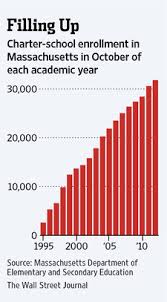
And so they do. Charter schools were meant to be an alternative to standard public schools, not simply public schools with a new name. If charter schools do not do the job they were intended to do — significantly improve student achievement — they shouldn’t be funded, whether the Federal money is at hand or not. And if charter schools do do what they were intended as, they should be funded regardless of money from Washington. Meanwhile, to look at how rapidly enrollment has climbed, it seems that charter schools have been a smashing success :

Image

Legislation to increase the number of charters being stalled now — the chief staller being Boston State senator Sonia Chang-Diaz, who serves on the senate Education Committee — those that do exist are kind of on their own, to prove their worth. Charter parents will have to speak out; to organize. Democrats for Education Reform, the local chapter of a nationwide group deployed to power up the alternative-schools constituency, will have to get talking. My own strong belief is that education in America needed badly to reshape itself enormously, to conform to the new workplace, new jobs, new technology and new communities of competitive collaboration. If schools exist to do anything, it’s to prepare students for the jobs of tomorrow (and for citizenship : but that’s a more traditional matter and doesn’t require an entire re-think). The best way to get schools shaped for that end is to try out many different shapes — school day lengths, curriculum choices, and out-of-school after-work — and see which one or ones meet the challenge. Charters, partnerships, collaborations, and, yes, standard public schools all have a seat at this particular table, and all should be set upon the task.

Did I mention curricula ? The battle is raging already to reject the national education establishment’s “common core” as being too difficult for children to master and too narrowly tested. Myself, having read through the “common core proposal, I find it a trope, a slice of common sense. Every society with schools at all has had a common core curriculum; it’s how that society prepares its children for the jobs it offers. this was as true of Rome in year 300 A.D. as of western Europe in year 1090 A.D. and 1500 A.D., and it was the basis of the New England School Law of 1634. Children must learn a common basic curriculum in order to do the jobs that will need to hire them; and to be good citizens. Is it difficult ? It always was. Life, too, is difficult. Tears come to one’s eyes as well as joy.

Kids can manage. They really can. as for testing, well : every job that a student is given as an employee is a test, believe me. So don’t complain; just do it. And please, don’t use lack of money as an excuse not to.

Time for Liam Kerr, Richard Stutman, Citizens for Public Schools, and Stand For Children to loosen up, set the past behind,and re-imagine the teaching of knowledge to children grasping at it.

As for teacher pay and standard school budgets, in Boston these look paid for — this year. After that, a lot depends on who the next School Superintendent will be. The “search committee” is already on it, but for me, the best choice is John McDonough, the current “interim superintendent,’ who says he doesn’t want to be considered for the permanent job : but whom all sides respect and who can therefore best steer “standard Boston public schools,” troubled schools as well, into the next phase, alongside charters as they are and all manner of experimental school set-ups that innovators may successfully propose — as they surely will, and should.

—- Mike Freedberg / Here and Sphere
5th SUFFOLK SPECIAL ELECTION: JEN JOHNSON INTERVIEW

Image

On Tuesday I had the opportunity to interview Jen Johnson, one of the four candidates seeking to hold the State Representative seat from which Carlos Henriquez was ousted by vote of the House.

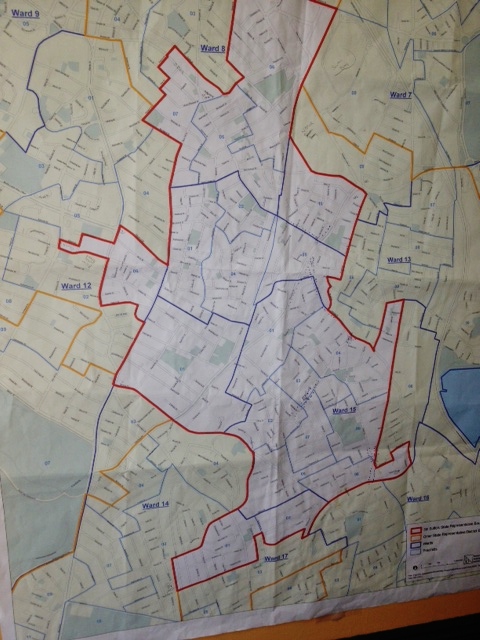
Johnson and I met at an eatery in Uphams Corner, which for me is the central crossroads of a district that grab-bags several neighborhoods of Boston that don’t get much attention from the powers that be or from the media — including stretches of Blue Hill Avenue, the north side of Dudley Street, the Stanwood Street area along Columbia Road, and Bowdoin-Geneva. Johnson sees the district in pretty much those terms and vows that she will be a voice for a district that needs just about everything.

One thing, the district already has : diversity. This, Johnson likes. “The diversity, I find wonderful,” she says. “we have to find a way to maintain it.” First priority ? “Public safety,” she says. “So many people living in poverty. 40 percent of the district’s families.”

And how to change that, as a State Representative ? “I look to bring my   training programs and entrepreneurship,” Johnson says. “More training programs; it supports jobs. We n  a liveable wage. So many people in the 5th hold three and four jobs right now just to make ends meet. And no, no separate wage for teenagers. Many teenagers in my district are already hears of families.”

Johnson supports the minimum wage increase legislation — to $ 11.00 an hour by 2016 — that now awaits House action. She also wants it to apply to tipped workers — waiters and waitresses and such — whose minimum wage is now $ 2.63 an hour (and who often have to bring a Labor Board complaint to get paid even that.) She also supports senator Elizabeth warren’s legislation to bar employers from accessing job applicants’ credit histories and using it as an employment criterion. “we need to do something similar here on the State level,” she says.

CORI reform and sentencing reform are also high on her list of things to voice at the State House. “Too many kids in my district have a couple of years in a gang and then end up in jail and now have a CORI,’ she says. “Yes, sociopaths need to be off the street, but most kids who pass in and out of a gang aren’t that. Prison should be the last resort.”

Johnson is no stranger to prisoner issues. “rom 2002 to 2005 I helped co-ordinate a Pen New England program for prisoners. It was eye opening to see how many of these (foster home) young men ended up in prison. One young man i knew was in 55 foster homes between ages 9 and 15.”

On public school funding, Johnson supports a policy that’s been pushed for at least three decades but has never been fully implemented : school pupil spending equity. “We spend 16,000 per pupil here in Boston, but in places like Wellesley and Needham it’s 23,000. So of course their schools do better. we should be treating all children the same.”

But school funding in Massachusetts has a long, long history of total local control. So how would Johnson reach her pupil spending equity goal ? “Take the money we save by sentencing reform and use it for schools,” she says. I point out to her that the State budget can’t be flexed that simply. She admits that it’;s a difficult problem but insists that a way must be found. “Teachers tell me all the time about the money they have to pay out of their own pocket for necessary supplies like books,” says Johnson. “We just HAVE to figure out a way to get prison money over to the school system !”

Johnson grew up in Saint Tammany Parish, Louisiana, on the north bank of lake Pontchartrain. She came to Massachusetts 25 years ago and almost immediately became an activist. She worked for Mass PIRG, then Share Group. More recently she’s done sales for venerable medical book publisher John Wiley and Sons but is campaigning full time now.

Johnson supported Felix G. Arroyo in last year’s mayor election and has the support, this time, of ward 15’s Judy Meredith, a key and longtime social justice and labor issues activist who also supported Arroyo. Johnson also has a full time campaign manager and a full campaign schedule.

If elected, Johnson would like to be assigned to the Committee on business and economic Development, also Judiciary and the committee that oversees Public health and welfare. Climate change also engages her time. After all, her District, albeit hilly, is part of Boston, a city in which much of the Downtown core will be under water if predictions come true. “There is going to be tremendous dislocation,” Johnson says. “How are we going to be prepared when 25 to 30 percent of Boston will be under water ; will we make Boston like Venice ?”

Johnson is making the rounds of community meetings and plans to take part in the First Parish candidates’ Forum to be held on Sunday, March 23d. The Primary takes place just nine days later.

—- Mike Freedberg / Here and Sphere

HOW CASINO POLITICS DETERMINED THE 2ND SUFFOLK…AND MORE

  • photo (6)
  • ^ got lucky, dodged a missile : Dan Ryan
  • The 2nd Suffolk state Representative race won on Tuesday by Charlestown was the big story of the night — I said so, and I’m sticking to it. But in the politics of casino development there’s an even larger story surrounding that one.
  • As it happened, the 2nd Suffolk race was won by exactly the man who looked a winner of it from day one : Dan Ryan. Yet as strong as his campaign flexed, he dodged a missile when, on the night of Febraury 25th, Revere voted 64 to 36 in favor of the Mohegan Sun / Suffolk Downs project. Consider this :
  • 1.Ryan faced a Charlstown rival, Chris Remmes, who made opposurion to all casinos a pivot of his campaign. Remmes raised plenty of campaign ,oney early and had a power base in the Ward 2 Democratic committee, which he chairs.

    2.Charlestown voters overwhelmingly do not want the Steve Wynn casino project planned for the Everett waterfront. At a hugely attended meeting at charlestown High School they made their opposition very plain.

    3.Dan Ryan favors the Revere casino, as did his Chelsea popponent, Roy avellaneda. Ryan’s large following among Building trades and transport workiers also favor a casino — b ut preferably the Revere choice — as does a key Ryan supporter, Mayor Walsh.

    4.had the Revere casino vote been won by the “no casino” crowd, Ryan would now have been squeezed both ways. Oppose the only remaining casino option — Everett — and his building trades supporters might well have gone with Roy Avellaneda. Support the Everett casino, and Ryan risked losing votes to Chris Remmes, even the election itself.

    Opposition to the Everett casino was indeed THAT strong in most Charlestown homes. Walsh, too, who lost Charlestown badly in last year’s Mayor race, would have found himself again at odds with a community that doesn’t change allegiances easily.

    That was the prospect facing Ryan (and Walsh) as, with fingers crossed, they awaited news of how Revere had voted on the Tuesday night before the 2nd Suffolk special election day. as we all know now, it didn’t happen. Revere voted Yes, Chris Remmes’s campaign lost its reason for beimg, and Ryan (and Walsh) could joyously tout the Revere casino plan, taking away Avellaneda’s hoped-for issue, and pleasing all supporters and offending none on his way to the big victory that he got on March 4th.

    But it might easily have come crashing down.

    Nor is the casino game over in the 2nd Suffolk District.

    In September, when Ryan runs for election to a full term, the Gaming Commission will likley have issued its decision. What if it selects the Steve Wynn, Everett proposal, as seems likely given the plan’s waterfront location and superior brand name ? What position will Ryan take, now as Charlestown’s elected voice ? And then there’s the man most responsible for Ryan’s election : Congressman Mike Capuano. Will he step into the Steve Wynn casino battle and help Ryan deflect possible opposition from C town ? I’m guessing that the two men have talked much about this prospect and what to do if it comes to pass. It wouldn’t surprise me if they wee already moving the Gaming Commission to pick the Revere option. If the Commission does take that route, you can bet six Navy Yard Bistro dinners that Ryan and Capuano were forcefully on it.

    Marty Walsh, too. With Ryan’s election, Walsh got lucky, more or less. A Revere decision by the Gaming Commission would double Walsh’s luck.

    — Mike Freedberg / Here and Sphere